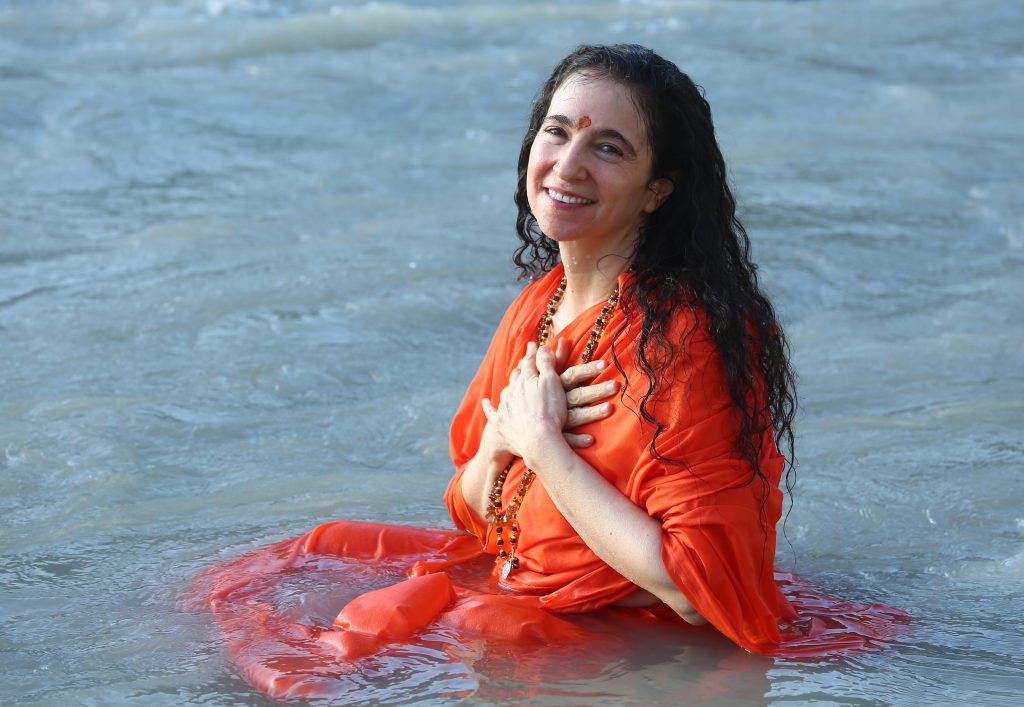

Sadhvi Bhagawati Saraswati's path reads like a bridge between two worlds. Born in Los Angeles and raised in what she describes as a secular American household within the Hollywood milieu, she represents a generation of Western seekers who found in Eastern philosophy something missing from their material success. With a PhD from Stanford University in hand and an academic career at her fingertips, she made a choice that baffled many: she stayed in India, took monastic vows in the Hindu tradition, and became a sadhvi—a female renunciate—in the ancient Dashnami order.
This wasn't a gradual drift into spiritual life but a decisive turning point. In the late 1990s, she traveled to India for what she expected to be a brief visit. Instead, she found herself at Parmarth Niketan, one of the largest ashrams in Rishikesh, situated on the banks of the Ganges River. Under the guidance of Pujya Swami Chidanand Saraswatiji, the ashram's president, she began studying Vedic philosophy, Sanskrit scripture, and yogic practice with an intensity that would reshape her entire trajectory. She didn't just visit India—she took sannyasa vows, formally renouncing worldly life and committing to a path of spiritual study and service. For more than two decades now, she has lived and worked from the ashram, becoming one of the few Western women to hold such a position within the traditional Hindu monastic framework.
What sets Sadhvi Bhagawati apart is not merely her personal transformation but her ability to translate ancient wisdom for contemporary audiences without diluting its depth. Her core contribution lies in this act of bridging—making Vedic philosophy accessible to global seekers while honoring its scriptural roots. She combines Western psychological frameworks with teachings from the Bhagavad Gita and Upanishads, offering what amounts to a bilingual spiritual vocabulary. This synthesis resonates particularly with those raised in secular or Judeo-Christian contexts who find themselves drawn to Eastern practices but lack the cultural context to fully engage with them.
Her teaching style reflects her own journey. She doesn't speak as someone born into the tradition but as someone who crossed over, carrying questions and doubts that many of her students share. This insider-outsider perspective has made her a uniquely effective interpreter, capable of addressing the specific confusions that arise when Westerners encounter concepts like dharma, karma, and moksha.
Sadhvi Bhagawati has authored two bestselling books that serve different but complementary purposes. "Hollywood to the Himalayas" is memoir and travelogue, chronicling her personal passage from Stanford academic and American suburbia to life as a renunciate on the Ganges. The book offers readers a rare window into the inner workings of ashram life and the practical, unglamorous aspects of spiritual transformation. It's a narrative of leaving, but also of arriving—of finding home in an unlikely place.
Her second book, "Come Home to Yourself," shifts from autobiography to instruction. Drawing on the Bhagavad Gita, Upanishads, and her years of ashram practice, she distills timeless teachings into frameworks applicable to daily life. The book addresses questions of purpose, suffering, relationships, and self-knowledge with both scriptural authority and contemporary relevance. Both titles have been translated into multiple languages and are now widely used in yoga teacher trainings and mindfulness programs worldwide, evidence of their reach beyond any single tradition or geography.
Sadhvi Bhagawati's current work encompasses teaching, social activism, and institutional leadership at Parmarth Niketan. The ashram hosts the annual International Yoga Festival, one of the premier gatherings of its kind, drawing practitioners and teachers from across the globe. Her role in these gatherings reflects her broader mission: creating spaces where ancient practice and modern seekers can meet on common ground.
Beyond the ashram walls, she engages in social activism, though the specifics of these efforts remain rooted in the broader framework of dharmic service. Her identity as a spiritual leader isn't separate from her engagement with worldly concerns—a stance consistent with Hindu philosophy's emphasis on karma yoga, the path of selfless action.
In an era of spiritual commodification, where yoga has been reduced to fitness and mindfulness to productivity hack, Sadhvi Bhagawati represents something more substantial. She matters because she hasn't diluted the tradition to make it marketable—she's deepened her understanding of it and found language to convey that depth. She reaches people who are hungry for something more than self-help slogans: seekers who want philosophical rigor, contemplatives who need practical guidance, and Westerners who feel called to Eastern paths but don't know how to walk them with integrity.
Her significance also lies in representation. As one of the few Western women to hold formal monastic status in the Hindu tradition, she embodies a possibility that didn't widely exist a generation ago. She demonstrates that spiritual authority isn't bound by birthplace or gender, and that traditions can accommodate sincere seekers willing to fully commit.
What began as a short visit became a lifetime. What started as personal seeking became public teaching. In Sadhvi Bhagawati Saraswati's journey from California to the banks of the Ganges, thousands have found permission to undertake their own.