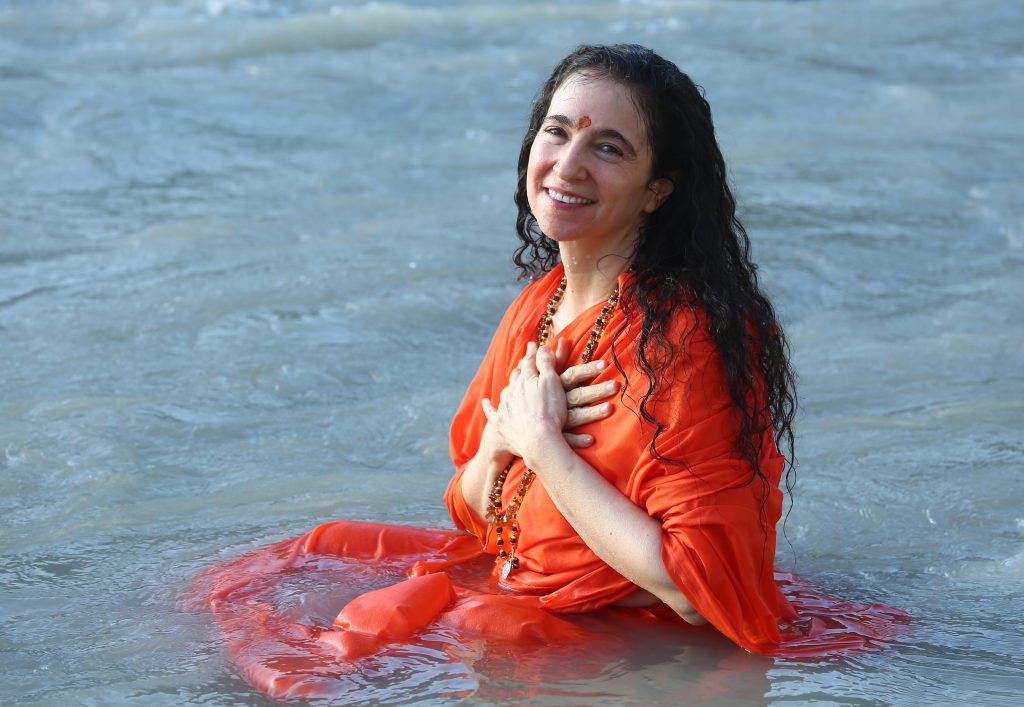

The Best Entry Point: Hollywood to the Himalayas
Start with Sadhvi Bhagawati Saraswati's memoir Hollywood to the Himalayas. This isn't just autobiography—it's the Rosetta Stone for everything she teaches. The book traces her journey from Stanford PhD and Los Angeles secular life to taking sannyasa vows as a Hindu monastic at Parmarth Niketan ashram in Rishikesh. You get the full arc: the existential crisis that drives someone to abandon conventional success, the culture shock of ashram life, and the slow rewiring of a Western mind through Vedic philosophy. The narrative structure makes dense concepts like dharma and surrender tangible because you watch them tested against real decisions—whether to stay when the Ganges floods, how to reconcile feminist ideals with traditional structures, what happens when ancient practice meets Stanford-trained skepticism.
What makes this the right starting point is that Sadhvi writes in the first person about doubt. She doesn't pretend the path was obvious or easy. That honesty creates permission for your own questions.
Where to Go Next
After the memoir, move to Come Home to Yourself. Now that you understand her journey, this book delivers the practical framework. It distills teachings from the Bhagavad Gita and Upanishads into applications for daily life—not as theory, but as practice. You'll find yogic concepts translated through both Sanskrit etymology and Western psychological language, which is Sadhvi's signature move.
Then seek out her talks and videos. Look for her presentations on bridging Hindu philosophy with contemporary life. Her speaking style is different from her writing—more immediate, with stories from ashram life and responses to real-time questions. The conversational tone reveals how she adapts ancient wisdom to individual circumstances.
Finally, explore her social activism work. Sadhvi doesn't separate spiritual practice from environmental protection, women's empowerment, and interfaith dialogue. Understanding this integration shows how she models engaged dharma rather than escapist retreat.
What to Expect on First Encounter
Sadhvi speaks and writes with unusual precision. Don't expect mystical vagueness or platitudes. Her Stanford training shows in careful definitions, logical progression, and attention to language. She'll explain the Sanskrit root of a concept, connect it to Upanishadic philosophy, then pivot to how it addresses anxiety or relationship conflict. The mix can feel jarring at first—academic rigor meeting devotional practice.
Her delivery is warm but not performative. She doesn't position herself as guru but as translator and fellow practitioner. Expect accessibility without dumbing down, reverence without obscurantism.
Common Misunderstandings
Beginners often mistake her path for renunciation of the world. The opposite is true. Taking monastic vows freed her to engage more fully—she runs environmental initiatives, speaks globally, and actively addresses social issues. The sannyasa framework provided structure for service, not escape.
Others assume her teachings require converting to Hinduism or moving to an ashram. She explicitly frames Vedic wisdom as universal principles applicable within any life structure. The philosophy doesn't demand you abandon your context; it offers tools to inhabit it more consciously.
Some expect quick fixes. Sadhvi is clear that transformation requires sustained practice, not epiphanies. She emphasizes daily discipline over peak experiences.
When This Work Lands Hardest
Sadhvi's work resonates most during transitions—career questioning, relationship endings, relocations, or the slow-burn realization that external achievements haven't delivered internal peace. If you're successful by conventional metrics but feel hollow, or if you're drawn to spiritual ideas but suspicious of New Age vagueness, her rigorous yet devotional approach provides rare middle ground.
It also lands during the middle years, when you've accumulated enough life experience to recognize patterns but still have energy to reconstruct them.
A One-Week Starter Plan
Days 1-3: Read Hollywood to the Himalayas, 50-75 pages daily. Journal on one moment that triggers recognition or resistance.
Day 4: Watch two of her talks on different topics. Notice which concepts recur.
Day 5: Read the introduction and one chapter of Come Home to Yourself. Try one suggested practice.
Days 6-7: Research Parmarth Niketan and the Ganges context. Read about her environmental work with river conservation. Notice how spiritual practice connects to activism.
By week's end, you'll know whether her particular bridge between traditions speaks to your questions.