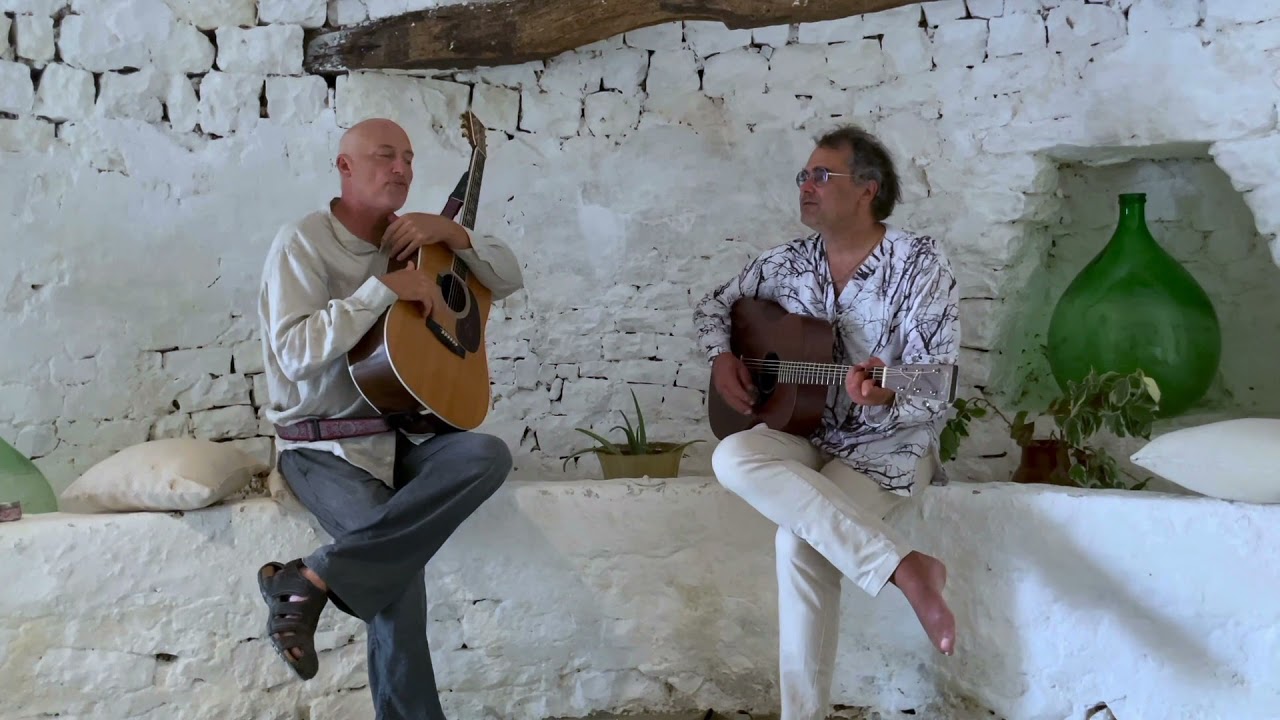
Om Namah Shivaya—"I bow to Shiva"—is one of the most widely chanted mantras in Hindu and Western spiritual practice. The phrase carries an ancient invocation: a recognition that consciousness itself, in all its formless, infinite expression, is the ground of being. When sung repeatedly, especially in community, this mantra becomes what kirtan practitioners call a gateway—a vibrational frequency that stills the mind, settles the nervous system, and creates a field of collective harmony. It is meditation made audible, older than most written texts, yet speaking directly to something timeless in human longing. Jim Beckwith's interpretation of this mantra, drawn from his 2017 album River of Song and released in self-produced video form, takes this ancient invocation and places it within a deliberately contemporary frame, raising a quiet question: How does devotional practice evolve when artists have access to tools of production that previous generations never possessed?
Kirtan is a Sanskrit term meaning "to describe, recount, celebrate." In practice, it refers to the call-and-response style of mantra chanting that has been central to Indian spiritual traditions for millennia, particularly within bhakti (devotional) practice. A kirtan artist leads a melody—often set to a simple, repeating phrase—while musicians support with percussion, harmonium, or other instruments. The community repeats, creating a feedback loop of sound and intention. The goal is not performance in the Western concert sense, but the cultivation of a shared meditative state, a collective entering into what the tradition calls rasa—the emotional and spiritual taste of the divine.
In Western contexts over the past three decades, kirtan has undergone significant evolution. What was once understood primarily as a communal practice tied to Indian temples and ashrams has become something more diffuse: it appears in yoga studios, music festivals, retreats, online platforms, and now in self-produced video work like Beckwith's. This shift hasn't diminished the practice's power; rather, it has expanded the forms through which that power can be transmitted. A listener anywhere with an internet connection can now access mantra chanting, meet the vibrational medicine of these ancient phrases, and integrate them into solitary or collective spiritual life.
The album title River of Song suggests flow, continuity, the understanding that spiritual practice is not a destination but an ongoing current. This piece, one track in that larger body of work, demonstrates how traditional devotional material can be re-contextualized without losing its essence. The mantra remains unchanged; the vehicle for its transmission has simply expanded to include visual narrative, spoken-word introduction, and the intimacy of the screen.
At just under five minutes, Beckwith's "Om Namah Shivaya" is brief but architecturally complex. The piece opens with spoken-word material from collaborator Saul David Raye, whose introduction grounds the listener before the chanting begins. This echo an ancient kirtan tradition: a guru or elder might offer teachings or poetic recitation before the singing commences, preparing the mind and heart for the invocation to come. By including this element in a contemporary format, the piece honors the pedagogical dimension of the practice—the listener is not simply asked to accept the mantra on faith, but to enter it with some intellectual and emotional preparation.
The visual dimension is equally intentional. Footage shot during a journey to India is woven through the audio, connecting the listener to the geographic and spiritual origin of the mantra itself—the landscape where Om Namah Shivaya has been chanted for centuries. But the piece then shifts to ocean footage shot off Bermuda, an Atlantic landscape far from the Ganges or the Himalayas. This visual choice makes a bold statement: the sacred is not confined to India; it moves with practitioners, dwells in their own landscapes, in the water they see, the air they breathe. This enacts, in image, what the Westernization of kirtan does in practice—it universalizes without appropriating, honors tradition while claiming full citizenship in new contexts.
The self-produced nature of this video merits attention. In earlier eras, to make a recording required access to a studio, an engineer, label support, institutional gatekeeping. Today, those barriers have largely dissolved. A kirtan artist with a camera, collaborators, and internet connection can create and release work directly to listeners. This democratization carries profound implications for how spiritual music circulates and evolves.
It means the most innovative kirtan work happening now often lives outside the music industry proper, circulating through YouTube, Spotify, podcast platforms, and social media—channels more responsive to niche audiences and experimental forms than traditional labels might be. The 1,425 views on Beckwith's piece may seem modest by streaming standards, but within devoted communities, organic word-of-mouth circulation is how new material becomes woven into collective practice. A few hundred practitioners might encounter this video, integrate it into their own spiritual lives, share it with fellow seekers.
The choice to self-produce also removes intermediaries from conversations about what spiritual music should sound like. Beckwith and Raye had total creative control—they could integrate spoken word and visual imagery in ways a traditional label might have deemed "uncommercial." The result is work that feels authentic precisely because it emerges from creative conviction rather than market calculation.
For practitioners, Om Namah Shivaya is specifically a mantra of Shiva consciousness—the principle of destruction, transformation, and transcendence in Hindu philosophy. Shiva is the ascetic, the yogi, the one who sits in meditation while the world spins. To chant Om Namah Shivaya is to invoke that quality within oneself, to bow to the transformative principle that dissolves what no longer serves.
This is particularly resonant in moments of transition. A four-minute meditation on Om Namah Shivaya becomes, in that context, both prayer and tool—a way of aligning the self with the vast, impersonal forces of change that move through all existence. The choice itself to render this mantra in self-produced, multimedia form might be read as an act aligned with Shiva consciousness: taking hold of one's own creative power, refusing to wait for permission, moving with the transformations that digital technology has enabled in music-making.
Contemporary neuroscience recognizes a principle called multisensory integration: when the brain receives information through multiple channels simultaneously, the effect is often more powerful than the sum of its parts. When you see sacred landscapes while hearing sacred sound, something shifts in the nervous system. The visual cortex, auditory cortex, and limbic system (which processes emotion) activate together.
Mantra chanting is often most powerful in community, where visual presence of other practitioners, collective voices, and shared space create richness that solitary practice sometimes lacks. By weaving image into the audio recording—India's sacred geography, Bermuda's oceanic vastness—Beckwith attempts to restore some of that multisensory richness to the individual listening experience. For contemporary practitioners accustomed to hypervisual digital environments, this integration may feel more accessible than a pure audio track, while the devotional material itself remains intact.
If you're encountering Om Namah Shivaya for the first time through this piece, explore the full album River of Song to understand how this mantra sits within a larger compositional arc. Seek out live kirtan events in your community—the group energy brings dimensions that even the best recording cannot fully capture. Research the theology of Shiva in Hindu philosophy and contemporary practice to deepen understanding of what you're invoking when you chant. Listen closely to how Saul David Raye's spoken-word introduction frames the practice, and notice in your own body what happens when mantra, image, and the oceanic sublime converge: that intersection is where your own practice begins, your own integration of ancient wisdom with contemporary life.