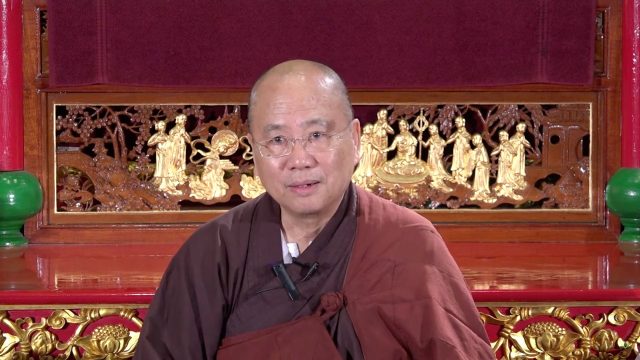
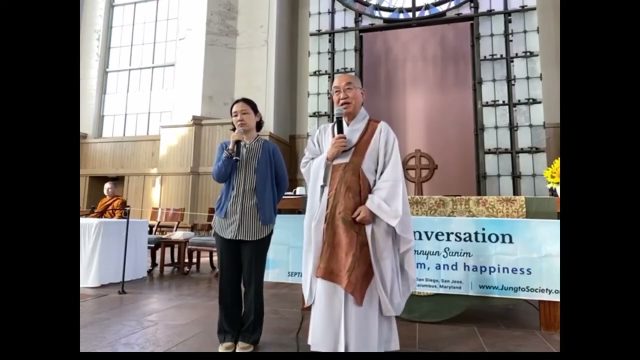
The question arrives with the earnestness of someone still new to the path: How do I let go of myself? It's the kind of inquiry that echoes through dharma centers and meditation cushions worldwide—a sincere attempt to reconcile the teaching of no-self with the lived experience of being undeniably, persistently here. The questioner has even tried the intellectual shortcut: denying free will as a tool for letting go. It didn't work. So they ask Ven. Pomnyun Sunim, a Korean Buddhist monk and Seon master, to explain not the theory but the felt reality. What does it actually feel like?
His answer, delivered with the clarity of someone who has lived Buddhism rather than merely studied it, turns the entire premise upside down. "Letting go is not the point," Sunim says. "The point here is whether that brings you suffering or not."
This is not the answer most dharma students expect. The spiritual marketplace is crowded with teachers insisting that attachment is the root of suffering, that the ego must be dissolved, that true freedom comes from surrendering the illusion of self. And there is truth in all of that. But Sunim's reframing cuts through the abstraction with a practical scalpel: If your free will, your sense of agency, your feeling of being a self—if these things don't cause you suffering, then why abandon them? The precepts and teachings are not laws imposed from outside. They are maps drawn by people who discovered that certain mental postures lead to pain and others lead to peace.
"If your free will become the source of your suffering, you need to let it go. But if your free will doesn't bring you suffering, you can still have your free will and act according to your free will." This inverts the typical shame-based spirituality—the idea that holding onto yourself means you haven't understood the dharma yet. Instead, Sunim offers a kind of diagnostic approach: Does this belief hurt? If yes, investigate it. If no, you're free to keep it. The difference is profound. It moves the work from the realm of doctrine into the realm of lived experience, where most of us actually live.
But Sunim doesn't stop at the philosophical reframing. The questioner asked for his personal experience, and he delivers it with the specificity of someone who has integrated a crucible into his understanding. As a young man, he was detained and tortured by police. They demanded a confession for crimes he had not committed. The torture escalated: beatings, then waterboarding. He writes: "It was so painful, and I was fearful, but I persevered. But there was a limit to how much I could persevere."
At the edge of consciousness, in the moment when breath became impossible and the body was shutting down, something shifted. An image of whiteness appeared in his mind. Within it: a frog, beaten and shivering, on the verge of death. He recognized it as his own state reflected back to him. And in that recognition came the memory of his childhood—of catching frogs by hitting them with a stick and feeding them to chickens, an act he had committed without guilt, without understanding.
What Buddhism had taught him intellectually—the precept of not killing, the preciousness of life—became, in that moment, something his entire nervous system knew. He was the frog. He felt what the frog had felt. The terror, the helplessness, the preciousness of a life being extinguished. Only then did intellectual knowledge become embodied wisdom. Only then did the teaching enter his bones.
What happened next reveals something crucial about the nature of letting go. Sunim stopped resisting. He "ceased all efforts to fight against the process of dying." And immediately—as though the universe itself operated on the principle he had just discovered—the torture stopped. His suffering ended. This is not romance; this is mechanics. The moment he released his grip, his grip no longer constricted him.
This happened repeatedly. Each cycle of torture, each moment of release, deepened his understanding. But it was during the breaks that something equally transformative occurred. Sunim overheard his torturers speaking among themselves. They discussed mundane matters: a child taking a college entrance exam, the economic strain of potential relocation, the ordinary anxieties of ordinary people. In that overhearing, the torturers stopped being demons. They became what they actually were—neighbors, husbands, fathers, employees doing a job they had been assigned.
The hatred vanished. This was not forced forgiveness, not a spiritual achievement willed into being through meditation. It was the natural result of seeing clearly. His torturers were caught in systems and circumstances, acting from ignorance, as the Biblical phrase he recalled puts it: "They do not know what they're doing." Jesus spoke those words about those executing him. Sunim understood them for the first time not in scripture but in his own flesh.
This is where Sunim locates the real teaching: not in the idea of letting go but in the experience of it. "Intellectual knowledge alone doesn't truly help in practical, everyday life. It's not enough to simply know what needs to be done or let go. When you actually experience letting go of something, you realize that your suffering just disappears." This is the gap that separates Buddhist intellectuals from Buddhist practitioners, the gap between knowing and knowing.
The question that opened this talk—How do I let go of myself?—reveals its own confusion in light of Sunim's answer. It assumes that letting go is a technique, a thing you do to yourself, an achievement to be accomplished through will or discipline. But the actual mechanics are different. You don't let go. You stop grasping. And the moment you stop grasping, you discover that you were never held as tightly as you thought. The cage door has always been open. The only imprisonment was the grip of your own hand.
What Sunim offers is not a faster route to ego dissolution. It's a more honest one. He invites practitioners to meet themselves where they actually are—with their free will intact, their sense of self still felt—and to use suffering itself as the teacher. If the belief that you are a separate self causes suffering, then yes, investigate it. But if it doesn't, if you can hold that sense of self without clutching, without fear, without grasping, then you're already free. The liberation is not in the belief system; it's in the quality of awareness you bring to whatever you believe.
For anyone drawn to Buddhism as a path of transformation, this teaching offers something both humbling and empowering. It suggests that the work is not about becoming someone else or achieving some advanced state of consciousness. It's about meeting reality as it is—including the reality of your own ego, your own desires, your own will—and discovering that when you stop fighting, when you stop demanding that life conform to your image of what spiritual progress should look like, something shifts. The very thing you were struggling against becomes the teacher. Your attachment becomes the classroom. Your suffering becomes the curriculum. The question is not how to let go of yourself, but how to let go of the exhausting demand that you should be different than you are.