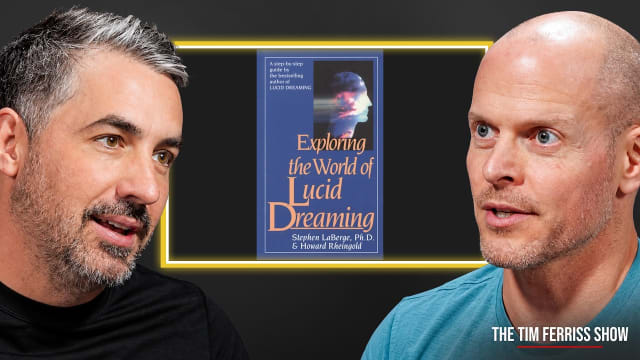
Ask someone what they have stopped trying to optimize, and you usually get a list of cuts: the extra errands, the side projects, the subscriptions. In a seven-minute segment from a recent Tim Ferriss video, Ferriss declines to produce that list. He takes the question sideways, and his answer is a single move that does the cutting for him: overinvesting. Put roughly ten times the effort into one or two areas that matter most, he says, and the rest of your week starts to shrink, not because you forced it to, but because it no longer has room. The clip also takes up a listener's harder question, whether all this deliberate design leaves any space for the unplanned encounters that often turn out to matter most. Taken together, the two halves make a compact argument about attention, planning, and the difference between surrender and drift.
Ferriss starts by interrogating the word itself. To optimize, he suggests, is often to try "bleeding the stone" or wringing "every last drop of efficiency and improvement out of that wet towel" (0:14). It is a useful instinct, and he admits he still practices it in some areas. But the wet-towel image carries a cost: the squeezing never ends, and the attention spent on it is attention not spent elsewhere.
That is why he reframes the question. Rather than cataloging what he has abandoned, he describes what he is pouring himself into. The reasoning is structural rather than sentimental. "When you over invest in things, they crowd out a lot of the things I would put on that no longer optimize list" (0:37). The list of things to drop does not need to be written in advance. It writes itself as the calendar fills with the things you have decided to prioritize.
Ferriss credits a heuristic from Ramit Sethi, whom he describes as better known as a finance guru and as the host of a podcast in which he interviews couples about money problems. The point of Sethi's question, as Ferriss recounts it, is not austerity. Ferriss is explicit: Sethi "is not focused on ultra-frugality or foregoing your lattes or anything like that" (1:15). The question is more expansive. Ferriss paraphrases it, and he flags that he is doing so: what would it look like to invest 10 times more in one or two areas that matter most? (0:52)
The power of the framing is that it removes the question of permission. Most people already know what matters to them. What they rarely do is imagine what full commitment would actually look like, in hours, in attention, in specific habits. The phrase "10 times" forces that imagining, because it is too large to fit into a vague resolution.
Ferriss names his two areas: health and relationships. He calls the question itself "another absurd question," placing it alongside a question from the billionaire investor Peter Thiel that he had mentioned earlier in the video. "Even if you don't have an immediate answer, it forces you to think differently about your life" (1:26). The absurdity is the feature. A question that sounds impractical can loosen the assumptions that keep a schedule in place.
He follows the logic through. If you invest ten times more in your health and ten times more in your relationships, he says, "there's not a whole lot left over, which is a good thing." The leftover time is not idle time. It is "less free-roaming time to completely burn on wasteful activities that might have a veneer of productivity" (1:41). That phrase is worth sitting with. Much of what fills a day has the look of productive work without delivering much. Overinvestment is a way of taking those hours back without a sermon about discipline.
Ferriss also says he regards this as the highest-leverage approach he has found. He does not claim it is the only way to live well, and he notes that he will return to the idea later in the Q&A, which is where the second half of the segment begins.
At 2:26 Ferriss reads a question from a listener named Hridika, who sets up the tension cleanly. There is an appealing idea, the listener writes, that the good life can be consciously designed: identify your values, understand your priorities, eliminate the unnecessary, and arrange your circumstances accordingly. But many of the most meaningful experiences seem to arise from things no one could have planned. At what point does being too deliberate make you less receptive to what might emerge? How do you leave room for serendipity when you are naturally inclined to be intentional?
Ferriss's response begins with agreement. "I do 100% agree that if you over-engineer your life, you are almost definitionally less receptive to life that emerges" (3:15). He then rejects the idea that there is a single answer to apply every day. For him it is a matter of rhythm. "You can have periods of heavily engineered focus and you can have periods of, in my case, reasonably engineered serendipity, where I am placing things in my calendar that are likely to produce these chance encounters" (3:33).
The key move is his insistence that focus and openness are not mutually exclusive. He gives a concrete example: deliberately seeking out people who disagree with him. He describes a friend in Austin whom he characterizes as far right in voting, while he himself is issue by issue rather than aligned with either side. He is clear the friend is not a caricature. "To dismiss him as some type of non-thinking knuckle dragger doesn't hold water," Ferriss says. The friend is "very, very intelligent" and "very good at questioning assumptions" (4:20). Sitting down and asking that friend questions, Ferriss argues, opens him to ideas that a personalized feed would never serve up. He adds that this is "every feed on any platform" (5:03). The scheduled conversation is a deliberate act, and its payoff is the unplanned one: a perspective you could not have engineered on your own.
He returns to his original pair of domains to show the overlap. Health, in his telling, includes group fitness and coaching, and both put him in contact with people he "would otherwise never meet in a professional context" (6:55). Investing in health and relationships is not only a way to crowd out waste. It is also a way to build the kind of unscripted contact that serendipity depends on.
Ferriss admits to a strange experience that happens often in his work: he mentions a book, and someone asks about it ten questions later. The book in this case is The Surrender Experiment by Michael Singer. Ferriss says Kevin Rose recommended it to him "to offer me a counterexample" to his own tendency to over-engineer, intention, and blueprint his life. He did not know whether it would be a good or a bad example. He enjoyed it, and found it helpful precisely because it was so far from his default.
He does not, however, take the book at face value. "If you squint a little too hard, you'll see that Michael must have said no to many, many, many things in order to focus on some of the things that are outlined in the book." That observation raises a useful distinction between total surrender and selective surrender. A life that looks like pure letting-go may, on closer inspection, be a life organized by hard choices about what to refuse. Ferriss says that is a conversation he may someday have with Singer.
The distinction matters because it names a real trap. Ferriss warns that if you are overly deliberate, and "indulge too heavily in the illusion of control," you blind yourself to what is around you (5:17 region of the discussion). But the opposite identity is no safer. If you take on the identity of someone who simply goes with the flow and surrenders to everything, you can end up what Seth Godin, as Ferriss quotes him, calls a "floating generality," someone who treats every distraction as an opportunity (7:18).
Ferriss does not claim to have solved this. He says he is "certainly writing a lot about that right now," and that the sweet spot looks different for him and for some people he knows (7:38). What his answer offers is a working model rather than a formula. Plan hard in the domains you have chosen to overinvest in. Protect open time on purpose, and fill it with exposure to people and ideas you would not choose on your own. Expect the rhythm to shift from season to season. The 10x question is not a rule that governs every hour. It is a way of deciding where your concentrated effort goes, so that the rest of your life has room to surprise you.
"Investing 10 times more in health, what would that look like? Investing 10 times more in relationships, what would that look like?"
Tim Ferriss, in the video, on the two questions he uses to decide where to overinvest (1:26 onward).
The segment is short, but it can be turned into a practical exercise. Start by writing your own 10x list rather than a not-to-optimize list, following the structure Ferriss uses. Choose one or two areas, and for each ask what ten times more would actually look like in hours, habits, and specific people. Then check what has to shrink to make room, and notice whether the things that disappear were ones you were only maintaining out of inertia.
Next, test the serendipity half. Schedule at least one conversation with someone whose views you find difficult but whose intelligence you respect, the way Ferriss describes his Austin friend. And watch for the two traps he names: the illusion that enough planning can control everything, and the drift that treats every distraction as an opportunity.
For the longer reading, Ferriss points to Michael Singer's The Surrender Experiment as the counterexample he chose on purpose. Read it with his caveat in mind: consider not only what the author surrendered to, but what he must have declined in order to make that surrender possible. That is the sweet spot Ferriss keeps circling, and it is one you can only find by trying it in your own calendar.