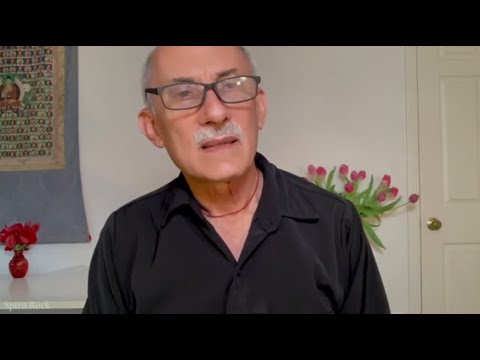
Jack Kornfield explores the false choice between inner meditation practice and outer service, revealing how both individual spiritual responsibility and universal interconnection demand engagement with the world. Rather than choosing between sitting and serving, practitioners discover that authentic awakening manifests as both deep inner work and compassionate action—with the understanding that separation between self and world, meditator and suffering being, is itself an illusion to be examined.
The central tension Kornfield addresses is not new to dharma circles, yet remains urgently alive: should a sincere practitioner invest their energy in deepening meditation, cultivating inner freedom and clarity, or should they pour themselves into direct service—feeding the hungry, sheltering the homeless, addressing environmental destruction, working for peace? The question assumes these are separate paths, competing for limited time and attention. But Kornfield locates the paradox deeper: the assumption itself rests on a fundamental misunderstanding about what is individual and what is universal.
The paradox is not merely practical (how to spend your hours) but ontological. It probes the nature of responsibility itself. If a practitioner awakens to interconnection—to the understanding that self and world are not ultimately separate—then individual practice and universal responsibility are not competing demands but expressions of a single insight. Yet in lived experience, they often feel like opposing pulls.
This question cuts to the heart of why the paradox exists at all. Kornfield invites practitioners to examine the boundary between self and other, between "my practice" and "the world's suffering." In the Buddhist understanding, this boundary is not as fixed as conventional thinking suggests. When you sit in meditation, you are not a separate consciousness observing neutral reality from outside. You are embedded in a web of causes and conditions that extends far beyond the skin-boundary of the body.
The concept of individual responsibility, then, does not mean a isolated ego managing its own spiritual portfolio. It means recognizing that wherever consciousness arises, wherever awareness engages with reality, that engagement has consequences—ripples that extend into the larger web. To practice deeply is not to withdraw from the world; it is to awaken within it. To serve authentically is not to lose oneself in busyness; it is to act from clarity about one's actual nature as interconnected with all beings.
Kornfield illustrates this through reference to exemplary practitioners and activists. Joanna Macy's journey to Chernobyl, for instance, was not a betrayal of her meditation practice but an expression of it. Having cultivated the capacity to face reality clearly—a fruit of sustained practice—she brought that clarity to witnessing nuclear devastation and supporting others in their grief and rage. The journey was both painful and healing, and the pain itself was not something to transcend away but to include within a wider circle of compassion.
Similarly, teachers like Vimala Thakar, Ajahn Chah, and Maha Ghosananda modeled a both/and approach. These were not meditators who reluctantly served, nor servants who occasionally meditated. They understood that awakening naturally expresses itself as presence and responsiveness to the suffering of others. Their example suggests that the dichotomy dissolves when practice deepens enough to reveal the illusion of separation at its root.
Kornfield distinguishes freedom—the genuine fruit of practice—from states that superficially resemble it but actually rest on subtle forms of grasping or denial. A near enemy is a quality that appears similar to a virtue but lacks its depth and integrity. For instance, detachment can masquerade as freedom when it is actually avoidance. Equanimity can harden into indifference. Both detachment and indifference create distance from suffering, but freedom—true freedom—moves toward it.
The distinction matters for the meditation versus service question. If a practitioner cultivates what appears to be freedom but is actually detachment, they may justify sitting in meditation while the world burns. They frame it as non-attachment, as release from ego-driven activism. But Kornfield suggests this is a near enemy of freedom. Genuine freedom, born of clear seeing, does not separate from suffering; it meets it with both clarity and heart. Freedom is not freedom from the world but freedom within it—the capacity to act with full presence and compassion.
Kornfield invites practitioners to understand themselves as stewards of each other, the earth, and the future. Stewardship is neither domination nor denial of responsibility. A steward tends something that is not theirs to exploit but theirs to care for. This framing reorients the question entirely. It is not "Should I sit or serve?" but "How do I tend wisely to what I find myself entrusted with?"
Stewardship includes both the intimate inner work of understanding your own mind and conditioning, and the broader work of responding to collective suffering. The earth is not something separate from your practice; your practice is something that happens within the earth, part of the earth's own awakening. To be a steward is to recognize that individual and universal responsibility are one responsibility, seen from different angles.
Kornfield addresses concrete challenges: homelessness, warfare, environmental destruction. These are not theoretical problems; they are the lived reality of countless beings. The question becomes not whether to respond—the fact of suffering demands response—but how to respond in a way that is both authentic and helpful.
Authenticity means not pretending to care more than you do, not adopting a persona of enlightened activism. It means starting from where you actually are. Perhaps you are still learning to sit with your own fear and grief about the state of the world. That is a legitimate place to practice. Perhaps you have the energy and clarity to engage directly in addressing specific forms of suffering. That too is legitimate practice. The key is not to confuse your actual capacity with an idealized image of what a "real practitioner" should be.
Helpfulness means acting from wisdom rather than reactivity. Kornfield suggests that the most powerful changes blossom from the human heart—from genuine care, not from guilt or ideology. When you feed the hungry, the quality of presence you bring matters. When you work for policy change or environmental restoration, the clarity and compassion you embody ripple through your work. This is not to say intention is all that matters; concrete action is essential. But the integration of inner clarity and outer action makes a difference that reactive busyness cannot.
Kornfield reclaims a controversial phrase: "Don't just do something, sit there." In a culture of relentless activism and busyness, the invitation to sit still and face yourself is genuinely radical. It is not an escape; it is a direct confrontation. To sit is to stop running from your own mind, your own fears, your own sense of helplessness in the face of large problems.
Many activists burn out because they never sit with the despair that fuels their work. They exhaust themselves trying to outrun inner pain. But when you sit, when you face yourself with honesty and kindness, something shifts. You discover that you are not separate from the suffering you are trying to address. Your own fears about the future, your own grief about injustice, your own rage about exploitation—these are not personal problems to be overcome before you can serve. They are the gateway to authentic compassion.
The radical act, then, is the willingness to include yourself in the circle of beings who deserve care and attention. From that place, action becomes possible without the brittle quality of forced duty.
Kornfield also invokes the opposite warning: "Don't just sit there, there isn't time." This is equally true. The world's suffering is urgent. Beings are dying, ecosystems are collapsing, injustices continue. The luxury of endless meditation while these things unfold is itself a kind of delusion. So how do you hold both truths?
The answer, Kornfield suggests, is cyclical rather than static. There are times when you need to sit, to restore your clarity, to face yourself, to allow your practice to deepen. There are times when you need to rise and act, to bring your clarity into the world, to meet the concrete needs of beings. Neither cancels the other; both are necessary. The rhythm of inner and outer, contemplation and engagement, withdrawal and return—this is the natural cycle of a spiritually alive life.
Practitioners who stay only in the withdrawing phase eventually lose touch with reality; they cultivate what looks like peace but may be numbness. Practitioners who stay only in the engaging phase eventually lose touch with depth; they burn out. The path with heart involves returning to both again and again, letting each inform and deepen the other.
A path with heart, in the language Kornfield uses, is one that is both personally meaningful and responsive to the actual world you find yourself in. It is not chosen once and followed rigidly. It is lived, felt, adjusted moment by moment based on what the heart reveals.
Following such a path means accepting that you will sometimes feel uncertain about the right balance between sitting and serving. You will sometimes regret time spent in meditation when action was needed, and sometimes regret activism that pulled you from depths you needed to explore. This uncertainty itself is part of the path. It keeps you awake, keeps you questioning, keeps you from settling into ideology—whether the ideology of pure contemplation or pure activism.
What matters is the sincerity of your engagement: with your own mind, with other beings, with the earth. Each of these engagements is practice. Each has the potential to reveal the interconnection at the heart of things.
If Kornfield's exploration resonates, consider these concrete next steps. Examine your own tendencies: do you lean toward inner practice at the expense of engagement with the world's suffering? Or do you use busyness to avoid deeper self-knowledge? Neither is wrong, but clarity about your pattern is valuable. Then, experiment with the opposite. If you are primarily a meditator, find one concrete way to serve—not as a duty, but as an exploration of what it means to respond from your awakening. If you are primarily an activist, establish a simple practice of stillness—not to escape your work, but to deepen it. Let the paradox work on you. Let it teach you what "individual" and "universal" really mean in your own lived experience.