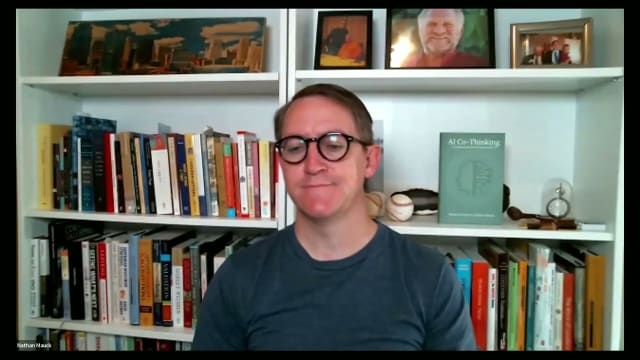
On a Sunday afternoon, morning, or evening, depending on where you are, a small circle of faces appears on a screen. A bell sounds. Voices rise in Tibetan and then in English, reciting the refuge verses and the bodhicitta dedication, the lines a practitioner speaks to commit the mind to waking up for the sake of all beings. Longtime students Elizabeth Dabney Hochman and Jon Hochman are guest hosts this week, and they are not performing anything. They are simply making time, which they call very precious, to sit with a teacher, Lama Surya Das, and with everyone else who has logged on. What unfolds over the next hour is a meditation town hall in the most literal sense: unhurried, conversational, anchored in practice, and built around a few ideas that are deceptively simple and very hard to stop thinking about once you have heard them. This is a close look at those ideas: the paradox of being "already accomplished," the classical wisdom of going within, the strange power of beginner's mind, a field-of-awareness practice that dissolves the boundary between you and the room, and the Dzogchen view that the whole thing is what Lama Surya Das calls the natural great perfection.
Lama Surya Das opened not with doctrine but with a family story. He and John had been visiting dear friends in Cleveland, and the friends told him about a moment with their granddaughter Margo, about four years old. Margo was talking with her grandfather and announced, "I'm crushing it, Grandpa, and piano, too." The teacher found the line delightful, and his reflection on it is the hinge for the entire session.
What struck him was the feeling underneath the boast. A child that young, he suggested, has a sense that something is already complete, that nothing needs to be added. Meditation, in his framing, asks adults to recover that felt sense of already being enough. He moved from the anecdote to the present moment directly: "just as we sit here and turn the spotlight in and just feel into this moment, just this moment, and it being already accomplished."
He then complicated the sentiment with the kind of playfulness that runs through his teaching. It is also true, he noted, "that there's nothing to crush and no one to crush it, but that's a different matter." The laughter in the room came from that tension. The adult mind wants a goal, a finish line, a measure of progress. The teaching says the goal is already present and the self that would do the crushing is itself a construct. Both statements point at the same freedom from effort, and the session returns to that freedom again and again.
Before the practice began, Lama Surya Das read a passage he had been enjoying in Marcus Aurelius's Meditations. He noted that the text was never meant for anyone but its author, a set of exhortations the Roman emperor wrote to himself. The passage he chose is one that many people who have never heard of Buddhism will recognize as a spiritual classic:
"People try to get away from it all to the country, to the beach, to the mountains. You always wish that you could too, which is idiotic. You could get away from it all anytime you like by going within. Nowhere you can go is more peaceful, more free of interruptions than your own soul."
— Marcus Aurelius, as read aloud by Lama Surya Das in his Meditation Town Hall, October 25, 2026
The teacher's gloss was practical. The inner refuge, he said, is something you can return to, and "keep it brief and basic. A quick visit should be enough." This is a useful correction for anyone who imagines meditation as a grand retreat requiring hours of uninterrupted solitude. The instruction is to visit the back roads of yourself often, briefly, and without drama. The stoic and the Buddhist meet here: the mind is the place you keep returning to, and its peace is not located in a landscape or a schedule.
Whatdoesbeginner'smindlooklikeinpractice?
The most revealing passage in the session came when Lama Surya Das described an ordinary morning. He and his community had introduced meditation to friends who had never sat before. He gave them basic instructions and found the exchange powerful. Reflecting on it afterward, he traced the power to beginner's mind, the freshness that appears when experienced practitioners stop assuming they already know what meditation is.
He broke down the basic instructions that beginners tend to hear, and that seasoned practitioners often forget they still need: letting go of the struggle, not trying to change anything, not trying to achieve anything, leaving things as they are, and watching what arises "with no idea how that's going to unfold." These are not complicated directions. They are, however, nearly the opposite of how most adults approach their own minds, which is why he invited the listeners to imagine sitting in the presence of people who have never sat before, and then to feel into what that is like for them, and therefore what it is like for you.
This is a serious pedagogical point. Teachers in many traditions repeatedly say that the first experience of meditation is unusually clear precisely because nothing has yet been layered onto it. Lama Surya Das's invitation is to borrow that clarity on purpose. You do not need to become a newcomer in your life. You can practice imagining the newness and then notice what the mind does when it is given no task.
Howdoyoupracticeawarenesswithnoinsideoroutside?
The central practice of the session was a three-stage exercise attributed to a teacher the speaker calls one of his favorites. It is worth doing slowly, even if you only do it once, because it is a practical demonstration of a view that might otherwise remain abstract.
First, bring awareness to the body and fill the entire body with a field of awareness, so that every cell, bone, muscle, and sinew is awake and alive, full of feeling and sentience. Second, shift attention to the space outside the body: the air in the room, the ambient sounds, everything that is not inside you. Imagine the whole field of awareness as everything else, with only a small empty cutout where your body is. Third, bring both together into one vast, undifferentiated field of awareness, everything awake, no inner and no outer. Sensations, feelings, and thoughts simply hang in that space, appearing and disappearing by themselves.
The instruction is precise without being rigid. The first two stages build a sense of the body as both sensed and sensing; the third asks the boundary to go soft. Many people experience the third stage as a moment of relief, because the effort of maintaining a separate self-observer begins to ease. It is not a trick to induce a special state. It is a way of noticing that the mind already contains sound, sensation, and thought without needing a wall between "me" and "everything else." Lama Surya Das also framed awareness as the common ground of all experience: "awareness itself," he said, and whether one is distracted or undistracted on some level, "it's absolutely all the same."
Iseverythingalreadythenaturalgreatperfection?
The session's most philosophically dense moment came as the teacher returned to his own joke about crushing it. He framed it through Dzogchen, the Tibetan teaching he calls the natural great perfection. The question he posed is one many listeners ask: how can you speak of an ultimate reality of natural great perfection in a world full of suffering and trouble?
His answer was that everything is always "crushing it" in the sense of being exactly what it is. Appearances, as they show up in consciousness, are consciousness and its manifestations and ornamentations. What we call reality is simply awareness being aware of that play. In that view, the natural great perfection is not a state reached after the struggle ends. It is the nature of what is already happening, including the struggle itself. This is why the teaching can be both a comfort and a challenge: it refuses to make the present moment wait for improvement, and it still does not pretend that suffering is absent.
The session closed with a dedication. Lama Surya Das asked for a page to be shared, read the English translation, and offered the merit of the practice toward the realization of the natural great perfection, and toward bringing all beings to complete realization. The dedication asked that the pure brilliant son of bodhicitta dawn in every heart and mind, dispelling the darkness of suffering. It is a traditional closing, and it reframes the whole hour: the practice is not private self-improvement but a gift extended outward, which is what dana, the generosity the free offering is supported by, is meant to honor.
Wheretogofromhere
The fastest way to take this session into your week is to start with the small things it asks for. Pick one moment a day to sit for two or three minutes, and treat it as the "quick visit" Marcus Aurelius recommended. Before you begin, notice one thing that is already complete, the way Margo did, without turning it into a performance. Then try the three-stage field of awareness: body, then the space around the body, then both together. If the boundary softens, let it. If it does not, simply notice that too.
If you want the full experience, the video of this Meditation Town Hall is available on Lama Surya Das's YouTube channel, LamaSuryaDas. The description notes that the weekly meditation town hall is free to attend, with registration and dana donations handled through dzogchen.org. Watching a session from start to finish, including the refuge chant and the long silences, gives you something a summary cannot: the sound of a room full of people deciding, together, to be still for an hour.
Finally, take the teacher's invitation seriously. Imagine sitting with someone who has never meditated before. Feel into what the first breath feels like to them. Then notice that you can sit with the same freshness yourself, and that the mind you are looking for is, as the teaching suggests, closer and more ordinary than the places you imagined going to find it.
Comments
Loading the conversation…
Transcript
[0:15] Hello friends.
[0:18] Wonderful to see your faces today.
[0:26] Happy Sunday wherever you are.
[0:31] afternoon, morning, evening. Wonderful
[0:35] to be together and thank you so much for
[0:38] being here. John and I uh pop in every
[0:41] now and then. We're longtime students of
[0:43] Lamasuridas and we're so happy to be
[0:46] with you today. It's it's a great treat
[0:49] really to have this time and to save the
[0:52] time to make the time is very precious
[0:56] and we really really deeply appreciate
[0:59] um being with you today and just take a
[1:01] moment
[1:04] this moment this moment only moment. So
[1:07] let's take enjoy enjoy this precious
[1:12] time being together.
[1:17] >> [bell]
[1:17] [music]
[1:22] [bell]
[1:24] [music]
[1:31] >> Dory, could you please screen share the
[1:34] inner refuge in bodhic chica?
[1:38] So, let's do this if you wish. Join in
[1:40] Tibetan one time and then in English
[1:42] once.
[1:57] >> [singing]
[2:02] [singing]
[2:10] >> In Buddha, Dharma and Supreme Spirit.
[2:13] spiritual community we go for refuge
[2:16] until fully enlightened by the power of
[2:19] all six perfections from generosity to
[2:22] non-dual wisdom for the sake of all
[2:25] beings may we realize Buddhahood
[2:29] and then if we could go to page nine to
[2:31] pure perception and bodhicitta please I
[2:35] and all beings are primordally Buddha
[2:38] knowing this to be essentially true I
[2:41] give rise to the awakened mind of
[2:43] supreme enlightenment.
[2:55] I wanted to share with you John and I
[2:57] were recently visiting some dear friends
[2:59] in Cleveland. I don't know if anyone
[3:01] here is from Cleveland, but we had a
[3:03] lovely time and were with your old
[3:06] buddies who have small grandchildren.
[3:09] And our friend told a story that
[3:13] something had just happened to him with
[3:14] his granddaughters, one of whom is like
[3:16] four and the other was eight or nine.
[3:19] And the little one whose name is Margo
[3:22] was talking to her granddad. And she
[3:25] said, "I'm crushing it, Grandpa, and
[3:29] piano, too."
[3:31] And uh this struck me as so delightful.
[3:34] Uh just because of course out of the
[3:36] mouths of babes hilarity ensues always.
[3:38] But just the notion of the this very
[3:42] small lovely person feeling that she was
[3:46] already right already crushing it even
[3:49] at age four or whatever nothing nothing
[3:51] needed. So she had this somehow this
[3:54] wonderful sense that in all was
[3:58] accomplished
[4:00] right. So, it's kind of lovely to be
[4:02] reminded uh of that sometimes in the
[4:04] most unexpected way. And so just as we
[4:08] sit here and turn the spotlight in and
[4:15] just feel into this moment, just this
[4:18] moment
[4:21] and it being already
[4:24] accomplished
[4:25] that of course on there's also it's also
[4:29] true that there's nothing to crush and
[4:30] no one to crush it but that's a
[4:32] different matter. [laughter]
[4:34] >> Tell Margo that. Marco. But in any case,
Lama Surya Das is an American Buddhist scholar and meditation teacher who has dedicated decades to studying Tibetan Buddhism, particularly the Nyingma tradition. He trained under r…
In this Meditation Town Hall, Lama Surya Das describes Dzogchen as the natural great perfection and explains it as the view that everything is already exactly what it is. Appearances in consciousness are consciousness and its manifestations, and what we call reality is awareness being aware of that play. The teaching points to a completeness that is present now rather than achieved later.
Lama Surya Das recommends three stages: first fill your whole body with awareness so every cell and muscle feels alive, then extend attention to the space and sounds outside your body, and finally hold both together as one undifferentiated field. Sensations, feelings, and thoughts are allowed to appear and disappear without an inner or outer boundary. Keep the practice relaxed and let the boundary soften if it does.
In his Meditations, Marcus Aurelius wrote that people chase escape to the country, beach, or mountains, but you can get away from it all anytime by going within to your own soul. Lama Surya Das read this passage in a 2026 Meditation Town Hall and advised keeping such visits brief and basic. A quick visit to your inner refuge is often enough.
Beginner's mind is the freshness of approaching meditation without assumptions, the way people who have never sat before experience it. Lama Surya Das describes it as letting go of struggle, not trying to change or achieve anything, and watching what arises with no idea how it will unfold. He suggests imagining sitting with first-time meditators to recover that clarity yourself.
According to the video description, the weekly meditation town hall with Lama Surya Das is a free offering. Registration and dana donations are handled through dzogchen.org. Dana is the Buddhist practice of generosity, and donations are optional.
He shared a story told by friends in Cleveland about their four-year-old granddaughter Margo, who said, "I'm crushing it, Grandpa, and piano, too." He saw in her confidence a sense that something is already accomplished, which parallels the meditative recognition that the present moment is already complete. He added with humor that there is nothing to crush and no one to crush it.