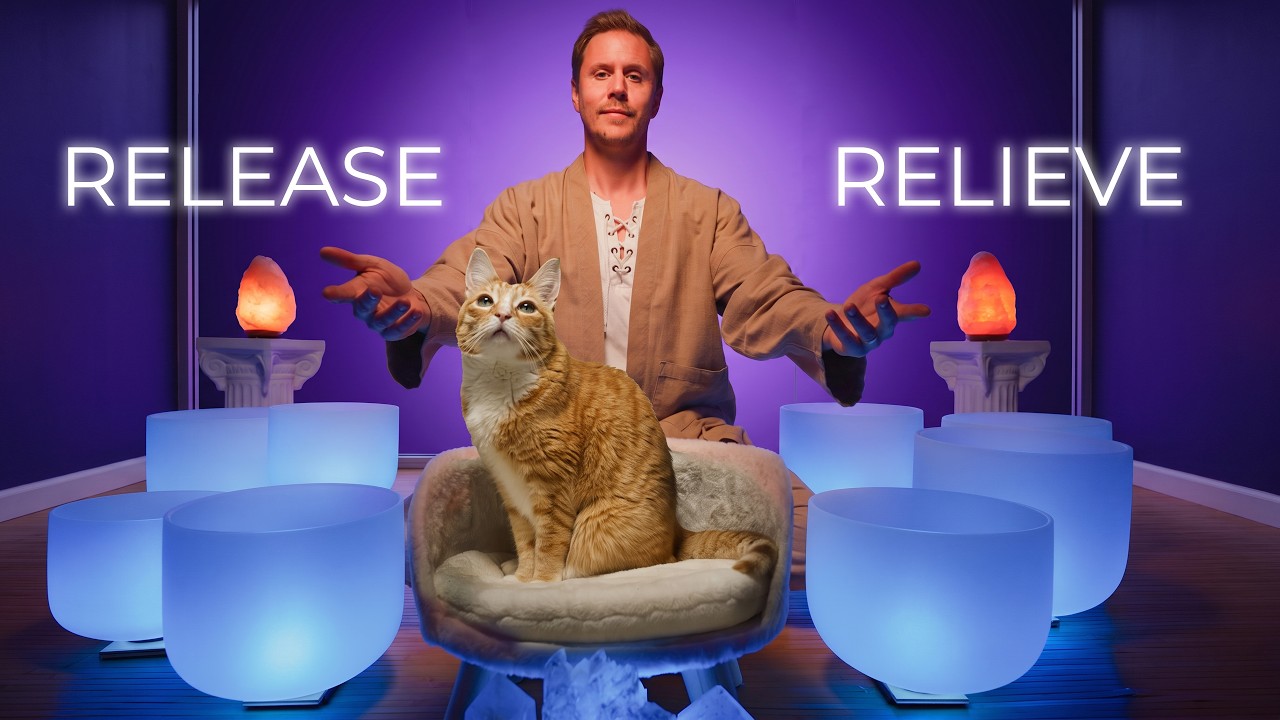
Somewhere past the first hour of a sound bath, the room stops being a room. The lights are low, the blanket has settled over your legs, and the tones of a crystal bowl begin to hang in the air a little longer than your thoughts do. A single resonant note rises, holds, and fades, and in the gap before the next one arrives you notice that your jaw has unclenched without your permission. That quiet moment is the whole promise of a long-form session like the one released on the Healing Vibrations channel, a crystal singing bowl recording of roughly three and a half hours, titled to promise relief from negative energy and a return to peace, and described by its creators as a space for the body to set down what it has been carrying.
This piece is about that kind of listening: what a session of this length asks of you, how to work with the sound rather than against it, and where the honest limits lie. The video is the source material here. What follows is a guide to the practice it invites.
A sound bath is a period of listening, usually lying down, in which resonant instruments fill the space and the listener is invited to do very little. Crystal singing bowls are one of the instruments most often used for this. They are typically made from quartz, and they are sounded either by striking the rim or by running a mallet around it, which produces a sustained, glassy tone that can swell and thin out over many seconds.
The description of this session is explicit about its intent. It says the recording "was created to support deep relaxation and help soften the physical and emotional strain that can build throughout the day," and that "the slow, resonant tones offer the nervous system a calmer environment to settle into." Those are the terms of the practice: slowness, resonance, and an environment rather than a demand. Nothing in the session asks you to achieve anything. The sound is the offering, and the listener is the one who decides what to do with it.
The length matters. At 3 hours, 33 minutes, and 33 seconds, this is not a ten-minute meditation track dropped into a playlist. It is a durational piece, closer in spirit to a long drone or an all-night raga than to a single soothing moment. Long recordings like this reward a different kind of attention: you stop waiting for the session to "work," and the question shifts to what the body does when nothing is asked of it for a very long time.
The most useful instruction in the description is also the simplest. "As you listen," it reads, "notice where you may be bracing without realizing it. Let your jaw soften, your shoulders drop, and your breathing find a more comfortable rhythm. You do not need to force anything to release."
That last sentence is the one most listeners will need to hear more than once. Many people arrive at a sound bath with the same effort they bring to everything else. They try to relax, they chase the feeling of being deeply calm, and they grade themselves when it does not come. The session is structured against that habit. Bracing is something you notice, not something you fix. A shoulder that lifts back up three times in an hour is not a failure. It is information about where your attention has wandered and where your body has been holding its own vigilance.
A practical way to work with it is a slow scan. Start at the crown of the head and move downward, pausing at each area just long enough to ask whether it is held. Jaw, tongue, eyes, forehead, neck, shoulders, the hollow of the chest, the belly, hands, hips, the backs of the legs. You are not trying to change anything in those places. You are simply reporting what is there. Between bowl strikes, when the tone has faded and the silence is open, this scan can feel almost like listening with the body.
Breath follows the same logic. The description speaks of breathing that "find[s] a more comfortable rhythm," which means you do not need to direct it into a particular pattern. Let the exhale be a little longer than the inhale if that happens on its own. Let it be uneven if it is. The sound will tend to slow things in its own time.
The framing of this session blends several kinds of strain: physical tightness, a busy mind, and an overworked body. The description opens with a line that deserves attention: "When the body has been holding stress for too long, tension can start to feel like the new normal."
That observation is worth sitting with, because it describes something most people recognize without naming. Chronic tension often stops registering as tension. The shoulders that sit near the ears during a long workday become the posture you assume you have. A session like this is one way of stepping outside that baseline long enough to feel the difference between holding and releasing. Whether or not that feeling is what the title calls "negative energy," the experience of noticing a contrast is itself the practice.
The title's language about clearing negative energy belongs to a particular tradition of wellness vocabulary, and it is not a term the description takes up in detail. The description's own vocabulary is more grounded: tension, strain, rest, an exhale, space. Reading the session on its own terms, the most concrete claim it makes is that the listener can create "a little more space" in the body. That is a modest and experiential claim, and it is easier to test than a metaphysical one. Try a session, pay attention before and after, and see what you notice.
Any honest guide to a recording like this has to draw the boundary clearly, and the channel does so itself. The description includes a disclaimer: "Healing Vibrations content is in no way meant to be a replacement for traditional medicine. We seek to facilitate mental and physical healing through techniques that are designed to calm and relax the body, creating a state of mindfulness and reflection."
That line is important. A sound bath can be a pleasant and restorative way to spend an afternoon, and it may help some listeners settle into rest. It is not a treatment for pain, anxiety, or illness, and it should not be used in place of medical care. If tension is persistent, severe, or accompanied by symptoms that worry you, the appropriate next step is a conversation with a qualified clinician, not another hour of bowls. The best use of this kind of recording is alongside whatever other care you already rely on.
There is also a question of expectation. The title makes a strong promise. The description is careful. Read together, they suggest the session as an invitation to rest rather than a guarantee of transformation. Listeners who approach it that way tend to get more from it, because they are not waiting for a verdict on whether it worked.
The description offers a simple prompt: "Use this session whenever your body feels tense, heavy, or in need of a deeper exhale." Given the running time, you have several options, and none of them is wrong.
You can listen in one unbroken stretch, lying down in a dim room, perhaps with a timer set to a comfortable point rather than the end. You can also treat it as a background companion for a long quiet task, though the description's emphasis on the body suggests that lying still and listening is closer to its intent. Some listeners will drift off partway through, which is a common and welcome outcome of a session designed around a calmer nervous system. You can return to it in pieces, picking up at a different point each time, which turns the three-hour runtime into a library of short resets rather than a single commitment.
Whatever shape you choose, keep the same two instructions in mind from the description: notice where you are bracing, and do not force anything to release. Those are the entire method. Everything else is the bowls doing what bowls do, a slow sustained tone filling a room and giving the body something gentle to organize itself around.
If this session speaks to you, the channel's own description points to a few directions. The creators invite listeners to subscribe and join what they call the Vibe Tribe for further sessions built around rest, reset, and reconnection. The same channel family includes separate recordings focused on metal bowls, sleep music, and chakra-themed music, which may suit different moods or times of day. Each of those is an extension of the same idea: slow sound, a quiet room, and a body invited to stop bracing.
For a first session, try the following. Choose a time when you will not be interrupted. Lie down, lower the lights, and listen for the first ten minutes without judging the experience. Then do one slow body scan, naming where you feel held. Return to the breath, and let the exhale lengthen only if it wants to. When the session ends, pause before getting up and notice whether anything in the jaw, shoulders, or chest is different. That small difference, if it appears, is the practice working on its own terms. If it does not appear, that is also useful information, and the bowls will still be there next time.