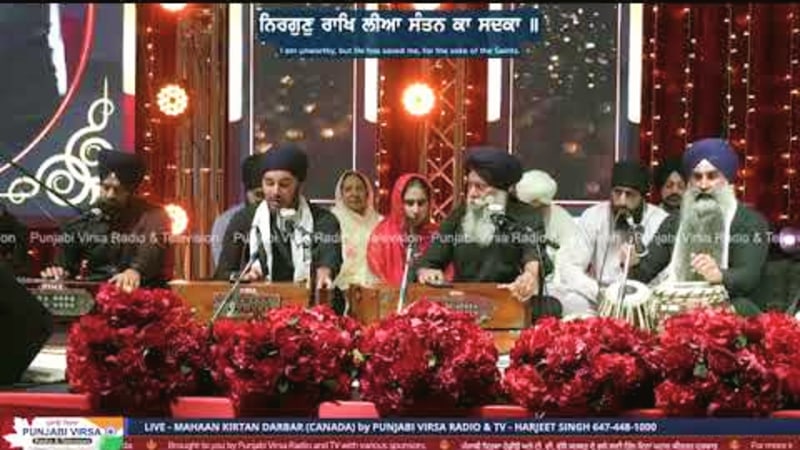
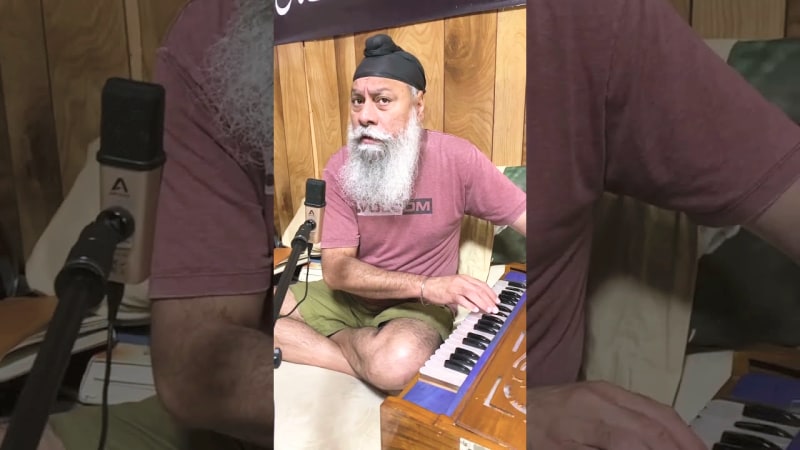
Professor Paramjeet Singh is an Indian classical vocalist and scholar of kirtan, the devotional singing tradition rooted in Hindu, Sufi, and Sikh spiritual practice. Known for his command of gurbani and the ragas that structure Indian classical music, he has anchored his career in both performance and the transmission of tradition—as a teacher, composer, and keeper of compositions passed down through generations of musicians.
His musical foundation began with mastery of three disciplines: vocal performance, harmonium, and tabla. The tabla's rhythmic foundations and the harmonium's harmonic range informed his approach to the raga system, where a single melodic framework can sustain an entire concert through infinite variation. His practice extends across the Gharana tradition, the lineage-based schools of North Indian classical music that privilege oral transmission and personal mentorship over notation. Within this lineage work, Singh has mastered over 125 ragas—each a complete universe of melodic possibility and emotional association—and hundreds of compositions, many of his own creation and many preserved from earlier generations of musicians.
The devotional repertoire that defines his concert practice spans multiple traditions and languages. He performs kirtan of medieval saints revered across India: the bhakti poet Mirabai, the weaver-saint Kabir, the Dalit saint Ravidas, and the Sufi master Farid. His programs also include ghazal, the literary song tradition of Persian origin, alongside folk and light classical forms. This breadth reflects a distinctly ecumenical approach—the sacred music of saints who themselves moved between religious boundaries, whose verses are sung in temples, mosques, and gurdwaras alike.
Singh earned his PhD from Delhi University before joining Punjabi University as its youngest-ever professor at age 24, a position that formalized his role as a teacher and guardian of the tradition he had already mastered as a performer. This early appointment reflected recognition of both his scholarly depth and his capacity to convey living musical knowledge to students, a dual competency rare among classical musicians of his generation.
His recordings include the devotional album Dhan Dhan Ramdas Gur, released in 2012, which documents his interpretation of compositions dedicated to Guru Ramdas, the fourth Sikh Guru. The album stands as a record of his approach to the sacred repertoire—one grounded in the melodic logic of ragas and talas (metric cycles) while honoring the spiritual intention embedded in each text.
Professor Singh continues to perform and teach, maintaining a practice that honors both the technical mastery required of a classical musician and the devotional commitment that distinguishes kirtan from concert performance. His work preserves a living connection to the Gharana tradition and the saint-poetry that has sustained Indian spiritual music for centuries.
For listeners new to North Indian classical music and its devotional applications, Singh's body of work offers a gateway rooted in scholarship, technical precision, and genuine spiritual anchoring.