
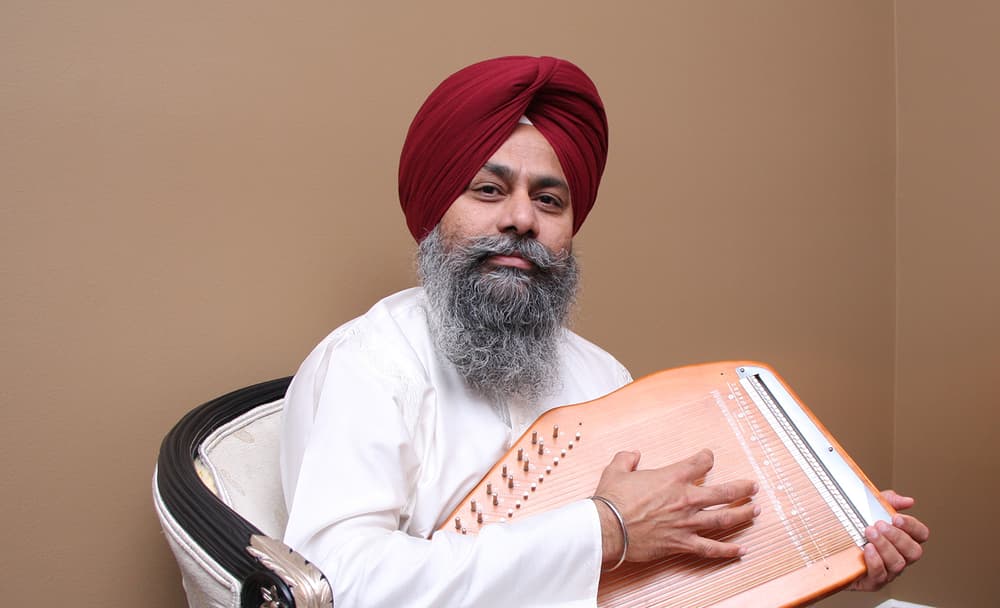
What is Sitar?
The sitar is a long-necked, fretted, plucked lute of North India and the principal string instrument of the Hindustani classical tradition. A typical concert sitar has a hollowed gourd resonating chamber (tumba), a wide hollow wooden neck (dand), about 18 to 21 strings, and 16 to 20 curved metal frets that can be moved along the neck. Six or seven strings run over the frets. Of these, one or two are drone strings (chikari), which the player strikes to mark rhythm. The remaining 11 to 13 are sympathetic strings (taraf) that run beneath the frets and resonate without being plucked. The player plucks with a wire plectrum (mizrab) worn on the index finger. Those searching for the sitar meaning or asking what sitar is will find that the instrument is defined by its sound as much as by its construction. The curved frets let the player pull the string sideways to bend a note across several semitones, and a flat bridge (jawari) makes the strings buzz against it, giving the sitar its shimmering, nasal timbre.
The sitar is not a sacred object in a strict liturgical sense. It is a concert instrument within a classical system, the raga tradition, whose practice has long been bound up with devotional and contemplative ideas (see raga meditation).
Origins & lineage
The sitar’s origins are debated. The name is usually derived from the Persian sehtar (“three strings”), and many scholars link the instrument to Persian and Central Asian long-necked lutes that reached North India under the Delhi Sultanate and Mughal courts. A popular account credits the poet and musician Amir Khusrau (1253–1325) with inventing it by adapting the Indian veena. Most historians treat this as legend, because no contemporary evidence supports it. Another view holds that the sitar evolved from the Indian tritantri veena and from the rudra veena, with Persian influence on the name and some features. The instrument in recognizable form appears in sources from roughly the 17th and 18th centuries.
The modern sitar took shape in the 18th and 19th centuries. The Senia tradition, which traces its lineage to Tansen, the 16th-century singer at the court of Akbar, is associated with the rudra veena and the later surbahar. The sitar was cultivated in the Delhi, Lucknow, Jaipur and Etawah traditions. Masit Khan (18th century) is credited with the slow-tempo instrumental style called Maseetkhani gat, and Raza Khan with a faster style called Razakhani gat. These compositional forms are still taught.
The 20th century produced the principal modern gharanas. Inayat Khan and his sons, including Vilayat Khan (1928–2004), developed the Imdadkhani (Etawah) style, which stresses a vocal-like, singing quality (gayaki ang). Ravi Shankar (1920–2012), a disciple of Allauddin Khan of Maihar, built the Maihar-style approach that emphasises the long, slow alap and an influence from the rudra veena. Other major figures include Nikhil Banerjee (1931–1986), Abdul Halim Jaffer Khan, and Budhaditya Mukherjee. Ravi Shankar’s work with Western musicians, including Yehudi Menuhin and George Harrison, brought the instrument to world audiences in the 1960s.
How it’s practiced
A sitar performance follows the structure of a raga: a melodic framework with specific ascending and descending notes, characteristic phrases, emphasized tones, and associations with a time of day or season. A full performance typically begins with the alap, an unmetered, slow exploration of the raga. It proceeds through the jor, which introduces pulse, and the jhala, a rapid passage using the chikari strings. The gat, a composed piece accompanied by the tabla or pakhawaj, follows, with improvisation within a tala (rhythmic cycle).
Traditional training takes place in the guru-shishya (teacher-disciple) relationship, with years given to sitting posture, mizrab strokes (da and ra), and basic exercises (alankars) before extended raga performance. The tuning of the sympathetic strings to the notes of the chosen raga is part of the preparation. Notation is secondary. Much of the repertoire passes by ear.
Sitar today
The sitar is taught through gharana lineages, university music departments, and conservatories in India. It is also taught in cultural centres and schools in Europe and North America. Recordings, including those of Ravi Shankar, Vilayat Khan, and Nikhil Banerjee, are available widely, and online lessons now supplement in-person teaching. Seekers meet the instrument in concerts, in yoga and meditation settings where raga recordings are played, and in sound-based retreats. Some players also work in fusion and ambient music, or with Western instruments (see conscious music).
Common misconceptions
- The sitar is not the same as the veena. The veena family is an older group of Indian instruments, and the sitar is a distinct, later one.
- It is not a Beatles invention. Western pop adopted it after George Harrison played it on “Norwegian Wood” (1965). It had a centuries-long classical tradition before then.
- It is not inherently a spiritual or healing tool. Claims about therapeutic effects of particular ragas are common but are based on tradition and personal report. They lack strong clinical evidence.
- It is not mastered quickly. Developing the right-hand technique and the left-hand meend (string bending) takes years.
- It is not purely Indian in origin. Its history includes Persian and Central Asian influences, and scholars disagree on the details.
- A single sitar style does not exist. Gharanas differ in technique, repertoire and sound.
How to begin
For sitar for beginners, the first step is finding a teacher, ideally one trained in a recognised lineage, because posture and right-hand technique are hard to learn from video alone. Many teachers allow trial lessons. A student sitar from a reputable maker in Kolkata, Miraj or Delhi is preferable to a cheap tourist instrument, which may not hold tuning or have proper jawari. Beginners start with the basic scale (Bilawal, or Kalyan in some schools), simple alankars and the Raga Yaman or Bhupali.
For listening, start with Ravi Shankar’s Three Ragas (1956), Vilayat Khan’s Raga Yaman Kalyan, or Nikhil Banerjee’s recordings of Raga Hemant. For reading, Ravi Shankar’s autobiography Raga Mala (1997) and his instructional book My Music, My Life (1968) are accessible introductions.