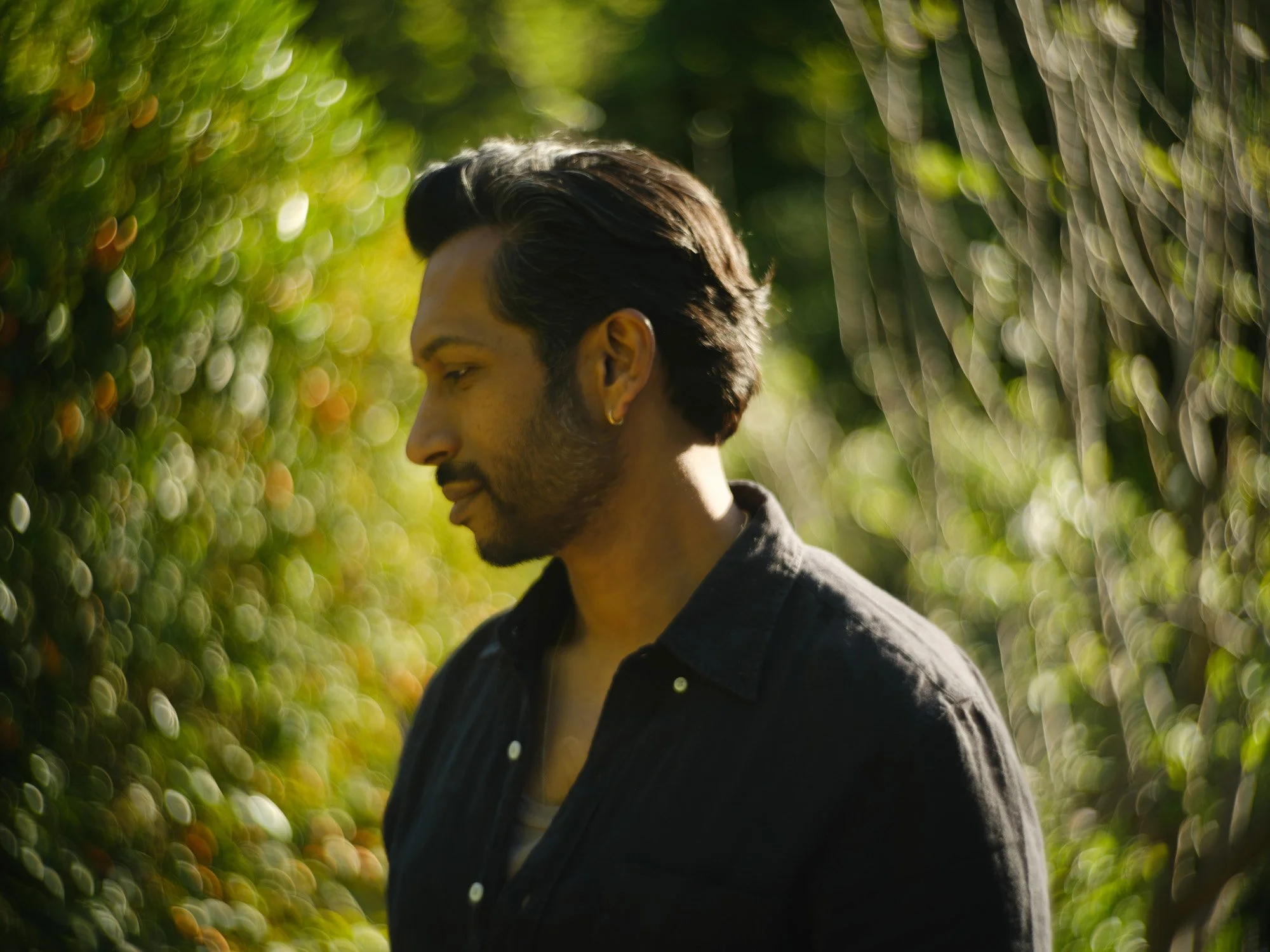

Hrishi occupies an unusual position in contemporary sound practice—not quite a performer in the traditional sense, not quite a therapist, but something more specific: a practitioner who has taken the ancient architecture of Indian classical ragas and repurposed them as tools for healing. With roughly 7,300 followers on Spotify, their reach is modest but deliberate, reflecting work that resists the usual metrics of visibility in favor of depth and intention. What distinguishes Hrishi is the precision of their methodology: they treat raga not as a genre to be performed, but as a living technology capable of regulating the nervous system and facilitating emotional release.
Hrishi's work is rooted in years of training in classical Indian vocal and instrumental techniques, drawing from both Hindustani and Carnatic traditions. These two lineages—one from the North, one from the South—share a fundamental belief in the power of raga: melodic frameworks that correspond to particular times of day, seasons, and emotional states. This is not metaphorical. The structure of a raga, its characteristic phrases, its microtonal ornamentation, the sustained drone that anchors it—all of these elements were understood by practitioners centuries ago to have tangible effects on mood, attention, and physiological state.
The turning point came when Hrishi began to integrate this classical foundation with study in somatic practices and sound therapy modalities. The shift was conceptual as much as practical: instead of presenting ragas as repertoire to be appreciated, they began to understand them as frameworks for experience. The question became not how to perform a raga beautifully, but how to structure sound so that listeners could enter states of deep rest, emotional opening, or focused awareness.
What Hrishi offers is a recontextualization of tradition. They work at the intersection of two often-separated worlds: the rigorous melodic and rhythmic discipline of classical Indian music, and the therapeutic application of sound for healing purposes. In practice, this means creating immersive sound experiences that use the repetition, tonal nuance, and extended duration characteristic of raga performance to guide participants into meditative states.
The approach is grounded in specificity. Different ragas carry different qualities; some are meant for dawn, others for late night. Some evoke longing, others peace or devotion. Hrishi draws on this embedded knowledge to compose and facilitate sound sessions that are both musically coherent and therapeutically intentional. The microtonal ornamentations, the drone structures, the careful pacing—these are not decorative elements but functional ones, designed to create conditions for the nervous system to downregulate and for emotional material to surface and move through.
Hrishi's recorded output is selective, each release functioning as both a listening artifact and material for guided sessions. Their composition "therigiradhe" stands as a representative work, exemplifying the method: raga structure blended with contemporary sound design, accessible to those unfamiliar with Indian classical music while remaining deeply rooted in its principles. The piece has served as an entry point for new listeners, offering a bridge between tradition and therapeutic application.
While the discography remains focused rather than prolific, this restraint speaks to the nature of the work itself. These are not songs meant for passive consumption or background listening. They are designed for engagement, for use in contexts where sound becomes a medium for transformation rather than entertainment.
Hrishi's cultural significance lies not in mass reach but in specificity of contribution. In a moment when sound baths and healing music have become widely commodified, their work stands apart for its rootedness in lineage and its rigor. They are not extracting aesthetic elements from Indian classical music; they are extending its application, honoring the knowledge systems that understood sound as medicine long before the term "sound healing" entered contemporary wellness discourse.
Their audience tends to be those seeking alternatives to conventional therapeutic modalities, people drawn to practices that integrate ancient wisdom with experiential learning. Students who have worked with Hrishi encounter not just sound, but a pedagogy—a way of understanding how music, time, and attention interact to create conditions for restoration.
Today, Hrishi continues to develop work that resists easy categorization. As a musician, composer, and sound practitioner, they inhabit all three roles simultaneously, refusing the boundaries that typically separate them. Their practice includes both one-on-one and group sound therapy sessions, compositional work that appears on streaming platforms, and teaching that transmits not just technique but a framework for understanding sound's therapeutic potential.
The legacy being built is quiet but durable: a body of work that demonstrates how tradition can be honored and evolved simultaneously, how specificity can create broader access, and how the ancient understanding of raga as a technology for consciousness can find new relevance in contemporary life. In an era of distraction and nervous system dysregulation, Hrishi offers something increasingly rare—an invitation to listen deeply, and in that listening, to remember what sound has always been capable of.