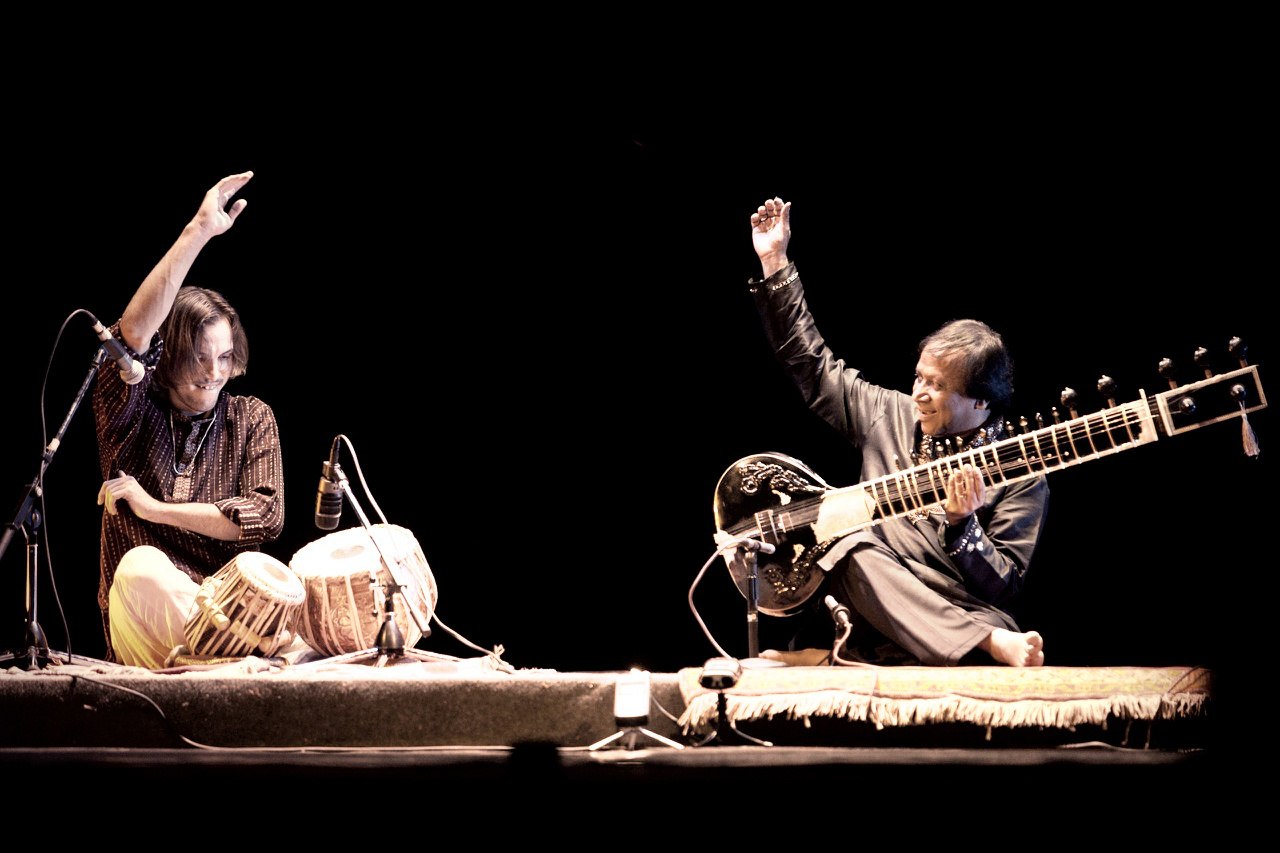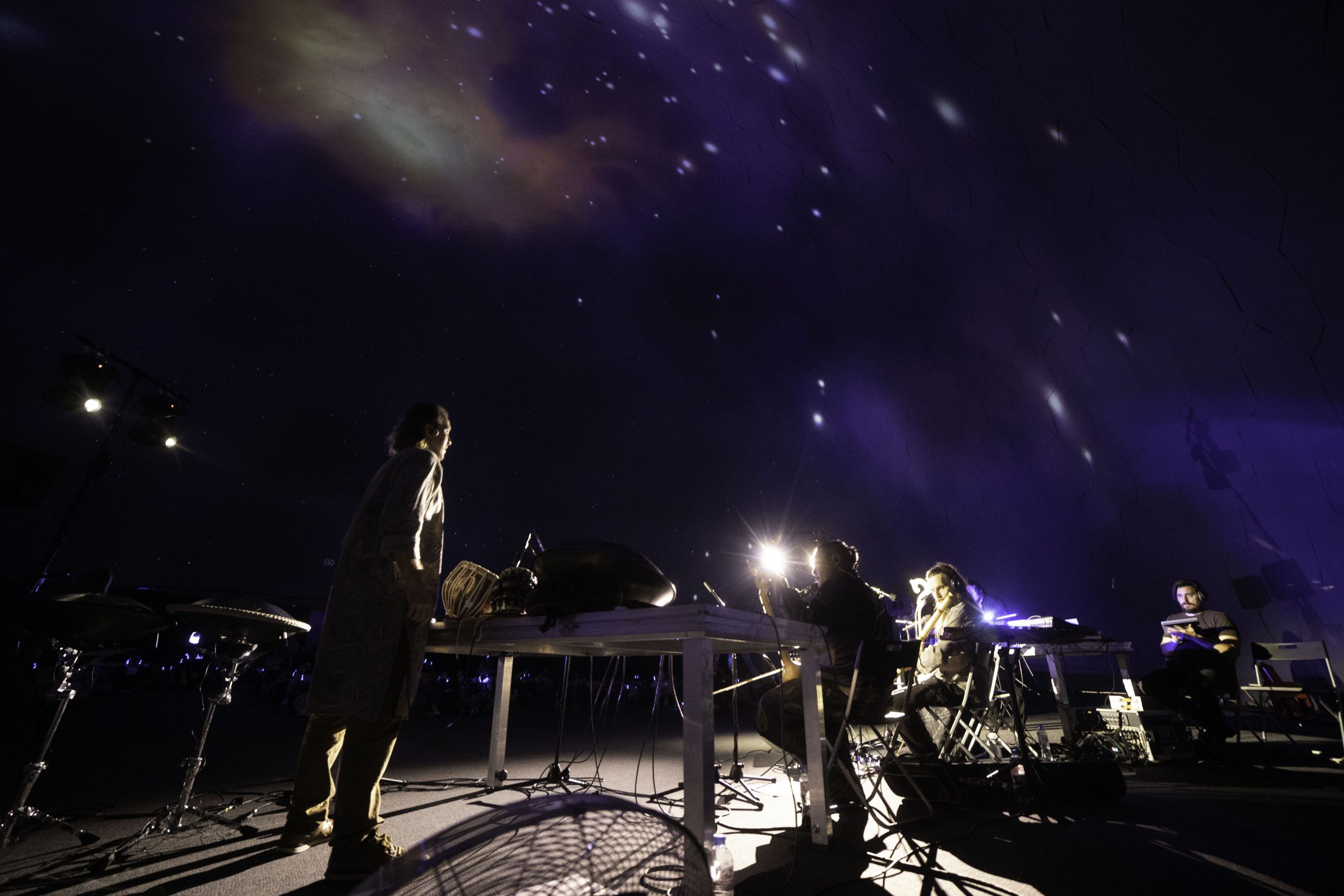

Denis Kucherov occupies an unusual position in contemporary percussion: a London-based musician whose practice bridges the centuries-old discipline of North Indian tabla with the barely two-decade-old tradition of the handpan. Where these instruments might seem to belong to entirely different worlds—one rooted in rigorous classical lineage, the other born from experimental metalwork in 21st-century Switzerland—Kucherov has spent years exploring the conversation between them. His work as a performer, composer, and teacher has gradually built a devoted following among those seeking music that rewards sustained attention and cultivates what he calls "embodied listening."
Kucherov's entry into percussion came through tabla, the paired drums that form the rhythmic foundation of Hindustani classical music. This was not a casual interest. Tabla pedagogy demands years of oral transmission, working directly with a recognized ustād (master teacher) to internalize complex rhythmic cycles, memorize hundreds of bols (spoken syllables that correspond to drum strokes), and develop the finger technique required to produce the instrument's distinctive tonal vocabulary. It is a discipline measured in decades, not months.
This apprenticeship fundamentally shaped Kucherov's musical philosophy. The tabla tradition emphasizes precision, patience, and the cultivation of musical memory through repetition—values that would later inform every aspect of his teaching practice. But it also introduced him to the concept of cyclical time in music, where compositions unfold within repeating rhythmic frameworks called tālas, creating a kind of architecture that listeners can inhabit rather than simply follow.
Kucherov's encounter with the handpan marked a turning point in his artistic direction. The instrument—a convex steel drum with a central note surrounded by a carefully tuned scale—emerged from Switzerland in the early 2000s and quickly attracted musicians drawn to its meditative, bell-like tone. Unlike tabla, which requires years to produce a proper sound, the handpan is immediately accessible. Yet beneath that accessibility lies considerable depth for those willing to explore its harmonic possibilities.
Rather than treating the handpan as a novelty or a departure from his classical training, Kucherov began investigating how its metallic resonance and sustain could complement the tabla's percussive precision. He developed compositions that layer the two instruments, creating pieces where the handpan's tones ring out over intricate tabla patterns, or where both instruments engage in rhythmic dialogue. This approach—treating the instruments as conversational partners rather than separate disciplines—has become a signature of his compositional voice.
Kucherov has performed across the United Kingdom and continental Europe at festivals where his music reaches audiences seeking alternatives to conventional concert formats. His sets range from carefully composed works that demonstrate the structural possibilities of combining tabla and handpan to improvised performances that emphasize spontaneity and interaction with acoustic space.
He has released recordings featuring both solo and ensemble work, though these remain somewhat underground, circulating primarily among his community of students and retreat participants rather than through conventional distribution channels. This approach reflects a broader philosophy in his practice: music as something experienced in shared space and time, not merely consumed as a product.
Beyond the stage, Kucherov has developed a distinctive practice as a facilitator of music retreats—multi-day immersive gatherings that combine instruction, group improvisation, and structured practice sessions. These retreats attract percussionists and other musicians interested in deepening their relationship with rhythm, but they also draw participants without prior musical training who are drawn to the contemplative dimensions of his teaching.
His pedagogical method emphasizes what he describes as rhythmic accuracy, embodied listening, and the cultivation of presence through repetition. Students work with both instruments, learning not just technique but also how to listen—to themselves, to others in the room, and to the acoustic properties of the space itself. The retreats function as temporary communities of practice, where the boundaries between teacher and student, performer and listener, become deliberately porous.
Kucherov's work exists somewhat outside the mainstream music industry, and that positioning appears intentional. He has built a practice that values depth over reach, cultivating relationships with students and audiences who return repeatedly to his performances and workshops. In an era of algorithmic playlists and viral attention spans, his emphasis on deep listening and sustained practice offers something increasingly rare: music that demands patience and rewards it.
For his community—percussionists seeking to bridge traditions, listeners drawn to contemplative sound, students interested in music as a meditative discipline—Kucherov represents a possibility. He demonstrates that it's feasible to build a serious artistic practice around instruments and approaches that don't fit neatly into commercial categories, and that teaching can be as central to an artistic life as performing.
His legacy, still being written, may ultimately rest not in recordings or high-profile performances, but in the practices he's helped others cultivate and the conversations he's enabled between seemingly disparate musical worlds.