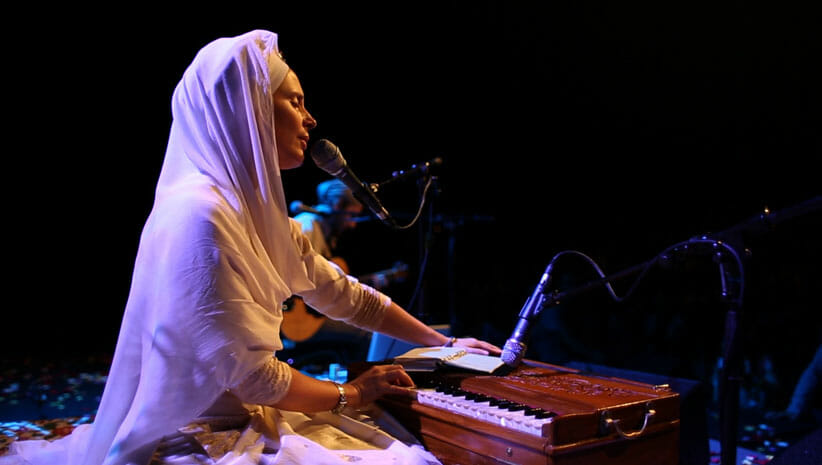
Snatam Kaur's profound assertion, "To chant is to breathe with the divine," invites us to explore the intimate relationship between our breath and the sacred. This statement suggests that chanting transcends mere vocalization; it becomes a spiritual act that aligns our very essence with a higher reality. In a world often filled with noise and distraction, this teaching serves as a reminder of the power of sound and breath to connect us to the divine, urging us to cultivate a deeper awareness of our spiritual practice.
In this light, the act of chanting emerges not only as a form of expression but as a vital practice that nourishes our spiritual lives. It emphasizes the importance of breath as a conduit for divine energy, suggesting that each inhalation and exhalation can be a sacred rhythm that resonates with the universe. By engaging in this practice, we are invited to harmonize our inner world with the outer, fostering a sense of unity that transcends the individual self and connects us to the divine source.
The image / the metaphor
The imagery in Kaur's quote evokes a sense of fluidity and connection, where chanting becomes synonymous with breathing. The verbs "chant" and "breathe" suggest an active participation in a divine dialogue, where sound and breath intertwine to create a sacred rhythm. This metaphorical relationship highlights the idea that our breath is not merely a biological function but a spiritual practice that can elevate our consciousness and deepen our connection to the divine.
In the speaker's tradition
Snatam Kaur's teachings are deeply rooted in Sikhism, a tradition that emphasizes the importance of devotion (bhakti) and the pursuit of truth (sat). The act of chanting, or "shabad," is central to Sikh practice, serving as a means of connecting with the divine through sound and vibration. This practice aligns with the concept of "sangat," or community, where collective chanting fosters a shared spiritual experience that transcends individual differences and unites practitioners in their devotion.
Moreover, the idea of breathing with the divine resonates with the Sikh understanding of "hukam," or the divine order. In this context, chanting becomes a way to align oneself with the universal flow of existence, surrendering to the divine will. The Guru Granth Sahib, the central scripture of Sikhism, emphasizes the significance of sound and vibration in spiritual practice, illustrating how the act of chanting can lead to a deeper understanding of one's place within the cosmos and the divine order.
Living the teaching
Consider a modern scenario where the teaching of breathing with the divine through chanting can be applied. Imagine a busy professional, overwhelmed by the demands of daily life, who seeks solace in the chaos. By incorporating a simple practice of chanting into their morning routine, they create a sacred space to breathe and connect with the divine. This practice not only calms the mind but also serves as a reminder of the deeper rhythms of life, allowing them to approach their day with renewed clarity and purpose.
In another context, this teaching can be transformative within relationships. During moments of conflict or misunderstanding, individuals can turn to chanting as a way to center themselves and reconnect with their inner peace. By breathing deeply and engaging in the rhythmic practice of chanting, they can cultivate a sense of compassion and understanding, fostering a more harmonious interaction. This practice serves as a reminder that, even in challenging moments, we can breathe with the divine and allow that connection to guide our responses.
A reflection
As we contemplate Snatam Kaur's assertion, we are invited to reflect on our own relationship with breath and sound. How can we incorporate the practice of chanting into our daily lives to deepen our connection with the divine? In what ways can we allow our breath to serve as a bridge between our inner selves and the greater universe? These questions encourage us to explore the sacred rhythms of our existence and to embrace the transformative power of chanting as a means of breathing with the divine.