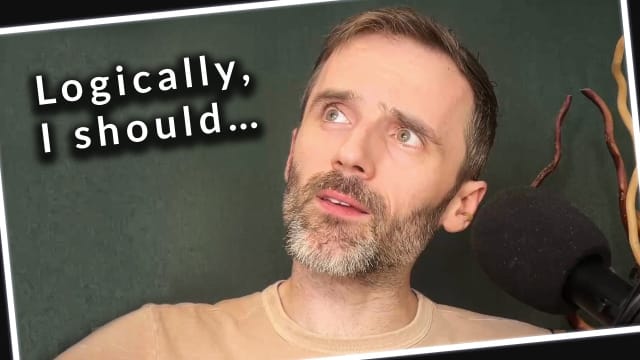
A quick, analytical mind is often the last thing to suspect when a conversation goes sideways. In a short 2026 YouTube video, Sōtō Zen practitioner and Hakomi-trained counselor Michael Caloz describes a morning phone call with a veterinary pharmacy in which he was certain the person on the line had misunderstood a basic fact, only to discover that the gap in understanding was his own. From that small, slightly embarrassing moment he builds a broader argument: that the sharper you are, the faster your pattern recognition hardens into verdicts, and the more readily you place other people beneath you. His remedy is the old Zen idea of beginner's mind, translated into a single practical question. Before you decide someone is missing something, ask what you might be missing yourself.
Caloz's story begins with ordinary logistics. He had submitted a prescription for more medication for his cat, and the pharmacy offered a 300-milligram version of a capsule he usually ordered at 100 milligrams. Shipping was expensive, so the larger option looked like a way to save money and time, and he was in a hurry because he was about to leave on a trip. He placed the order and moved on.
Then came a voicemail. The pharmacy had put his order on hold and wanted to know whether the change was an error. His reaction, by his own account, was immediate and unflattering to them.
"Oh my god, it's not a big deal. Just approve my stupid order. You know, you think I I I made a mistake here that I accidentally put in 300. No, I know what I'm doing."
— Michael Caloz, in his video (2:12)
What is useful about this moment is how fast it moved. Within seconds, his mind had decided the pharmacy was careless and that he was the one who understood the situation. He noticed the irritation, took some breaths, and then, as he put it, faced the prospect of calling back, waiting on hold, and explaining himself in a rush, all because of what he was sure was their misunderstanding.
The core of the video is a claim about intelligence and judgment. Caloz says that people who are highly rational, and perhaps higher than average on some measure of raw intelligence, which he admits he cannot define precisely, are especially prone to a particular trap. They label other people almost without noticing, and the labels build a ranking in which the other person is "below me." Once that ranking exists, the irritation follows: they are wasting my time, I can't trust what they say.
"We can so quickly label people without meaning to, without even consciously doing it, to create a hierarchy where they are below me, therefore I am annoyed with them."
— Michael Caloz, in his video (1:07)
The logic here is subtle and worth slowing down for. Pattern recognition is one of the mind's great strengths. It lets an experienced person see what matters in a situation before a novice can name it. The same faculty, though, can mistake a familiar shape for the full picture. The description of the video makes the point directly: pattern recognition leads you to what feels like a verdict, that the other person is missing something and you are not. The feeling of certainty is doing the work that evidence should be doing.
This is why Caloz frames the problem as a matter of attention rather than ability. He opens with the familiar teaching of beginner's mind, the idea of approaching everything as if seeing it for the first time, without preconceived assumptions. The description credits the phrase to Zen, most famously to Shunryu Suzuki, a Sōtō teacher. Caloz's contribution is to point out that the people most likely to need this teaching are the ones who feel least in need of it.
While on hold, Caloz tried to practice what he preached. His private theory was that the 300-milligram pill was simply a bigger pill holding three times as much medication. But he opened his pills and sprinkled the contents over dry food, so the amount in each capsule mattered less to him than it might to someone else. In his mind, the pharmacy had simply misunderstood how he administered the medication.
When the staffer got on the line and said the larger dose probably would not work for his cat, he cut her off. He had a method, he explained, and the dosage did not really matter. She kept trying to get through to him. She told him he did not understand. At that point, he asked the question that changed the conversation:
"Am I understanding correctly that the 300 milligram is the same pill, just a larger size that holds three times the amount?"
— Michael Caloz, paraphrasing his question in the video (4:14)
Her answer contained the fact he had been missing.
"No, that's not how it works. It's actually the same size pill, but just a higher concentration."
— Pharmacy staffer, as Michael Caloz recounts it in the video (4:28)
Caloz's own summary is blunt: he had been making an assumption that he knew better, that he understood, and that she was simply lacking information. It is worth noticing what the question did. It did not challenge her, and it did not argue for his method. It restated what he believed in a form she could correct. A question that reflects your understanding back to someone gives them the opening to say where you have gone wrong, and it signals that you are actually listening rather than waiting for your turn to talk.
The video does not claim to tell you anything about medication or dosing. Its subject is the habit of mind, and the pharmacy story is simply the vivid case that revealed it.
Caloz makes a distinction that many people will recognize from their own difficult calls and meetings. He wants to get on the phone not with the intention of explaining things to the other person, but with the intention of having them explain things to him. That reversal changes the emotional texture of the conversation. Instead of guarding a position, you are gathering information. The questions he proposes are open ones: What might I be missing here? Could you explain your perspective to me?
He treats the internal signal as the important part. When the mind creates a hierarchy and places you above someone else, that is, in his words, a good sign to stop and question your assumptions. The sentence he suggests is worth borrowing directly: I assume she is missing something here, but is there any chance that I am missing something? The point is not to conclude that you are wrong. It is to keep the possibility open long enough for the other person to show you what you cannot see from where you stand.
It is also worth being honest about what this practice does not require. Caloz is not asking anyone to pretend the other person is right or to suppress a legitimate complaint. He is asking that the first move be curiosity rather than verdict, and that the verdict wait until the facts are in.
Caloz is also a coach and counselor, and he describes how the practice has deepened in his own work. The more people he has worked with, he says, the more his practice has matured, and the more he tries to come to each session with a beginner's mind, even when a new client reminds him of many people he has helped before. His pattern recognition is ready to say that an approach worked for one person and will probably work for this one. More and more, he says, he questions that reflex.
"I don't actually know what's best for you. Right? So my job is to really get to know you. Who are you? What have you gone through in your life? What have you tried? What has worked? What has not worked?"
— Michael Caloz, in his video (6:24)
The argument here is that a client can look similar on the surface and still carry an entirely different history, set of constraints, and sense of what has or has not helped. The coach's task is to find out rather than to assume. The point is not that the coach's knowledge is worthless. It is that the client holds context the coach can never fully possess.
"Not that I know best, but you are actually the expert on you. You have way more context on yourself than I will ever have. And that's true of anyone."
— Michael Caloz, in his video (6:42)
This is the same move as the pharmacy call, scaled up to a relationship. In both, the person who seems to be missing something may hold the one fact that changes everything, and the most useful stance is the one that leaves room for that fact to appear.
Caloz closes with a simple swap. Next time you catch yourself thinking "how do they not get this," he suggests asking a different question: what might I be missing? In his closing, he widens this into a general posture, asking the viewer to be careful when they think they know what is best for someone and to be curious instead. What do they know that you do not?
Several practical habits follow from his account. Notice the physical and emotional signal of hierarchy, the flash of irritation and the sense that the other person is wasting your time. Treat that signal as information about your own mind before you treat it as information about them. Breathe before you respond, as Caloz did while still on hold. Restate your understanding as a question so the other person can correct it. And go into the conversation as a student of the other person's situation rather than as an advocate for your conclusion.
None of this is easy, and Caloz does not pretend otherwise. His story is small on purpose. A cat, a prescription, a hurry before a trip. The lesson is that the stakes of the moment are often low, and that the mind's certainty is most confident precisely when it is least examined. The smarter you are, he suggests, the more reason you have to check.
If this video resonated, the most direct next step is to watch it in full and notice the moments where Caloz describes his own reactions. His point is easiest to test in your own life, so start with a small, low-stakes call or conversation this week and practice asking what you might be missing before you reach a verdict. Caloz also invites viewers to explore his own work through his website, michaelcaloz.com, and to take his personality quiz at michaelcaloz.com/personality. Whether or not you do, the underlying question travels well: when someone seems to be missing the obvious, what is the one thing you have not yet heard?