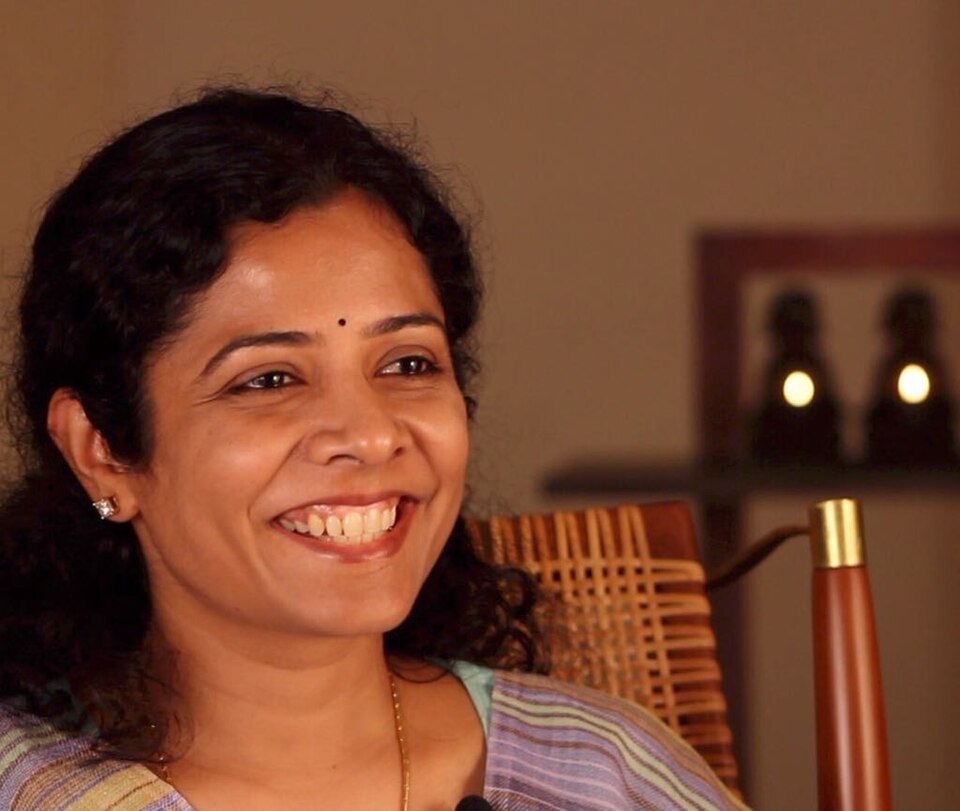
A counseling psychologist stands up at a microphone at the Oneness Abundance Festival and explains a problem most people would never admit in public. Working in Abu Dhabi as a school counselor, and seeing adult clients online, she can sit with almost anyone and help them. Her clients feel heard. Her own family does not get the same access. The moment a sister, a parent or an old friend needs her in a personal rather than professional way, she says, "a wall goes up." In a short Q&A video, Sri Krishnaji takes that wall apart. His answer runs through the Sanskrit idea of samskara, the ingrained impressions that shape how we react, and it insists that family cannot be treated as patients, that hurt is the real blockage, and that love awakens only when the heart is healed. The conversation then turns to a second questioner, a technology executive whose life has filled with abundance, and asks how to keep that abundance from becoming a trap. Both questions lead to the same place: what it means to move beyond roles.
The video runs about ten minutes and is built from auto-generated captions, so some words are garbled. What follows stays with what the teacher clearly says, and it tries to explain the logic behind it, not just repeat it.
The counselor's own description is precise. She can connect with people professionally. She can relate to them and help. Even at home, if a family member is stressed, "the psychologist version of me comes up and I can connect with them immediately." What fails is the other kind of relating: forming a plain, equal bond with people she already knows.
Sri Krishnaji does not treat this as a personality flaw. He treats it as a samskara, a pattern carved by repetition, in this case the pattern of the doctor and the patient. Her work has trained her into a position where she is listening, guiding and seeing impact. "You're also in a little bit of an authoritative position," he says, and that position is comfortable. It is the reason the helping role feels natural. Family, though, does not offer that position.
"Well, first of all, you must understand that your family are not patients. Yeah, they're family. So if you're trying to relate to them as patients continuously, it won't work out."
— Sri Krishnaji, in the video (2:02)
There is a subtle point buried in this exchange. The teacher is not saying that counseling is bad or that helping is a disguise. He is saying that a role can become a substitute for presence. When every relationship arrives as a case to be solved, the person in front of you stops being a partner in a two-way exchange. Family, he says, is "like a two-way journey." You cannot lead it from behind a clipboard.
He also gives the counselor a way to recognize the pattern. Earlier in the same exchange he compares her to another attendee who is focused on everything being correct. Each person has a place where they feel most at ease and where they enjoy things most, and the rest of life can feel strenuous by comparison. For her, that place is helping. The task is not to abandon it but to notice what it is protecting her from.
Whatistherealblockage:samskaraorhurt?
Here the answer becomes more pointed. Sri Krishnaji says that "one of the major reasons people don't connect with family is when they are hurt." The hurt is not always visible. It can show up as a negative samskara that keeps the person "constantly making sure that you're getting hurt." In his framing, that expectation becomes its own filter: you walk into a conversation braced for injury, and the bracing itself closes the door.
He is also refusing to hand the counselor a quick fix. He says he will bless her to discover the samskara, but she must do the discovering. "You have to observe and see what is it," he tells her. The method is self-observation, the patient noticing of a reaction as it arises, and freedom comes from seeing the pattern clearly enough that it loosens.
"Always within family hurts will not make you connect because family are masters in hurting each other. In fact they go for competition. You hurt me, I'll show you. I'll hurt you back."
— Sri Krishnaji, in the video (4:59)
The teacher's account of family conflict is blunt and, in its way, recognizable. He describes legal fights, emotional fights, physical fights and verbal fights, with each side escalating until someone is "in ICU before dying" and everyone starts apologizing. He is not lecturing about families as a category. He is describing a mechanism: hurt begets hurt, and the cycle keeps the heart shut. This is why, in his words, the work is to "heal your heart," and why he suggests that family members attend these gatherings together, so that "everybody can heal and everybody can awaken to love and these massive boxing matches can stop."
"So become free of your hurt, heal your heart. That's very important. So that you can awaken to love."
— Sri Krishnaji, in the video (5:39)
What makes this teaching useful beyond the counselor's situation is the way it reframes connection. Connection is not a skill you acquire through better communication alone. It is what remains when the hurt that makes you guard yourself is seen, and the habitual role that keeps you one step removed is recognized as a role. Sri Krishnaji's phrase for the goal is "effortless connection," which is what the counselor asked for in the first place.
Canyouhaveabundanceandstillloseyourway?
The second questioner shifts the frame. Her life, she says, "feels abundant" after experiences that brought her what she describes as miracles and shifts. Her question is how to keep from losing her way, and how to move from receiving to serving.
Sri Krishnaji's answer depends on a three-part structure he has been teaching at the festival, which he names as abundance, dharma and a third area that the captions render unclearly. His point is that abundance is good, but it has a shadow. "When you have too much abundance or good abundance and you're not awakened to your dharma, you will lose your way basically," he says. The drift he names is specific: into pleasures, meaninglessness, purposelessness, wrong relationships and wrong decisions.
"Wealth is a blessing that's coming to you which is a great blessing and I bless that it keeps coming. But your next step... should be to awaken to dharma. Why are you here on this planet? What is the purpose of your life?"
— Sri Krishnaji, in the video (7:26)
He is clear that the blessing is not the problem. The problem is the gap between having and knowing what the having is for. That gap is where most people start to drift, and the teacher's advice is to close it with a question rather than a plan: what is your life for?
Most people hearing the word dharma, Sri Krishnaji says, will think at once of work or business. He treats that as one aspect only. In his teaching, dharma spans four domains: dharma toward your work, dharma in your relationships, dharma toward your body and dharma toward Mother Earth. Each person may find that one of these is particularly strong, and that is where the next step begins.
"Normally if I say dharma all of you will be thinking about work or business but that is only one aspect. So in the Nova journey we go into dharma towards your work, dharma in your relationships, dharma towards your body and dharma towards mother earth."
— Sri Krishnaji, in the video (8:03)
The four-part frame connects neatly to the first question. If relationships are one of the four dharmas, then the counselor's difficulty with family is not a side issue; it is part of her dharma. Her work-dharma is strong and her relationship-dharma is still forming. The teacher does not say this outright, but the logic of his answer points there.
He also describes how people usually arrive. Many come to his Nova program from India and abroad, and their first question is often what their dharma is. He says he tells them they already have one, and asks them to go deeper. On the second day, he says, many report that they have no dharma at all. "That's the journey," he says. The sequence is not a failure. It is the point where the easy self-description gives way to a real inquiry.
"I have my dharma already. I said very good let us go deeper into it. And second day is when they say we don't have any dharma. So that's the journey."
— Sri Krishnaji, in the video (9:22)
Whatdoesthisteachingaskareadertodo?
Taken together, the two questions give a practical shape. The first asks you to notice where you feel most at home and to ask whether that home has become a wall. The second asks you to notice where abundance is pulling you without direction, and to ask what your life is for across work, relationships, body and the earth. In both cases, the teacher's method is inward: observe the samskara, heal the hurt, awaken to purpose. He is not offering a technique for managing other people. He is asking each person to become free of the pattern that keeps them from meeting others as they are.
The exchange is short, and it leaves a great deal unsaid. The teacher does not offer a therapy protocol, and he does not claim to know the counselor's specific samskara; he says it is for her to find. That restraint is part of the teaching. The video's real claim is that a helper's skill can hide an unhealed heart, and that the first step toward love is seeing that the hiding is happening.
Wheretogofromhere
If this conversation landed close to home, the most useful next step is small and specific. Take one relationship where you feel a wall go up, and write down the moment you first notice it. Ask whether you are relating to that person as a role, as a patient, a helper, an authority, or as an equal. Then ask what hurt you expect them to deliver. That is the samskara Sri Krishnaji keeps pointing toward, and it is the place where, in his words, you "can awaken to love." If you are also trying to clarify your purpose, try the four-part frame: work, relationships, body and Mother Earth. Notice which one feels strongest, and which one you have been avoiding. Watch the full conversation to hear the questions in the teacher's own cadence, and to catch the parts the captions have made difficult to follow.
Comments
Loading the conversation…
Transcript
[0:01] [music]
[0:03] You have to observe and see what is the
[0:05] samscara that is stopping you from
[0:06] connecting. Everything else seems to be
[0:09] a little bit more stressful. No,
[0:11] strenuous, not so comfortable and you
[0:13] have to heal from your hurts. You can
[0:16] awaken to love.
[0:16] >> Namaste Sri Krishna G.
[0:18] >> Namaste.
[0:20] >> My name is Na. I am from Dubai.
[0:22] >> From Dubai.
[0:23] >> G. Um, so I'm a counseling psychologist
[0:27] >> currently [clears throat] working as a
[0:28] school counselor in Abu Dhabi. Okay.
[0:30] >> And also I see uh clients online, adult
[0:34] clients online as well for counseling
[0:35] sessions. Um what I need guidance for is
[0:39] that um when it comes to my role as a
[0:42] counselor, my work in the helping
[0:44] professional, I can do it really
[0:46] wonderfully. I can connect with people.
[0:48] I can relate to them. I can help. All of
[0:51] that I can do. However, when it comes to
[0:54] connecting with people, relating to
[0:56] relationships, uh, family or, uh,
[1:00] people, new people, uh, making
[1:03] relationships with them,
[1:04] >> I feel a wall goes up.
[1:06] >> New people means you're saying partner.
[1:08] >> No, no, new people, friendships or
[1:10] networking or you know, community.
[1:13] >> So, only with your patience, you're able
[1:14] to relate well.
[1:15] >> Yes.
[1:15] >> Why they listen to you?
[1:17] >> Uh, no. I just feel that I'm helping
[1:19] them. So even with my family if I feel
[1:21] some compassion like they they're going
[1:23] through some concerns or stress the
[1:25] psychologist version of me comes up and
[1:27] I can connect with them immediately but
[1:29] when it comes to forming relations like
[1:31] my family connecting with them from a
[1:33] relations
[1:35] >> sense it's hard for me and it all goes
[1:37] up
[1:37] >> so I need guidance what can I do uh so I
Co-founder of the O&O Academy and Ekam — the Indian school of consciousness based at the Ekam temple north of Chennai — and one of the most widely-followed contemporary teachers in…
In this video, Sri Krishnaji explains that a helping role can become a strong samskara, an ingrained pattern, that treats people as patients. Family is not a patient relationship, so the role fails there, and unhealed hurts can keep the wall up.
He uses samskara to mean an ingrained pattern or impression that shapes how we respond, such as a doctor-patient habit or a habitual expectation of being hurt. He says the person must observe and discover their own samskara, and become free of it through self-observation.
Sri Krishnaji says one of the major reasons people do not connect with family is when they are hurt, and that a negative samskara can keep a person expecting to be hurt. He describes family conflict as a cycle of retaliation, and says healing the heart is necessary before people can awaken to love.
He names four areas of dharma: dharma toward your work, dharma in your relationships, dharma toward your body, and dharma toward Mother Earth. He notes that dharma is often assumed to mean only work or business, and that one of the four may be especially strong for a given person.
Sri Krishnaji says that abundance without awakening to dharma can lead to pleasures, meaninglessness, purposelessness, wrong relationships and wrong decisions. His advice is to ask why you are here and what your life's purpose is, treating wealth as a blessing while awakening to dharma as the next step.
The video is a spiritual Q&A, not a clinical treatment guide, and Sri Krishnaji does not offer a therapy protocol. It offers a contemplative frame: observe your patterns, heal your hurts, and awaken to purpose. Anyone dealing with serious emotional distress should also seek qualified professional support.