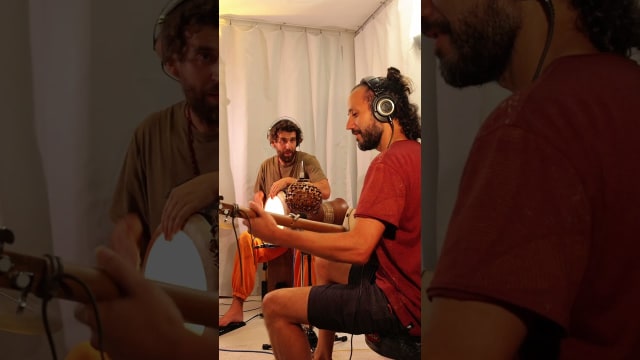
A minute and a half of music, a few soft wordless vocal cues, and a title that announces both a turning point and an unfinished process: "The Tide Has Turned (Composition under construction)," posted by Kabeção on October 31, 2026. The video runs 1 minute and 34 seconds and has 727 views at the time of the transcript. It is a small object, and it does not explain itself. What it does offer is a clear emotional arc, carried almost entirely by the description, and a reminder that a piece of music can be published while it is still being assembled.
The first thing a listener hears is the voice. At 0 seconds, the transcript registers a single "Ooh," and the video moves almost immediately into instrumental music. The transcript records the audio as "[music]" for most of its length, which means there are no lyrics, no spoken introduction and no narration. The piece begins as sound before it becomes anything else.
That choice matters. A wordless vocal is one of the oldest ways to say something without naming it. It leaves room for the listener to bring their own weight to the piece, and it fits a description that speaks in the language of feeling rather than plot. The voice here is not a message. It is a presence that comes and goes.
The "Ooh" returns at 22 seconds, then again at 71 seconds, and closes the video at 93 seconds. Between those cues the transcript shows long stretches of music alone. This is a structure of return and rest. The vocal surfaces, recedes into instrumentation, and surfaces again, which is close to how the description describes its own subject: a process that moves in waves rather than in a straight line.
Anyone who has worked in a studio knows how much a single returning element can organize a short track. Repetition gives a listener something to hold. Silence between returns gives them something to feel. Because the transcript is sparse, the exact arrangement, instrumentation and any developments in the music cannot be described beyond the timestamps and the "[music]" markers. What can be said is that the piece is built on a simple pattern of call and open space.
The clearest guide to the work is the text Kabeção posted beneath the video. It describes a passage through "deep waters," in which one is "confronted with pain, uncertainty, illusions and truths" that may have been avoided. It then turns toward recovery. As the description puts it:
"Not everything disappears. Not everything needs to be forgotten. Sometimes, healing is simply learning to no longer live inside what once hurt us."
— Kabeção, in the description of "The Tide Has Turned" (YouTube, 2026)
This is a notable idea to build a piece of music around. It rejects the fantasy that healing means erasure. The past is allowed to settle rather than vanish. The description frames the piece as something born "somewhere within that transition," in "the feeling of slowly finding my breath again." The music, then, is not a victory lap. It is a record of breathing returning after a long hold.
The description ends with an image that reads almost like a note to the listener: "perhaps the beauty of moving forward is not knowing exactly where the current will take us, but finally allowing ourselves to flow again." The tide metaphor is doing a lot of work. A tide turns on schedule and yet never tells you its destination; the title asks the listener to hold both of those truths at once.
The description lists several credits. It notes that the piece was "Played with Eb La Sirena by @yishama_official," and it names @iamadrianagenova with a camera icon and @bobay_beats with a microphone icon. The material does not spell out what each contributor did, and nothing further about the credited work can be confirmed from the material. Those credits are worth recording as part of the document, not as a claim about roles beyond what is printed.
The parenthetical in the title is the most candid thing about the video. It labels the work as unfinished. In a culture of polished releases, announcing a piece as still under construction is a deliberate stance: it treats the music as a process rather than a product. That fits the description's own language about allowing things to settle and remaining open to what comes next. The piece is presented in the same state the author describes in their own life, mid-transition.
For a listener, this is an invitation to listen differently. A finished record asks for judgment. An unfinished one asks for company. The 94 seconds on this page are better understood as a snapshot of a work in motion than as a complete statement.
Start with the video itself, and listen through once without reading the description. Notice where the "Ooh" arrives, how long the music stretches before it returns, and what the silence feels like at the 71-second mark. Then read the description and listen again. The second listen will sound different, because the text supplies the vocabulary the sound leaves open.
If you are moving through a transition of your own, the piece's central idea is worth holding onto: healing does not require forgetting, and moving forward does not require knowing where the current leads. Kabeção's own words put it most directly: sometimes the work is simply "learning to no longer live inside what once hurt us."