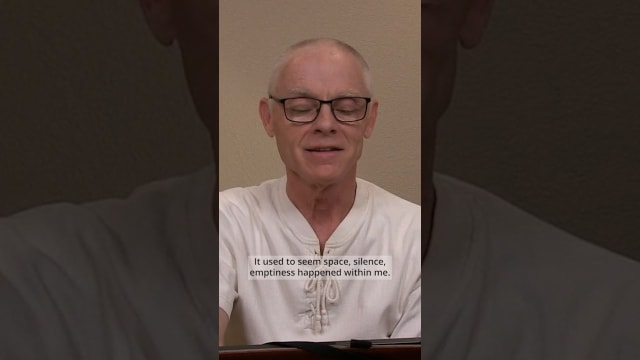
Ask a spiritual teacher what makes practice effective and you will often get a technique, a reading list, or a warning. In a short excerpt from a June 2, 2021 broadcast titled "The Wide Expanse of Enlightenment," Adyashanti answers a student's question with something more compact: three elements he calls the essence of effective spiritual practice, namely silence, inquiry, and intuition. Taken together, they are meant to do one thing. They return the seeker to a question that can only be answered from the inside, and they warn against the most common way that search goes off course, which is looking up somebody else's answer. What follows works through each element, the reasoning he gives for it, and the ideas underneath that are easy to skim past.
The excerpt opens mid-stream, with Adyashanti reading a question from a student named Michael. "Michael asks, 'What constitutes effective practice?'" (0:00). He pauses to say that he could talk all night about it, then decides against it. His stated aim is to offer something "that can live in you and that can evoke your own wisdom, evoke your own meaning, evoke your own intuitive way" (0:39).
That framing matters. He is not handing over a procedure to be executed on schedule. He is offering a small set of seeds and trusting the listener to grow something specific from them. Notice the word "evoke" appearing twice in that sentence. The teaching is designed to draw out a recognition that already exists, not to install a belief.
His first element is silence, and he is direct about its relationship to meditation: silence is "essentially what meditation is." But he quickly widens the frame. "We can attend to silence any time, any old time, all times" (1:09). Silence is not a special state reserved for the cushion. It is the background against which everything else is noticed, and he calls it "the ground of all spiritual practice."
He also names the trap that silence can become. Picture it: you are sitting quietly, the mind settles, and there is a pleasant, warm sense of ease. He describes the inner voice in that moment as, "oh yeah I've got silence and I'm in this nice kind of blissy space." The problem is not that the experience is bad. It is that, as he puts it, "it's temporary." The feeling will shift, and a practice built only on pleasant quiet has nothing to hold on to when it does.
The second element, inquiry, is where the excerpt gets most specific. He is careful to say he does not mean "something overly mechanical." Inquiry is "a living spirit of inquiry" (1:36). He acknowledges why people reach for rigid instructions. "We want to be told what do I do and exactly how do I do it," he says, adding that he remembers feeling the same way himself.
His answer is that inquiry is "a spirit of curiosity but it needs direction." The direction he offers is a question: Who am I really? He notes that "what am I" is also a question he likes, and then he gives the listener permission to find the wording that resonates. The exact phrasing is less important than the quality of the asking.
Then he delivers the warning that gives the excerpt much of its weight:
"If you read about other people's answers and other spiritual teachers' answers to who you are, before you know it, you're not actually involved in the inquiry at all. You're looking for somebody else's answer." (Adyashanti, excerpt from his June 2, 2021 broadcast, "The Wide Expanse of Enlightenment")
In the transcript he follows it with the line, "Don't look for someone else's answer. Don't look for my answer. Find your answer" (2:30). This is the spine of the whole teaching. A question that is handed to you with its answer attached has stopped functioning as a question. The reader has become a collector of conclusions, and the inquiry that was supposed to dissolve the sense of a fixed self has quietly been replaced by another set of ideas about the self.
He returns to the question of curiosity several times, and it is the hinge between silence and inquiry. "You have to want to know," he says (3:08). Without that wanting, silence drifts back toward comfort. Curiosity, in his description, is what "adds a kind of dynamic quality" to quiet. It refuses to let the good feeling settle into complacency.
The move he suggests is subtle. When the pleasant stillness arrives, do not simply rest in it as an answer. Let the inquiry ask a sharper question: "Yes, you feel good, but really, really, really, who are you that feels good right now? Let's get down to it. Who's the you that feels good, that's hanging out in silence?" (3:54). He is specific about what to do next. Do not answer that question in your head. Let it open "a felt sense of mystery." The question is meant to be carried in the body and the attention, not solved by the intellect.
Here he is generous to the full range of human concerns. Questions about healing, therapy, life, relationships, and work are, in his words, "all relevant in their own right." He says they are "not to be belittled or dismissed," and that there is a time and place for them.
But he draws a line around what he calls the big existential questions: "Who am I? What is God? What is life? What is real? What's actually true?" He describes these as "the hallmark of the deeper forms of spirituality," the ones that "open the doors to the essence of our being" (5:44). His test for whether a question deserves a lifetime of attention is energy. "A question is only relevant when it's relevant to you. It has to have energy. It has to have power. You have to really want to know."
He offers a practical way to find that question. Imagine reaching the end of your life without having looked into it, and ask what you would most have wanted insight into. He frames it as a matter of perspective that death can sharpen. Then he adds the line that keeps the whole teaching from becoming a new authority: "Your spirituality is yours, not mine, not anybody else's." (5:05) The question you carry has to be yours, or it will not do its work.
This is the passage where many listeners will feel the teaching turn. Adyashanti says the practice of inquiry should lead you to admit you do not know. "I don't know is the doorway of all spiritual realization. I know blocks the way. It really does." (7:38)
He is not recommending despair. He is distinguishing two kinds of not-knowing. One is the frustration of wanting an answer you cannot reach. The other is the recognition that something about you is so mysterious that the intellect cannot get a grip on it. His instruction is to notice when the mind is reaching for a new definition, and to stop. "Maybe let yourself feel your way into the mystery of your being" (8:14).
He names this approach "meditative inquiry." It does not require you to be sitting cross-legged, though it can happen there. What makes it meditative is its connection to "your immediate experience," and to the feeling of mystery that the question opens. In this framing, inquiry is not a mental exercise that runs alongside practice. It is a way of staying present with what is actually happening.
The third element is intuition, and Adyashanti is blunt about why so many people feel cut off from it. Many have never been told that they can trust themselves, that they are allowed to even attempt to trust their own sense of things (8:55). In its place they have absorbed a stream of inherited views, which he sums up with a sharp distinction: "This is what I think and this is what I believe. That's not intuition. That's conditioning."
What he points toward instead is "that deeper thing. A deeper thing that gives direction." The excerpt does not spell out further what that deeper thing feels like or how to recognize it, and it is worth being honest about that gap. What it does establish is the relationship. Intuition is the faculty that can tell the difference between an answer that is genuinely yours and one that was only handed to you. Trusting it is part of the practice, not a reward for finishing it.
Read as a sequence of instructions, the three can look like separate tasks. Read as a single movement, they fit together. Silence supplies the ground, the stillness in which the question can be heard at all. Inquiry supplies direction and energy, keeping the stillness from becoming a pleasant rest stop. Intuition is the sense that recognizes when a response is truly one's own rather than borrowed, conditioned, or merely comfortable. Remove any one and the practice tends to drift: silence without inquiry becomes bliss, inquiry without silence becomes mental grinding, and either without intuition can collect other people's answers indefinitely.
This is the through-line the excerpt keeps returning to. Effective practice, in this account, is not measured by how much you know or how good you feel. It is measured by whether you are still doing the looking yourself.
If this teaching lands, the most useful next step is small and concrete. Sit in silence for a few minutes without trying to make anything happen. When a pleasant feeling arrives, ask Adyashanti's question without answering it: who is the one that feels this? Choose one question that carries real energy for you, and resist the urge to read what others have concluded about it. Notice when a thought arrives that sounds like a belief you were taught, and ask whether it comes from a deeper place or from conditioning.
For a fuller version of this material, the excerpt is drawn from the June 2, 2021 broadcast, "The Wide Expanse of Enlightenment." According to the video's description, full-length teachings like it are available to members of Adyashanti's YouTube community at the basic membership level, which is a reasonable place to go if you want to hear the surrounding context in his own words.