Transcript
[0:00] Tow [singing]
[0:04] money
[0:06] is so
[0:08] tire
[0:12] money. Mahoney is [singing] so
[0:19] money.
[0:21] Ma [singing] is so
[0:25] tire.
[0:31] [singing]
[0:40] Oh,
[0:44] money
[0:47] is so [singing]
[0:49] ta
[0:56] [singing]
[1:01] money.
[1:08] >> [singing]
[1:09] >> money.
[1:11] Mahar is so
[1:15] Tow
[1:17] [singing]
[1:18] money
[1:21] is so [singing]
[1:23] t
[1:34] [singing]
[1:46] Mahoney is [singing] so
[1:49] ta
[2:00] [singing]
[2:02] money
[2:04] [singing] so
[2:09] money
[2:11] m
[2:14] soul.
[2:53] Oh,
[2:55] what did
[2:59] It's too good.
[3:25] Good.
[3:27] [clears throat]
[3:28] Yeah.
[3:58] To the teacher and transcendent
[3:59] destroyer, one gone for destroyer
[4:02] completely and fully awakened. One
[4:04] perfect in knowledge and good conduct,
[4:06] one gone to bliss, nor the world's
[4:08] supreme guide of beings to be tamed.
[4:10] Teacher of gods and humans to you the
[4:12] Buddha and doubt and destroyer. Glorious
[4:14] conqueror Shakiuni I prostrate make
[4:16] offerings and go for refuge when supreme
[4:19] among humans. You born on this earth you
[4:21] pay seven strides and said I am supreme
[4:23] in this world to you wise and I bow with
[4:26] pure bodies form supremely fine wisdom
[4:29] motion like a golden mountain. Fame that
[4:32] blazes in the three worlds. Winner of
[4:34] the best supreme guide to you I bow with
[4:36] the supreme sign face like the spotless
[4:39] moon color like gold to you I bow you
[4:42] are the three worlds are not
[4:44] incomparable wise one to you I bow great
[4:47] compassionate protector all knowing
[4:49] teacher field of merit and good
[4:51] qualities vast as notion to the bow
[4:54] through purity freeing from attachment
[4:57] through virtue freeing from the lower
[4:59] realms unique supreme ultimate reality
[5:02] to the dharma that Peace I bow having
[5:05] freed themselves showing the path to
[5:07] freedom too well established in the
[5:09] trainings the holy field endowed with
[5:12] good qualities to the I do not commit
[5:15] any non virtuous [clears throat] actions
[5:17] perform only perfect virtuous actions
[5:20] subdue your mind completely this is the
[5:22] teaching of the Buddha a star mirage a
[5:25] flame of a lamp and illusion drop of do
[5:27] a bubble a ding flash of lightning a
[5:30] cloud see condition things as such
[5:32] Through this merit may sentient beings
[5:35] attain the state of all seeings of
[5:37] beautiful false and be delivered from
[5:39] the ocean of psychic existence perturbed
[5:42] by the ways of aging sickness and death.
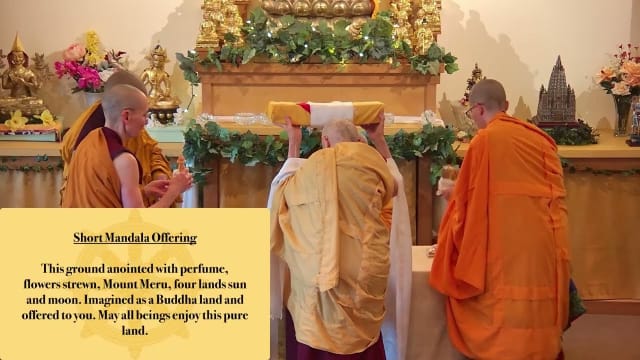
[5:46] This ground anointed
[5:49] [singing] with perfume.
[5:52] Flowers strewn mu
[5:57] for [singing] land sun and moon
[6:03] [singing]
[6:04] in desert Buddha land and offer
[6:07] [singing]
[6:08] to you. May all beings
[6:13] enjoy
[6:15] [singing] this pure land. Venerable
[6:20] [singing]
[6:22] gurus
[6:24] in the space [singing]
[6:26] of your true body
[6:30] from [singing] billowing
[6:33] clouds of your wisdom and love. And
[6:38] [singing] all the rain of the profound
[6:41] and extensive
[6:43] Dharma [singing]
[6:45] in whatever form is suitable for
[6:49] subduing
[6:52] sentient beings.
[7:01] I take gratitude until I have awakened
[7:04] in the Buddhas, the dharma and the by
[7:08] the merit I create by listening to the
[7:12] dharma. I will attain Buddha [singing]
[7:16] in order to benefit all sentient beings.
[7:19] I take refuge until I have awakened in
[7:23] the [singing] Buddhas, the dharma and
[7:25] the s by the merit I create by listening
[7:29] to the dharma. I will attain Buddhahood
[7:34] in order [singing] to benefit all
[7:36] sentient beings. I take refuge until I
[7:40] have awake again in [singing] the
[7:42] Buddhas, the dharma and the sa by the
[7:46] merit I create by listening to the
[7:49] dharma. I will attain
[7:53] [singing] in order to benefit all
[7:56] sentient beings.
[7:59] [cough]
[8:37] So um first as the great uh scholar the
[8:40] great master Chandrai has stated if when
[8:44] free and living with favorable
[8:46] conditions we do not retain this status
[8:48] we enjoy we will fall into the abyss and
[8:52] be at the mercy of others. What could
[8:54] enable us to rise up again from such a
[8:57] state?
[8:59] >> Oh yeah.
[9:10] Foreign
[9:13] speech. Foreign speech. Foreign speech.
[9:23] Foreign
[9:32] speech. Foreign speech.
[9:42] Foreign
[9:52] speech. Foreign speech. Foreign speech.
[10:09] Yeah.
[10:12] So here um if at this time when we are
[10:16] born with all of these freedoms and
[10:18] favorable conditions and so the freedoms
[10:21] mean we haven't been born in a state
[10:23] like say an animal where we are unable
[10:26] to practice the dharma due to that kind
[10:29] of rebirth or even we haven't been born
[10:31] as a human say born in a very remote
[10:35] area born um like in some place where
[10:38] the dharma hasn't spread or have been
[10:41] born wherein we don't have the
[10:43] faculties, the intellectual capability
[10:45] of actually understanding the dharma. So
[10:48] we have all of those conditions where we
[10:50] can listen to the dharma. We can
[10:52] actually process and understand the
[10:55] dharma. So we haven't been born in any
[10:58] of those kinds of births wherein you
[11:00] don't have such favorable conditions. We
[11:03] have the capacity to accomplish the
[11:05] dharma. We are able to think about this
[11:08] to process this. And so right now we do
[11:11] have the kind of freedoms including the
[11:13] freedom of being in a place wherein we
[11:15] have the autonomy, the freedom to
[11:17] practice the dharma as we wish. So right
[11:20] now we have all of those kinds of
[11:22] favorable conditions.
[12:32] Fore! Foreign! Foreign!
[13:01] Yeah.
[13:05] So over many eons this universe is
[13:09] destroyed. It comes into being. It
[13:11] abides and so forth. And this goes on
[13:14] again and again. But to have a supreme
[13:17] emanation body, the Buddha, come into
[13:20] the world is something that is extremely
[13:22] rare. It doesn't happen all the time.
[13:25] And so to have had a such a supreme
[13:29] emanation body, a Buddha come into the
[13:32] world even though we didn't actually
[13:34] meet that Buddha. The continuity of his
[13:37] teachings remain and we are able to
[13:40] encounter those teachings. We can listen
[13:42] to those teachings. We can understand
[13:45] those teachings. We have those who are
[13:46] able to explain them. This continuity
[13:49] still remains. And so um if we didn't
[13:52] have the kind of capacity to know or
[13:54] listen or explain or or or understand or
[13:58] we didn't have those kinds of conditions
[14:00] wherein there were those to explain it
[14:02] to us or we didn't have those around us
[14:05] who are practicing a similar path who
[14:08] are our companions along this path then
[14:10] we wouldn't be able to practice. But
[14:12] right now we have all of those
[14:15] conditions assembled. we have the
[14:18] ability to practice the dharma both from
[14:20] the conditions of our own side as well
[14:23] as those external to us if we don't
[14:26] accomplish the dharma. It's really on us
[14:28] because right now we have all of those
[14:30] favorable conditions assembled as it
[14:32] says in this first line when we have
[14:34] taken um a birth of freedom and have all
[14:38] favorable conditions.
[14:53] Fore! Foreign! Foreign!
[15:03] Fore! Foreign! Foreign!
[15:29] >> [snorts]
[16:04] >> Fore! Foreign! Foreign!
[17:00] So this kind of um situation that we
[17:03] have right now though is something that
[17:05] we don't always have. It's something
[17:07] that is quite rare to come across. And
[17:10] because it's so rare, we should
[17:12] recognize how precious it is. We should
[17:15] contemplate how precious it is and
[17:18] actually use it for something meaningful
[17:20] rather than just pursuing the kind of
[17:22] affairs of this life or the needs of
[17:25] this life. I mean, even worse than just
[17:27] kind of being preoccupied with getting
[17:29] what we need to sustain ourselves is the
[17:32] way in which we rely upon our anger and
[17:34] our attachment. We're willing to do
[17:36] things like steal from others or lie to
[17:39] them, say things that are divisive and
[17:41] so forth. And so in the course of just
[17:43] sustaining the life that we have, we end
[17:45] up accumulating a great deal of non
[17:47] virtue. So we have this great
[17:50] opportunity, but rather than using it
[17:52] for something meaningful, we squander it
[17:54] in really um meaningless or even
[17:57] negative acts that are going to throw us
[17:59] into kind of a worse um situation. So if
[18:02] we do not retain this status we enjoy by
[18:06] creating the causes for a good birth in
[18:08] the future, we will fall into the abyss
[18:11] and be at the mercy of others. What
[18:14] could enable us to rise up again from
[18:16] such a state? So um here when we think
[18:19] about um using this life in such a
[18:23] meaningless way, it's really a great
[18:26] loss. It's something where we have this
[18:28] incredible opportunity, but we're
[18:29] letting it go to waste. we're incurring
[18:32] such a loss. A good and a bad birth is
[18:35] dependent upon the virtues and non
[18:37] virtues that we do right now. And so, I
[18:40] mean, an animal, for example, they don't
[18:42] uh really un they don't have the ability
[18:45] to know what is good or bad. They kind
[18:47] of just go along sustaining themselves,
[18:49] but they're not doing anything
[18:50] incredibly negative for the most part.
[18:52] But if we are in this situation where we
[18:54] have the ability to understand, we can
[18:56] make those distinctions and yet we still
[18:59] choose to not use this for something
[19:02] good, but rather squander it and um even
[19:04] worse create the conditions to fall into
[19:07] the abyss of the lower realms. Like what
[19:10] greater loss could there be than that?
[19:12] Because once you're in such a situation,
[19:15] what protects you? What is able to get
[19:17] you back out of that? Like if you're an
[19:19] animal, you don't understand the dharma.
[19:21] You can't listen to the dharma. You
[19:23] can't benefit from that. And so, having
[19:25] fallen into such a state, into such an
[19:28] abyss where you're under the control of
[19:30] those circumstances, what could possibly
[19:33] extricate you from that? How could you
[19:34] rise up again?
[19:37] Oh, yeah.
[20:14] forchech.
[20:44] Fore speech.
[21:13] Yeah.
[21:15] >> So, um here again, uh while we have
[21:19] these kinds of freedoms and favorable
[21:21] conditions, we should use them to like
[21:24] retain the status we enjoy rather than
[21:26] allowing ourselves to fall into the
[21:28] abyss of the lower realms. This is often
[21:31] um likened to the example of some sort
[21:34] of like hero or strong man. You know,
[21:36] someone who has a great deal of bravery
[21:38] and confidence and all of the kinds of
[21:41] conducive circumstances like all of them
[21:43] people around them are on their side and
[21:46] they have like all of the kind of
[21:48] support and all of the bravery and um uh
[21:51] all of those sorts of conditions to be
[21:53] able to like accomplish whatever aim.
[21:55] But if they were to be captured and have
[21:58] all of their limbs tied up and then
[22:00] taken and dropped in some sort of remote
[22:02] area, like totally abandoned area, well
[22:05] then they can't really do anything,
[22:07] right? They have no ability to protect
[22:10] themselves, let alone accomplish
[22:12] whatever they want. And so we too have
[22:15] all of the circumstances. We're like
[22:17] this sort of hero that is surrounded by
[22:19] all favorable conditions with their
[22:22] whole entourage, with all of the
[22:23] necessities. And if we squander this and
[22:26] fall into the state of like an animal um
[22:29] then we don't have the ability to do
[22:31] anything about that right we can't
[22:33] understand the dharma we can't listen to
[22:35] it we can't process it and so while we
[22:37] have this kind of chance we should use
[22:40] this for pursuing definite goodness like
[22:43] a definite kind of a happiness in the
[22:45] sense of securing good rebirth after
[22:47] good rebirth we're able to improve and
[22:50] develop and pursue that kind of a goal
[22:52] rather than falling into a state with no
[22:54] protection.
[22:57] >> Oh yeah.
[23:57] foreign
[24:47] Foreign
[24:50] speech. Foreign speech.
[25:57] >> [clears throat]
[26:00] >> So um here the point of this verse is
[26:03] that we need to take the essence of this
[26:05] life or we really need to make this
[26:08] meaningful by pursuing um really the
[26:12] benefit of all sentient beings but first
[26:14] ensuring that we have a good rebirth. a
[26:17] good rebirth after good rebirth to be
[26:19] able to continue to develop our
[26:22] qualities and eventually attain that
[26:24] kind of definite happiness. And this
[26:27] means at the beginning we need to
[26:29] refrain from any kind of negative
[26:31] actions with our three doors, our body,
[26:33] speech and mind and make an effort to do
[26:37] acts that are beneficial with our body,
[26:39] speech and mind in order to create the
[26:42] causes for such a good rebirth. And here
[26:45] um if we are to be born in um sukavati
[26:49] uh by making prayers here we are um
[26:51] looking at this prayer to be reborn in
[26:54] sukavati. And we see that this has the
[26:57] kinds of conditions that create the good
[27:00] opportunities for us to be able to
[27:01] listen to the dharma, right? And to be
[27:04] able to practice and develop our
[27:06] qualities. And so here in order to be
[27:08] born in sukavati we need to have
[27:11] accumulated a vast amount of merit right
[27:14] and we take those merits that we have
[27:16] created and dedicate them toward the
[27:19] cause of all [snorts] beings
[27:21] enlightenment but being born in sucavati
[27:24] in order to be able to accomplish that
[27:26] and training in love and compassion and
[27:29] the mind of awakening in addition to
[27:32] making these kinds of prayers. This is
[27:34] the way in which we are born there. And
[27:37] so here when we develop the I mean by
[27:40] developing love and compassion and so
[27:42] forth the kinds of attitudes of us and
[27:45] them these divisive attitudes that we
[27:48] have we become less concerned with those
[27:51] and less concerned with the kinds of
[27:53] worldly affairs like our profit and our
[27:55] loss and our pain and pleasure and fame
[27:58] and so forth. And we sort of relax the
[28:02] control that those have over us. Um and
[28:04] so when we are less uh concerned with
[28:07] that, we are able to really pursue the
[28:09] dharma in a more meaningful way by being
[28:11] born there. Again, you have uh the
[28:14] ability to quickly achieve these
[28:16] supernowledges, including the kinds of
[28:19] miraculous powers that allow you to
[28:21] travel to various realms and make
[28:23] offerings to Buddhas and bodhicattas.
[28:25] again accumulating more and more merit
[28:28] which in turn allow you to emanate into
[28:31] impure realms and work for the benefit
[28:33] of sentient beings and so um here when
[28:36] we don't have the kinds of uh coarse
[28:38] sufferings that are uh connected with
[28:40] our body I mean often the ways in which
[28:42] we make non- virtues are because of the
[28:45] needs of our body um our hunger or our
[28:47] thirst or um those other kinds of things
[28:50] but the body in sukavati is different
[28:53] and the way in which that's supported is
[28:56] different. And so this again comes about
[28:58] due to the power of that field, the
[29:01] power the power of which is um arisen
[29:03] from the prayers of Amitaba and as well
[29:06] our own virtues that lead to such a
[29:09] rebirth and due to this kind of
[29:12] condition wherein we can progress
[29:14] quickly um we are able to in turn
[29:16] emanate to these impure realms and work
[29:18] for the benefit of sentient beings. And
[29:21] so thinking about that we should set our
[29:23] motivation um saying that by hearing
[29:26] about um this prayer of sukavati and
[29:28] making an effort towards accomplishing
[29:30] the causes that will lead to such a
[29:33] rebirth I'm going to listen to these
[29:35] teachings um on this prayer and uh in
[29:38] that way please set a good motivation.
[29:42] >> Oh yeah.
[30:08] That
[30:59] Foreign
[31:07] speech. Foreign speech. Foreign speech.
[31:57] Foreign
[32:00] speech. Foreign speech. Foreign speech.
[32:50] Fore! Foreign! Foreign!
[33:00] Fore!
[33:11] Foreign! Foreign!
[33:19] [clears throat]
[34:51] Foreign
[34:55] speech. Foreign speech. Foreign speech.
[35:05] [cough]
[35:06] [clears throat]
[35:08] >> [laughter]
[35:12] >> So um here the Buddha the Bavan um came
[35:16] into uh this world particularly at the
[35:19] time of the five degenerations um and
[35:21] due to his previous prayers he had made
[35:23] prayers to be able to display the
[35:25] various deeds of a supreme emanation
[35:28] body at this time. I mean uh at this
[35:32] time where beings have especially sort
[35:34] of degenerate uh views and lifespan and
[35:37] the afflictions are particularly strong.
[35:39] Um these beings who are angry and who
[35:42] are jealous and who are prideful and so
[35:44] forth. And so um due to the kinds of
[35:46] prayers that uh the Buddha the Bavan had
[35:49] made he was born at this time or he came
[35:52] into the world displayed these various
[35:54] deeds in this time of the five um
[35:57] degeneration wherein again there are so
[35:59] many different kinds of [clears throat]
[36:00] u views wrong views and there are so
[36:03] many afflictions. It's sort of like
[36:05] we're over uh we have an overabundance
[36:07] of afflictions. Like when we give rise
[36:09] to um anger, then we're giving rise to
[36:11] hatred, then we're giving rise to pride,
[36:13] then jealousy, then all of these things
[36:14] sort of set off a whole cascade. They're
[36:17] very easily given rise to. And so um
[36:20] looking at this kind of uh world with
[36:23] all of these sort of coarse minds and a
[36:25] world in which there is all of this
[36:26] uncertainty there's no um certainty
[36:29] about our wealth our possessions what we
[36:31] have or we won't have our lifespan and
[36:33] so forth um he had u sort of also I mean
[36:37] earlier made prayers to come into the
[36:39] world at this time of the five
[36:41] degenerations but looking at it upon
[36:43] having attained enlightenment his
[36:45] initial thought was that I'm not going
[36:47] to be able to teach the to these people
[36:50] right the kinds of things that I have
[36:51] discovered are so um different are so so
[36:55] much like clashing with the ways of the
[36:57] world um there's nothing uh in what I am
[37:00] teaching that they will be able to um
[37:03] understand it's just so much um you know
[37:06] in contrast to the things that this
[37:08] world believes and so there was a period
[37:10] after his enlightenment in which the
[37:12] Buddha remained um silent uh there is
[37:15] the the famous uh verse um in which he
[37:18] uh says says that this kind of uh
[37:20] profound and peaceful uh dharma that he
[37:22] has discovered no one will understand
[37:24] and so he's going to remain um silent. I
[37:27] believe that's from the the extensive
[37:28] play sutra. Um and here then it was um
[37:32] um Brahma and Indra who requested saying
[37:35] you know these beings have different uh
[37:38] kinds of aptitudes. There are those who
[37:39] are dull, there are those who are more
[37:41] middling. There are those with sharp
[37:43] faculties and extremely sharp faculties.
[37:45] And so um even though you might feel
[37:48] that you're not going to benefit them,
[37:50] there's so many different aptitudes that
[37:52] you should teach this dharma. Um and so
[37:55] please teach for the benefit of sentient
[37:57] beings. And it was on this basis then
[38:00] that the Buddha turned the wheel of
[38:02] dharma. But the Buddha taught in a way
[38:04] in which he taught to the various
[38:06] dispositions and inclinations of beings.
[38:10] So we have to look at the the teachings
[38:12] of the Buddha, the dharma, and see that
[38:14] there are those teachings which are
[38:15] definitive and those which require
[38:18] interpretation um which we could say are
[38:20] provisional. Um so sometimes the Buddha
[38:23] teaches for example that there is a
[38:24] self. Um and this seems very much to
[38:27] accord with the kind of views at the
[38:29] time. Um he taught that the the self is
[38:32] like the kind of um bearer of the
[38:34] aggregates in the way that someone would
[38:36] sort of carry a burden or something. And
[38:38] so there are times in which um
[38:41] recognizing that disciples would fall
[38:43] into an extreme of nihilism that they
[38:46] wouldn't properly understand
[38:48] [clears throat] a dependently originated
[38:50] or dependently designated self that they
[38:52] would just fall into thinking that
[38:54] there's nothing whatsoever. And so for
[38:55] them he taught that there was a self. Um
[38:58] and there were other times when posed
[39:00] the question is there a self or is there
[39:02] not a self? He didn't respond. he
[39:04] remained silent because that was the
[39:06] proper kind of way to respond what would
[39:08] be of benefit to those disciples. And
[39:11] then there are those to whom he did
[39:12] teach selflessness and emptiness. And so
[39:15] um here we just uh we can't look at the
[39:18] teachings of the Buddha and take them
[39:20] literally. Um but rather we need to
[39:22] recognize that the Buddha teaches in
[39:24] accordance with the various um
[39:26] inclinations and dispositions, the views
[39:29] of sentient beings in a way that is most
[39:32] beneficial to them. So there's those
[39:34] teachings that are provisional that
[39:36] require some kind of interpretation
[39:38] because they were taught for a
[39:40] particular purpose. So we can't take
[39:42] them literally. Whereas there are those
[39:44] teachings that are definitive that we
[39:46] can take um literally or we can say are
[39:48] really getting at the way that things
[39:50] actually are and can be taken as such.
[39:55] >> Oh yeah.
[40:39] foreignch.
[41:09] Fore! Foreign! Foreign!
[43:15] Okay, I will do something. Okay, I will
[43:17] do something.
[43:48] for
[44:17] foreign.
[44:46] Oh,
[45:21] So, um here we have to recognize that
[45:23] again the Buddha taught um those things
[45:25] that are uh definitive that accord with
[45:28] final reality or the way that things
[45:30] are. Um but there are things that the
[45:32] Buddha taught that don't accord with
[45:34] that final reality that are provisional
[45:36] kinds of teachings. We see that there
[45:38] are different levels of subtlety with
[45:40] regard to the kind of view of uh reality
[45:43] like for example the mind only teachings
[45:46] and we have various [clears throat]
[45:47] levels of subtlety to the teachings on
[45:49] emptiness. And so this is something
[45:52] where we have to approach these
[45:54] teachings um with a kind of analytical
[45:57] faculty something that we are striving
[45:59] to improve and develop. And so um again
[46:02] as the Buddha and is often um quoted um
[46:06] that um it says here uh monks and nuns
[46:09] we should understand it uh to be of
[46:11] course applying to both genders that um
[46:13] you should in the way that you would um
[46:16] uh check out gold, right? If we have a
[46:18] piece of gold that we want to buy, we
[46:20] would first kind of like burn it and
[46:22] then cut it and then um kind of polish
[46:25] it uh to make sure um that it is
[46:28] actually gold. And so too, you should,
[46:30] having investigated my teachings, take
[46:32] them up. You shouldn't just accept them
[46:35] out of respect for me. And so again, if
[46:38] we're going to buy something in a
[46:39] worldly sense, if we're going to buy
[46:41] some gold and we want to not get
[46:42] cheated, we would make sure that it is
[46:45] gold by actually testing it, burning it,
[46:48] cutting it, and then kind of polishing
[46:49] it, making sure there aren't any kind of
[46:51] impurities. Otherwise, we might get
[46:53] fooled. And so too um the Buddha has
[46:56] said I'm not asking you to accept what I
[46:58] say just out of respect for me but you
[47:01] should investigate it using reasonings
[47:04] using those kinds of reasons. I mean
[47:06] sometimes we can use direct knowledge or
[47:09] sometimes it is an inference but you
[47:11] should use various reasonings looking at
[47:14] what I say. Well, and when you can
[47:16] establish that it is logical, that it is
[47:19] tenable through your own investigation,
[47:22] only then should you take it up into
[47:24] practice, having found it to be valid.
[47:27] It's not just looking at the Buddha and
[47:30] being told, "Oh, he's a valid being, so
[47:32] you just accept what he says." Well, if
[47:35] we do that, if we just sort of remain
[47:36] like, "Oh, okay, he said that." And we
[47:38] don't think about it at all, we can't
[47:40] improve our own analysis, our own
[47:42] intellectual capacity. necessitates like
[47:45] to improve that we have to actually
[47:47] engage with it. If we just kind of
[47:50] remain in this ignorance where we're
[47:52] saying, "Yeah, that's what the Buddha
[47:53] said," it doesn't help us to be able to
[47:56] actually develop our own mind. And so,
[47:59] we're not being asked to accept things
[48:01] blindly or with closed eyes. Um, like we
[48:05] need to actually speak about things. we
[48:08] need to um uh think about them um in
[48:11] terms of understanding them not just
[48:14] saying like oh yeah this is what the
[48:16] Buddha said and so when we use our mind
[48:19] like that when we use our own reason and
[48:22] logic and analysis that's how our mind
[48:25] becomes more clear our mind becomes more
[48:29] sharp we get a better understanding and
[48:32] so it's sort of like um when we come uh
[48:36] to
[48:37] recognize again it's the lack of
[48:40] understanding that is what is propelling
[48:42] us um within uh samsara there is uh the
[48:45] famous uh verse where it says through
[48:47] not den knowing um phenomena as empty
[48:50] peaceful and unarrison um it is through
[48:53] that ignorance that sentient beings
[48:55] wander in samsara um and so it is by
[48:58] that lack of knowledge um that sentient
[49:01] beings are forced to wander in samsara
[49:04] and so um uh the the the Buddha um here
[49:07] referred to by an epithet but the Buddha
[49:09] uh through various um methods uh and
[49:12] logic enters them into the path. So it
[49:15] is through teaching us logic using those
[49:18] kinds of intellectual capacities. I mean
[49:21] sometimes we can know something through
[49:22] direct knowledge through direct
[49:24] perception but most of the time we need
[49:27] to be able to use our reasoning to come
[49:31] to a conclusion about an object. And so
[49:33] it is through using that faculty that we
[49:37] will be able to develop it improve it to
[49:39] be able to distinguish um from what is
[49:42] and is not logical. And this is
[49:43] something that is really crucial for
[49:45] approaching the Buddha's teachings.
[50:04] Oh,
[50:28] superch.
[50:33] What do you do?
[51:05] Foreign
[51:13] speech. Foreign speech. Foreign speech.
[52:23] Fore! Foreign! Foreign!
[52:34] for
[52:44] Christmas.
[53:05] Fore! Foreign! Foreign!
[54:16] So here um the Buddha's scriptures, the
[54:19] Buddha's teachings um we have to
[54:21] understand then is some being definitive
[54:23] and others being interpretable requiring
[54:26] some kind of interpretation and our own
[54:28] investigation and analysis is something
[54:30] that we need to value. This is very
[54:33] important. So when we read things like
[54:36] um in sutras where it says that just by
[54:38] making this prayer to be born in
[54:40] sukavati you will be born there. Um we
[54:43] have to understand that as being a
[54:45] provisional statement that it is
[54:47] something that requires interpretation.
[54:49] For some disciples if they were to be
[54:51] taught these kinds of extensive
[54:53] teachings like you have to train your
[54:54] mind in love and you have to train your
[54:56] mind in compassion and bodhicitta they
[54:58] might um get like put off by the path.
[55:01] So for them something that is simple
[55:04] saying like pray make this prayer to be
[55:06] born in sukavati and you will get there.
[55:08] Um we know that this is not able to
[55:11] happen we have to create the kind of
[55:13] causes that will lead to a birth there.
[55:16] So if we use our investigation we can
[55:18] see that that kind of a teaching is
[55:21] something that requires interpretation
[55:23] was taught for a particular purpose
[55:26] right. Um and so the four kind of causes
[55:29] that we need again accumulating um a
[55:32] great deal of um merit uh recalling this
[55:35] field um uh generating bodhicitta and
[55:39] then um making prayers to be born there.
[55:42] If we have really accumulated those
[55:44] causes um and again if we have actual
[55:47] bodhicitta we would be born there as a
[55:49] bodhic sattva. Um but even if you uh are
[55:53] still striving in generating that you
[55:55] can be born in such a state where that
[55:57] is then something you're quickly able to
[56:00] give rise to. And this is again a realm
[56:02] in which we don't have to um sustain our
[56:06] body with the same sort of course
[56:08] causes. Um and therefore there isn't the
[56:10] kind of um need to uh like separate out
[56:14] our environment like saying this is my
[56:16] space and that's your space and so
[56:18] forth. all of the kinds of needs that we
[56:20] have are spontaneously and effortlessly
[56:23] met. And this eliminates then a lot of
[56:26] the problems that we have in this world,
[56:28] right? A lot of the problem um is really
[56:31] coming from um our ideas of personal
[56:33] property and fighting over various
[56:35] things. Um and we are born in this kind
[56:38] of a realm again due to the power of the
[56:41] mind of Amitaba, the prayers that he has
[56:43] made as well as the the efforts that we
[56:47] have put into our virtuous actions, the
[56:49] aspirations and dedications that we have
[56:52] made and having our mind in that kind of
[56:55] um different state due to the support
[56:59] that we have in the body there puts it
[57:02] in a much more like clear kind of a a
[57:05] position. we are the clarity of our
[57:07] thinking is very much enhanced and again
[57:10] a lot of this is due to the sort of
[57:12] support it's said that actually um when
[57:14] humans first appeared in this realm they
[57:17] lived uh sort of similar to this wherein
[57:19] they didn't have um the kind of need for
[57:21] coarse food and at that time beings were
[57:24] much more able to look at this as like a
[57:26] communal environment something that they
[57:28] were in shared possession of as opposed
[57:30] [clears throat] to um the world these
[57:32] days where uh personal property we start
[57:35] um dividing things up even like down to
[57:38] atoms like this is mine and that's
[57:39] yours, you know, we get to these really
[57:42] um subtle levels of that. And so when we
[57:45] think about the qualities of this realm
[57:47] by recognizing its ability to support us
[57:50] in our practice um and whatever virtues
[57:53] um like having this kind of very
[57:54] beautiful environment and lacking the
[57:57] sort of problems um and coarse minds
[58:00] that create all of the havoc in this
[58:02] world. Then through again the force of
[58:05] that field and the force of the sort of
[58:07] prayers that you have made along with
[58:09] accumulating a great deal of virtue this
[58:12] can then actually manifest in being born
[58:15] in that realm.
[58:39] >> [snorts]
[59:48] >> So um uh yesterday and the day before we
[59:51] were describing the kind of qualities of
[59:54] the external environment of sukavati as
[59:57] well as the beings that are within it.
[1:00:00] Um so describing the abode, the body,
[1:00:03] the possessions, the kind of companions
[1:00:05] and conditions um that one uh uh would
[1:00:08] uh have uh there you make these
[1:00:11] aspirational prayers um to be born in
[1:00:14] sukavati. And here um we could imagine
[1:00:16] doing so in front of the figure and the
[1:00:19] presence of um Amitaba um a body very
[1:00:22] large and brilliant in uh large in size
[1:00:25] and with a great deal of brilliance
[1:00:27] surrounded by his two um heart disciples
[1:00:30] Avalokeshwara and Vajraupani. Um and so
[1:00:33] here then we come to um we're going to
[1:00:36] turn from um looking at the sort of uh
[1:00:39] commentary or larger uh piece by de
[1:00:41] laopa to the prayer that we normally um
[1:00:44] recite uh here. So the prayer to be
[1:00:46] reborn in the land of bliss itself.
[1:00:50] >> Oh yeah.
[1:01:02] for
[1:01:36] Oh yeah.
[1:01:53] Foreign speech. Foreign speech. Foreign
[1:01:53] speech.
[1:02:57] Yeah,
[1:03:47] Fore speech.
[1:04:15] So um here making this prayer we should
[1:04:18] imagine that we are um making this
[1:04:20] request this prayer in front of um
[1:04:22] Amitaba um himself imagining the entire
[1:04:26] environment of this pure pure realm and
[1:04:28] so forth. Again, calling forth Amitaba
[1:04:31] as your witness, right? Being in his
[1:04:33] presence in order to make um this
[1:04:35] prayer. So here we did actually go
[1:04:37] through but we will um just uh reiterate
[1:04:40] the um uh uh uh homage and then um the
[1:04:44] pledge to compose those two verses. So
[1:04:46] beginning with the prostration to the
[1:04:48] principle in the field of the place of
[1:04:49] prayer. Um so this is then with deeds
[1:04:53] exalted you grant splendor unending. So
[1:04:57] um here uh the Buddha um is a being who
[1:05:01] displays all of these marvelous um these
[1:05:04] deeds exalted um in terms of his
[1:05:06] activities to benefit all sentient
[1:05:08] beings, teaching to sentient beings and
[1:05:10] so forth. Granting happiness and
[1:05:13] goodness. happiness in terms of those
[1:05:15] temporary um kinds of needs being
[1:05:18] fulfilled but also um the splendor the
[1:05:20] goodness of um uh Buddhahood and so
[1:05:24] forth. Um and so then once remembered
[1:05:28] you hurl far all fear of the lord of
[1:05:31] death um by having a kind of remembrance
[1:05:34] of uh uh amitaba or here amitias. So
[1:05:38] Amitaba means unending light and um
[1:05:41] Amitias unending life. Um so Amitias is
[1:05:45] said to have a very long life. Um so uh
[1:05:48] here um remembering recalling Amitias
[1:05:52] Amitaba at the time of death um can
[1:05:54] completely dispel any kind of fear in
[1:05:57] that moment. We have that has that sort
[1:06:00] of power and with constant love you look
[1:06:03] on others as sons and daughters.
[1:06:06] Amitias, teacher of gods and humans, I
[1:06:08] bow before you. Um so Amitaba Amitias um
[1:06:12] is one in which um looks upon uh like
[1:06:15] the way a mother would look on her
[1:06:17] singular child, her only child with a
[1:06:19] great deal of love and compassion.
[1:06:22] Buddhas look on all sentient beings
[1:06:25] without any sort of bias or partiality
[1:06:27] with that same kind of love. And not
[1:06:30] only have they cultivated that kind of
[1:06:31] love for sentient beings, they have
[1:06:33] generated through accumulating all of
[1:06:35] the causes, the ability and they have
[1:06:38] the knowledge, power and ability to be
[1:06:40] able to benefit sentient beings. So of
[1:06:43] course this is dependent upon a sentient
[1:06:45] being having the kind of causes from
[1:06:48] their own side to receive that. Right?
[1:06:50] there were animals born in India at the
[1:06:52] time of the Buddha and even if the
[1:06:54] Buddha had whispered direct like ear
[1:06:56] instructions to them unfortunately they
[1:06:58] wouldn't be able to understand that
[1:07:00] right so we have to have the kinds of
[1:07:02] conditions from our own side but Buddhas
[1:07:05] are those that have the ability to
[1:07:08] benefit all sentient beings if we can
[1:07:10] make that sort of connection and so we
[1:07:12] too um are are uh wishing to be able to
[1:07:15] uh follow in this kind of um uh pattern
[1:07:18] but first um paying homage too. Um,
[1:07:20] Amitaba.
[1:07:24] >> Oh yeah.
[1:07:36] for
[1:08:06] Foreign
[1:08:15] speech. Foreign speech. Foreign speech.
[1:09:53] So then next we have um the verse of the
[1:09:56] pledge of composition. Um and so here
[1:09:59] I'm going to begin with the second half
[1:10:00] of this where it says praised again and
[1:10:03] again by the mighty Buddha as the
[1:10:06] highest of realms. Um so uh here the
[1:10:10] Buddha has repeatedly um praised this
[1:10:13] realm of uh sukavati in various um
[1:10:16] sutras not just in one or in two. I mean
[1:10:19] although there are two primary sutras
[1:10:22] that describe the kind of arrangement of
[1:10:24] sukavati and so forth um there are many
[1:10:27] um sutras and dhanes and so forth in
[1:10:30] which we see this mentioned and the kind
[1:10:31] of qualities um of these uh described
[1:10:34] and of course there's not just sukavati
[1:10:36] but there are many different pure lands
[1:10:38] um like tushita gand and so forth and
[1:10:40] some are more difficult uh to take birth
[1:10:43] in um but it is said that sukavati is
[1:10:46] particularly um easy to um be reborn in
[1:10:51] due to again the kinds of powers of the
[1:10:54] prayers that the Buddha made while
[1:10:55] training as a bodhic sappa. aspirations
[1:10:58] and prayers um which he uh put forth at
[1:11:02] that point lead to the kind of uh
[1:11:05] establishment of such a pure land and
[1:11:07] one is able to take rebirth there out of
[1:11:11] your devotion your kind of belief in
[1:11:13] devotion and making um the sort of
[1:11:15] creating the causes and making those
[1:11:18] prayers. And so um here swayed by
[1:11:21] compassion I will write as best I can a
[1:11:24] prayer for birth in Sukavati land of
[1:11:28] bliss. Um so this is uh he's explaining
[1:11:31] that he's going to describe um or really
[1:11:34] make a prayer um that includes some of
[1:11:36] the like kind of arrangement of the
[1:11:37] realm but mostly um a prayer to be or
[1:11:40] born in sukavati um as best he can. So
[1:11:44] this is the traditional part of pledging
[1:11:47] to compose the text.
[1:11:50] >> Oh yeah.
[1:12:01] foreign.
[1:12:25] Oh yeah.
[1:12:59] Foreign
[1:13:08] speech. Foreign speech. Foreign speech.
[1:13:18] for
[1:13:42] anywhere.
[1:14:47] fores.
[1:15:16] Foreign
[1:15:25] speech. Foreign speech. Foreign speech.
[1:15:45] So um here then we turn to uh really
[1:15:48] sort of inviting this uh witness to um
[1:15:51] our prayer again imagining that we are
[1:15:53] making this prayer in the presence of
[1:15:55] Amitaba and we first begin by sort of
[1:15:57] laying out our own situation like this
[1:16:00] is how we are right now. Um so it begins
[1:16:04] with all knowledge of what to practice
[1:16:07] and what to abandon is covered by layers
[1:16:10] of ignorance. Um right now we are really
[1:16:13] confused about what it is that we should
[1:16:15] actually take up into practice and what
[1:16:17] we should abandon, what we should avoid.
[1:16:20] We have this kind of innate sense that
[1:16:22] we should take up our ego grasping and
[1:16:25] whatever comes after that, right? and we
[1:16:27] should um sort of abandon or have
[1:16:29] aversion toward the other which of
[1:16:32] course is entirely mistaken. We don't
[1:16:34] understand. We're respect we're deluded
[1:16:37] with respect to what we should take up
[1:16:40] um and what we should uh abandon in
[1:16:42] order to secure a good rebirth in the
[1:16:44] future in order to be able to attain a
[1:16:48] state of definite goodness for
[1:16:50] ourselves. What is it that we need to
[1:16:51] do? What do we need to avoid? And in
[1:16:54] order to be able to achieve Buddhahood,
[1:16:56] what is it we need to practice and what
[1:16:58] do we need to avoid? So, um we are in
[1:17:01] this really kind of pitiable situation.
[1:17:04] It's pretty a pathetic kind of a
[1:17:06] situation in which we are again without
[1:17:09] like any kind of knowledge of what we
[1:17:11] should actually do or not do. It's
[1:17:13] covered in layers of ignorance. And then
[1:17:16] we have um [snorts] all future lives in
[1:17:19] higher realms are slain by the weapons
[1:17:22] of anger. I mean anger is something that
[1:17:25] is really considered to be the worst. If
[1:17:28] something is just a little bit off, all
[1:17:30] of a sudden we're perturbed and then we
[1:17:31] get angry with that. I mean it can even
[1:17:33] happen not just with another human being
[1:17:35] but an inanimate object. We do like
[1:17:38] something little goes wrong and all of a
[1:17:40] sudden we're exploding at that thing and
[1:17:42] it is something that destroys us, right?
[1:17:45] It is a kind of destructive emotion that
[1:17:48] really um destroys us, destroys our
[1:17:51] happiness and that of those around us.
[1:17:54] It kind of spreads in that way. And it's
[1:17:56] not just that we are doing something
[1:17:59] nonverirtuous and getting angry. I mean
[1:18:01] when we get angry we can be motivated to
[1:18:04] um injure to kill others. Whatever we
[1:18:06] think of saying comes out of our mouth
[1:18:10] as unpleasant as it might be. we just
[1:18:12] say whatever we think and it is it so
[1:18:15] we're doing those kinds of negative
[1:18:17] actions but we're also destroying the
[1:18:19] virtues that we have previously
[1:18:21] accumulated and so we get um I mean we
[1:18:24] can see the power of anger like if there
[1:18:26] was someone that we really um thought
[1:18:28] well of we respected a lot and all of a
[1:18:31] sudden they explode they get angry that
[1:18:34] version of them is totally shattered
[1:18:35] right it's gone like that kind of bad um
[1:18:38] uh that's the destructive power of anger
[1:18:41] So it is something that like kills the
[1:18:44] path to higher realms. I mean or to sort
[1:18:47] of happier migrations. Um we have the
[1:18:49] bad migrations and then those happier
[1:18:51] migrations and anger is like killing
[1:18:54] those. It's like slashing um the the
[1:18:56] path to be able to get there.
[1:20:15] foreign
[1:20:31] [snorts]
[1:20:48] >> [snorts]
[1:21:45] >> forchech.
[1:22:20] >> [laughter]
[1:22:38] [snorts]
[1:22:44] >> Foreign speech. Foreign speech. Foreign
[1:22:46] speech.
[1:23:16] foreignch.
[1:24:30] Yeah.
[1:24:33] >> So [clears throat] um here these first
[1:24:36] um three perfections um ending with
[1:24:39] patience. I mean first we teach about um
[1:24:41] or the Buddha taught about generosity
[1:24:43] because first we need to have generosity
[1:24:46] or practiced generosity in order to have
[1:24:50] enough right in order to have the
[1:24:52] possessions that we need to live as an
[1:24:54] embodied being. It those come about due
[1:24:58] to the result of generosity. So if we
[1:25:00] haven't practiced generosity and we take
[1:25:03] rebirth even if we are a human but we
[1:25:06] lack say food or clothing and we're
[1:25:08] constantly just having to think about
[1:25:10] those needs there's no way that we can
[1:25:13] really pursue higher goals. So when we
[1:25:16] talk about generosity though it's not
[1:25:18] just material generosity that we can
[1:25:20] practice. Generosity is all of those
[1:25:23] things like giving the dharma.
[1:25:25] Generosity is protecting life, giving
[1:25:28] freedom from fear. And so it can be
[1:25:30] teaching someone a language, teaching
[1:25:33] someone a skill. There are many ways in
[1:25:35] which we can be generous with others. I
[1:25:38] mean by giving someone something like
[1:25:40] the knowledge of a language that opens
[1:25:41] up all kinds of other things for them by
[1:25:44] protecting their life. I mean imagine
[1:25:46] what that does. So it is the case that
[1:25:48] we need to practice generosity as like
[1:25:51] planting the seeds for the future crop
[1:25:54] of things that we need, right? We need
[1:25:56] to be able to perpetuate or keep that
[1:25:58] going. But we want that crop to ripen in
[1:26:01] the right kind of a rebirth. Um
[1:26:04] [clears throat]
[1:26:05] if we have practiced um generosity but
[1:26:08] we haven't practiced ethical conduct, we
[1:26:10] can have a situation like we see um many
[1:26:12] examples of here in the west where um
[1:26:15] someone um is say born as a a pet, a dog
[1:26:19] of a very rich person. Um and maybe that
[1:26:22] dog uh gets given a special title even
[1:26:24] or like you know a special place and can
[1:26:26] eat whatever they want and all of those
[1:26:28] things. So they have lots of possessions
[1:26:30] all of these things but what good does
[1:26:31] that do for a dog because they can't
[1:26:34] engage in generosity to sort of
[1:26:36] perpetuate keep that going and improve
[1:26:38] that into the future. And so we want to
[1:26:41] have our generosity ripen in a good
[1:26:44] rebirth wherein we can have that
[1:26:46] continuity of practice and continue to
[1:26:49] sew the seeds for our future needs by
[1:26:52] being generous. And so in order for
[1:26:54] these to both be successful though, we
[1:26:56] need to practice patience because um if
[1:26:59] we uh are to uh practice these um
[1:27:04] generosity and ethical conduct, but we
[1:27:06] allow ourselves to get angry, right, we
[1:27:09] basically are destroying those virtues
[1:27:11] that we have accumulated, we're
[1:27:13] destroying our chance at a good rebirth,
[1:27:15] let alone one with the kinds of
[1:27:17] necessary conditions for practice. And
[1:27:20] so um uh being able if we lack patience
[1:27:24] I mean from the moment that we get angry
[1:27:27] the very initial first thing is like
[1:27:30] even our face changes right when someone
[1:27:32] starts to get angry nobody wants to be
[1:27:35] around them. it initially sort of puts
[1:27:37] people off and if they continue to get
[1:27:40] more and more angry so much more do
[1:27:42] people not want to be um around them
[1:27:45] right um so it's said in uh Tibet uh
[1:27:48] that someone who is constantly angry and
[1:27:51] really displaying that angry anger
[1:27:53] creates the causes to be born as a
[1:27:55] scorpion um which is considered I guess
[1:27:58] especially bad um and so here uh we also
[1:28:02] when we are routinely angry we can't
[1:28:05] really be considered to be like a a sort
[1:28:08] of venerable person. We could say a kind
[1:28:10] of standup person, a holy person even um
[1:28:14] when we are constantly getting angry. I
[1:28:17] mean, no one wants to be around someone
[1:28:19] who is angry all of the time, right? And
[1:28:22] it's almost as if they're like under
[1:28:24] like crazed in a way. They're under the
[1:28:27] control of that anger such that they're
[1:28:29] sort of being crazy and no one wants to
[1:28:31] be in the presence of such a person. And
[1:28:34] additionally, anger steals our
[1:28:36] discernment. It steals our
[1:28:38] discriminating intelligence. It sort of
[1:28:40] um ruins that, right? We when we are
[1:28:43] angry, we act in ways that aren't
[1:28:45] logical, that aren't right. And then
[1:28:46] there's the difficulty of regretting
[1:28:48] those kinds of things that we have done.
[1:28:50] So, we really need to be careful with
[1:28:52] respect to anger. We need to um try our
[1:28:55] best to be patient. People who are able
[1:28:57] to be patient in whatever kind of
[1:28:59] situation are really considered to be
[1:29:01] honorable to be p to be um holy kinds of
[1:29:04] beings. And if we don't want to lose the
[1:29:07] sorts of good that we have created
[1:29:09] through generosity and ethical conduct,
[1:29:12] we need to be especially uh
[1:29:14] conscientious about our patients.
[1:29:31] forchech.
[1:30:21] Okay.
[1:31:32] forchech.
[1:32:01] Fore! Foreign! Foreign!
[1:33:15] >> [snorts]
[1:33:27] [clears throat]
[1:33:27] >> So um when we think about anger um and
[1:33:31] really Shanti Deva's uh chapter on
[1:33:33] patience is excellent um for this when
[1:33:36] we ask like how does anger uh come about
[1:33:39] um there is a verse describing how it's
[1:33:41] really um when our mind initially gets
[1:33:44] disturbed, something makes us a little
[1:33:46] bit unhappy, something like isn't
[1:33:49] pleasant to us or doesn't accord with
[1:33:51] our way of thinking, right? It starts um
[1:33:54] um with that sort of um this is like the
[1:33:56] food for our anger. And when we then um
[1:34:00] increase that, when we give that fuel,
[1:34:03] that food to our anger, um our hatred,
[1:34:06] our anger increases and it first
[1:34:08] destroys our self. So here when it comes
[1:34:11] to again we need to be able to have
[1:34:14] patience with those little things that
[1:34:16] irk us that are not quite right that
[1:34:19] don't accord with how we think or don't
[1:34:21] really look pleasant to us. And this
[1:34:23] really needs to begin with those around
[1:34:26] us right with our family. You here live
[1:34:28] um in community with other monastics. We
[1:34:31] need to be able to deal with those kinds
[1:34:34] of situations where things aren't quite
[1:34:36] how we want them or make us a little bit
[1:34:38] unhappy. Um and then uh when
[1:34:42] [clears throat]
[1:34:42] we are able to do that, I mean there are
[1:34:44] some that advocate um really starting a
[1:34:46] practice of patience with those that you
[1:34:48] don't know with external kind of um
[1:34:50] beings. But I think we need to practice
[1:34:52] beginning with those that we're
[1:34:54] interacting with. And if there's
[1:34:56] something that someone is doing in a way
[1:34:57] that you don't like, right, maybe you
[1:34:59] can explain that to them, have a
[1:35:01] discussion about them. But it's also the
[1:35:03] case that we don't get to have
[1:35:05] everything be done just how we like,
[1:35:07] right? um uh that we want uh things a
[1:35:10] certain way, but they aren't always
[1:35:12] going to go that way, right? We don't
[1:35:14] always have um uh the ability to make it
[1:35:17] our way. And so, um this is something
[1:35:20] where we need to be aware of this. We
[1:35:23] need to be able to have the kind of
[1:35:24] flexibility or forbearance uh the
[1:35:27] fortitude of mind to handle whatever um
[1:35:30] might uh come our way. Um because it is
[1:35:34] the case that once we become unhappy
[1:35:36] with something, right? And this might be
[1:35:38] um that we're not uh something isn't
[1:35:41] quite how we wanted it or it's a little
[1:35:43] bit inospicious. Um it's something that
[1:35:45] um we uh you know, we lost something or
[1:35:48] some we had some sort of um uh you know
[1:35:52] loss in terms of money or some other
[1:35:54] kind of thing. That's the best kind of
[1:35:56] fuel for our anger. So if we give into
[1:36:00] that, we immediately lose our mental
[1:36:03] happiness, right? It destroys us first.
[1:36:06] It destroys our own happiness and then
[1:36:09] when we are unhappy, we make those
[1:36:11] around us unhappy, right? We take our
[1:36:14] own kind of misery and spread that to
[1:36:17] everyone um that we interact with. And
[1:36:19] so um here it like when we see this take
[1:36:23] place between two individuals, it can
[1:36:26] then get larger and larger. It becomes
[1:36:28] between two different communities and
[1:36:30] then it becomes between two different
[1:36:32] states and all the way up to these um
[1:36:34] levels where we see this disturbance
[1:36:36] within the world where people allow this
[1:36:39] kind of mental unhappiness to become
[1:36:41] fuel for anger and hatred such that we
[1:36:43] get the kind of conflicts that are
[1:36:45] killing hundreds of thousands of people,
[1:36:47] right? and people are going around
[1:36:49] acting like they're heroes and really
[1:36:51] are just following after their anger.
[1:36:54] Um, so we shouldn't think that, oh, this
[1:36:57] is the desire realm, so everything is
[1:36:59] how I desire. Um, that's not how it
[1:37:02] that's not how it works. Um, we we have
[1:37:04] to be able to um have uh the the ability
[1:37:08] to bear with things not being quite how
[1:37:10] we wanted, right? And patience is
[1:37:12] extremely important.
[1:37:26] That's
[1:37:45] Foreign
[1:38:00] speech. Foreign speech. Foreign speech.
[1:38:23] >> [snorts]
[1:38:38] >> Foreign
[1:38:44] speech. Foreign speech. Foreign speech.
[1:39:03] >> [snorts]
[1:39:04] >> Foreign
[1:39:06] speech. Foreign speech. Foreign speech.
[1:39:56] Foreign
[1:40:17] speech. Foreign speech. Foreign speech.
[1:40:21] forchech.
[1:41:02] social foreign
[1:41:14] [snorts]
[1:41:33] that yeah that is [snorts]
[1:41:36] yeah
[1:41:37] >> so um here this is really working with
[1:41:40] our way of thinking right we have to uh
[1:41:43] work with our thoughts in order to be
[1:41:46] able to avert our anger or deal with
[1:41:49] those kinds of situations that arise
[1:41:52] where something is off or something bad
[1:41:55] has happened um as Shanti Deva advises
[1:41:58] us best piece of advice um if there's
[1:42:01] something that can be done about it.
[1:42:03] Well, why worry? Just fix it, right? And
[1:42:05] if there's nothing that can be done, um,
[1:42:08] why worry? There's nothing that can be
[1:42:10] done. So, um, if there's some way that
[1:42:12] we can fix it, like say something of
[1:42:14] ours was lost or it was stolen or it was
[1:42:16] broken, okay, well then make an effort,
[1:42:19] try to find where it was or figure out
[1:42:20] who might have stolen it. Um, but if
[1:42:23] there's nothing that can be done, um,
[1:42:26] then why get unhappy, right? It's not
[1:42:28] going back to how it was before. Or say
[1:42:31] you like um lost something or someone um
[1:42:34] stole uh something. Um maybe you could
[1:42:36] just instead dedicate it to them like,
[1:42:38] "Oh, I lost my iPad and or someone took
[1:42:41] it. Um I wasn't able to be generous this
[1:42:43] year, but now look, I've been able to be
[1:42:45] generous." Like, may that benefit them,
[1:42:47] right? Um so we could take uh that
[1:42:50] situation and rather than getting upset
[1:42:52] and kind of wallowing in it, um we can
[1:42:54] fix it somehow or we can really um
[1:42:57] change our way of thinking. Um so again
[1:43:01] why get unhappy if there's nothing that
[1:43:03] can be done about it. Um then there's
[1:43:04] nothing that can be done. If there is
[1:43:06] something that can be done we put our
[1:43:08] effort into that. There's no point in
[1:43:10] getting unhappy. Um and so here whatever
[1:43:13] occurs as Shanti Deva says later um that
[1:43:16] uh we should always like practice
[1:43:18] patience right whatever occurs I'm not
[1:43:20] going to let it disturb my mind. I will
[1:43:23] remain happy joyful in all um uh
[1:43:26] situations. Um when we recognize this
[1:43:29] that like we're in some sorrow, right?
[1:43:31] Suffering is going to happen. We are
[1:43:33] going to lose not just that iPad or
[1:43:36] other things but we're going to lose our
[1:43:38] body, right? And it's not just me, it's
[1:43:41] every other sentient being. It's
[1:43:43] suffering comes about and we have to
[1:43:46] encounter that. If we get caught up
[1:43:47] thinking like, oh, I'm suffering, we add
[1:43:50] to that suffering, right? We're not
[1:43:52] doing anything to actually benefit
[1:43:54] ourselves. And so if we can recognize,
[1:43:57] oh well, I'm in this suffering situation
[1:44:00] um but let me use my efforts to proceed
[1:44:02] to liberation to get out of this um
[1:44:05] somehow. Um so there's no use in being
[1:44:08] unhappy about things that have happened
[1:44:11] in the past. That's past. That's gone.
[1:44:14] There's no use in being unhappy about
[1:44:16] things that are yet to come. They
[1:44:18] haven't come about yet, right? We can't
[1:44:20] do anything. um I mean we have agency
[1:44:23] over particular causes but they aren't
[1:44:25] yet come into being and so we should
[1:44:28] take the kind of tactic I mean there
[1:44:30] there's different ways to work with the
[1:44:32] mind um but one important method is to
[1:44:34] really sort of step back and be able to
[1:44:37] sort of watch like watching a movie
[1:44:39] right rather than um backing ourselves
[1:44:42] up like if we think like oh this isn't
[1:44:44] right and oh I'm suffering I mean most
[1:44:46] of the time our mind then comes to our
[1:44:48] defense like oh yeah that's right you're
[1:44:49] suffering and all of these kinds of
[1:44:51] things to sort of back up that way of
[1:44:53] thinking. But if instead we're able to
[1:44:55] step back and sort of watch it like
[1:44:57] watching um a movie and we recognize
[1:45:00] well this is um where we are in samsara,
[1:45:03] this is how things are and we're able to
[1:45:04] let go and we can sort of watch those
[1:45:07] thoughts disappear rather than getting
[1:45:09] so caught up in them and starting to
[1:45:11] back them up in our own mind. And so
[1:45:14] again, this really comes through our own
[1:45:16] way of thinking and working with our way
[1:45:18] of thinking. M.
[1:45:21] >> Oh yeah.
[1:46:02] foreignch.
[1:46:43] True.
[1:46:52] [snorts]
[1:47:00] Foreign speech. Foreign speech. Foreign
[1:47:00] speech.
[1:47:46] This
[1:47:57] Foreign
[1:48:04] speech. Foreign speech. Foreign speech.
[1:48:23] Miss
[1:48:56] >> [snorts]
[1:49:03] >> for
[1:49:16] any
[1:49:32] Foreign
[1:49:37] speech. Foreign speech. Foreign speech.
[1:49:55] So um we have again all future lives in
[1:50:00] higher realms are slain by the weapons
[1:50:02] of anger and lying trust by the ropes of
[1:50:06] desire in the prison of samsara. Um so
[1:50:09] desire act is like uh these kind of
[1:50:12] ropes um that are binding us. Um we are
[1:50:15] >> [snorts]
[1:50:15] >> uh at the mercy of our desire. Uh right.
[1:50:19] And so um and that is what is keeping us
[1:50:23] um in in addition to our anger within
[1:50:25] this prison um of uh samsara. Uh so um
[1:50:29] here
[1:50:30] um we out of attachment um will do
[1:50:33] actions that are non-verirtuous, right?
[1:50:35] We have our desires, those things that
[1:50:36] we want and we are willing to do
[1:50:38] nonverirtuous actions that lead to
[1:50:41] rebirths in the bad migrations. But even
[1:50:44] if we do virtuous actions out of
[1:50:46] attachment and get a rebirth as a human
[1:50:48] or a god, we're still uh sort of bound
[1:50:51] within um this prison of samsara. Um it
[1:50:55] is something wherein if we want to get
[1:50:57] out of that, we have to get out of our
[1:50:59] attachment and out of our um anger and
[1:51:03] ignorance as well. And then it says um
[1:51:06] lying. Okay. So um I am carried
[1:51:09] helplessly to the oceans of cyclic
[1:51:12] existence by rivers of karma. Um so
[1:51:15] again it is out of attachment that again
[1:51:18] that out of attachment and anger that we
[1:51:20] engage in actions that we engage in
[1:51:23] various uh karmas. Our various
[1:51:25] afflictions drive us to then speak in
[1:51:28] ways that are harmful or do various
[1:51:30] activities with our body that are
[1:51:31] harmful and so forth. And so we or those
[1:51:35] that are virtuous but are still leading
[1:51:37] to rebirth within samsara. And so um we
[1:51:40] are carried helplessly um to the oceans
[1:51:42] or in these oceans um of uh cyclic
[1:51:45] existence by rivers of karma and tossed
[1:51:49] by endless waves of aging sickness and
[1:51:52] other suffering. Thrown to the jaws of
[1:51:54] that savage monster, the lord of death,
[1:51:57] I languish under the weight of unwanted
[1:52:00] suffering. So um again once you have
[1:52:03] entered into this ocean of samsaric
[1:52:06] existence you are basically um tossed by
[1:52:09] the various waves all of these different
[1:52:11] types of sufferings of birth aging uh
[1:52:14] sickness and death and we are like in
[1:52:16] the jaws of this savage monster the lord
[1:52:20] of death. I mean sometimes this is
[1:52:22] translated as crocodile but it's
[1:52:24] something wherein when it bites on and
[1:52:26] it clamps on it's not letting go. That's
[1:52:29] how we are. We are held in the jaws of
[1:52:31] the lord of death and he's not letting
[1:52:34] go of us. And when it comes then um to
[1:52:37] uh this situation we're afflicted by all
[1:52:40] of these kinds of unwanted sufferings,
[1:52:42] right? It's like thing wave on top of
[1:52:44] waves sort of oppressing us. We languish
[1:52:47] under the weight of unwanted suffering.
[1:52:50] So um again we are tossed about um in
[1:52:53] this ocean of samsara cutting the
[1:52:56] lifeline to the higher rebirths with our
[1:52:59] anger and out of our attachment bound
[1:53:01] into this kind of prison um which then
[1:53:04] uh we are uh pushed about by the waves
[1:53:07] of our karma or or uh the rivers of our
[1:53:10] karma and kind of beaten by the waves of
[1:53:12] that suffering. So we need to we sort of
[1:53:15] are recognizing acknowledging our own
[1:53:17] situation putting that out there um in
[1:53:20] this prayer that we then are making.
[1:53:45] Oh,
[1:54:02] >> [snorts]
[1:54:42] [clears throat]
[1:56:37] [clears throat]
[1:56:52] >> foreign.
[1:57:22] M
[1:57:26] >> so um then having uh described like here
[1:57:29] I am um a sort of pitiable uh without
[1:57:33] protector um and as it comes in the next
[1:57:36] session and with anguished cries um so
[1:57:38] then we describe how we make um the uh
[1:57:42] uh invitation um invoke them um again
[1:57:45] like we're calling um Amitaba as well as
[1:57:48] his two heart disciples um Avalad
[1:57:51] Deshwara and Vadraani as like a witness
[1:57:54] um to your prayer imagining that you are
[1:57:57] making this prayer this aspiration in
[1:57:59] their presence in front of them. And so
[1:58:02] here um it says without a protector and
[1:58:06] with anguished cries I ask with devotion
[1:58:09] as witnesses to the yearning of my mind
[1:58:12] Amitaba
[1:58:13] guide and soul friend to the deprived.
[1:58:17] Um so here uh one is uh again making
[1:58:21] this kind of uh call uh to uh you who is
[1:58:24] like the sole friend of these beings. Um
[1:58:26] Amitaba being um one who cares for
[1:58:29] beings who are in the most kind of
[1:58:31] desperate deprived sorts of situations
[1:58:34] and Amitaba is there with his um heart
[1:58:38] sons. Avalokeshwara who is the
[1:58:40] embodiment of the essence of love and um
[1:58:44] Vadraani who is the embodiment of the
[1:58:47] essence of power. Um and so here in um
[1:58:50] their presence um we respectfully it
[1:58:53] says then um so guide and soul friend to
[1:58:57] the deprived powerful avalokeshwara
[1:59:00] bodhic sattva um vadraani and entourage.
[1:59:04] Um so you're asking them do not forget
[1:59:06] the vows of the supreme bodhicittita
[1:59:09] made over countless eons for our sakes.
[1:59:12] Um so here uh Buddhas and bodhicattas
[1:59:14] bodhicattas initially generate this mind
[1:59:17] of awakening and develop that over
[1:59:19] countless eons. This is the the sort of
[1:59:21] pledge that they have made. They bring
[1:59:23] it to its perfection. And he's asking
[1:59:26] don't forget that kind of pledge but
[1:59:28] rather um by the power of uh your
[1:59:31] miraculous power. So the last line then
[1:59:34] says through or like the mighty Garuda
[1:59:38] hawk um this kind of bird swooping
[1:59:40] through the skies. Um in here that's
[1:59:42] said is like the path of the gods. It's
[1:59:44] a poetic way to say sky. Um please come
[1:59:46] before me through your miraculous power
[1:59:49] and great compassion. So you're making
[1:59:51] this request again um like please come
[1:59:53] here uh Amitaba and your heart children
[1:59:56] um by the the power of your compassion
[1:59:59] and the power of my prayer.
[2:00:02] >> Oh yeah. So so
[2:00:05] >> so um we're out of time for right now.
[2:00:07] So that will stop there.
[2:00:10] Due to this merit, may we soon attain
[2:00:14] the awakened state of Guru [singing]
[2:00:16] Buddha that we may to liberate all
[2:00:21] sentient beings from their sufferings.
[2:00:25] May the precious body mind not yet born
[2:00:29] arise and grow. May the born have no
[2:00:32] decline, but [singing] increase for