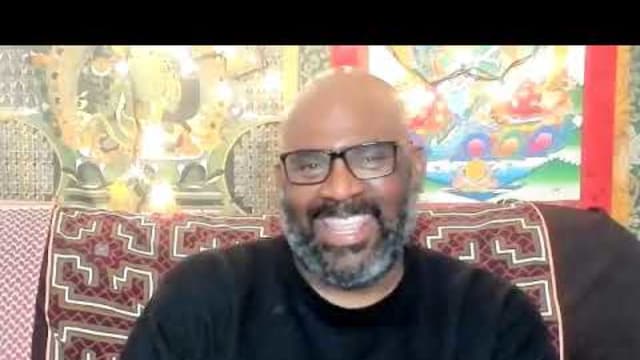
Ask a student of Advaita Vedanta how the universe relates to ultimate reality and you will often hear one claim: Brahman is everywhere, and whatever we experience is that reality. Ask why the tradition then spends so much energy repeating "neti, neti," meaning "not this, not this," and the puzzle lands hard. If everything is God, why negate anything at all? In an Ask Swami session held on 19 October 2025 at the Vedanta Society of New York, Swami Sarvapriyananda took up exactly that objection, which came from a questioner named Shandan Reddy. He answered it with a rope, a snake, a passage from the Mandukya Upanishad, and a covered dish. The answer is not a logic trick. It is a claim about how we actually see, and about why the way out of the world runs through the word "no."
Before answering, the speaker remarked on the room itself. He had been part of the series from the beginning, he said, and had watched the questions change: "Have you noticed how difficult the questions have been? ... The questions have become more and more difficult over the years. More technical, more precise." That matters for the reader. The neti-neti question is not a beginner's puzzle. It appears only once a student has already absorbed the basic vocabulary of Brahman, Atman, and the witness consciousness, and then sees a contradiction in it.
The contradiction, as Reddy framed it, runs like this. Brahman is limitless existence, consciousness, and bliss, present everywhere at all times. If so, then the present moment, with its perceptions and objects, should already be that reality. Yet the method of neti-neti appears to strip away the body, the breath, the mind, and the intellect, one by one, until only a pure witness remains. Why discard the very field where the truth is supposed to shine?
The speaker's first move is to separate the metaphysical claim from the lived experience. "Yes, in spirit you are right," he said, "but in practice it doesn't work like that." The problem is not what is true but what we perceive. "We see people, we see places and objects and activities, this world, we don't see God. So just seeing will not work."
He then names the obstacle. Ignorance is the usual word, and he admits that simple not-knowing would be a manageable problem. The real difficulty is that we know wrongly. He puts it bluntly: "I wish I were God, but I'm not. I must be honest. That would be the biggest dishonesty to say I am God." Most of us do not mistake our everyday self for the absolute. We are quite clear that we are a person in a world, and that the world is what it looks like: "how wonderful, beautiful or maddening or awful. It's just samsara."
He also points out why dualism often feels easier to people. A God who is "in heaven" can be believed in without any change in perception. Saying that this ordinary, sometimes maddening world is God is far harder, because it "seems utterly non-God." Advaita asks for something stranger: not belief in a distant reality, but a shift in what we take ourselves and our surroundings to be.
The term he uses for the method is de-hypnotization. The basic teaching, as he restates it, is that Brahman alone exists. The trouble is that "we have hypnotized ourselves into seeing it as the world and as ourselves." The mind has settled into two familiar categories, the individual self, the jiva, and the world, the jagat, and it treats them as final. The work is to loosen that spell.
This is why negation is not a rejection of reality. It is a rejection of a false reading of reality. Neti, in this framing, is the first move of the cure, not the last. It targets the assumption that what appears to be the self, or the world, is the whole truth about either one.
The central image of the talk is simple. A person walks at dusk and sees a rope on the path, but mistakes it for a snake. The rope is not appreciated as a rope. Now suppose a friend says, just see the rope directly. That advice does nothing, because the man is already certain he is looking at a snake. As the speaker explains, "you have to say, what you think is the snake is not a snake. Look closely. It's a rope."
The analogy is precise about why negation is necessary. Without first denying the snake, the man keeps searching for a rope somewhere else, "not there," and his attention never returns to the object actually in front of him. The denial is what breaks the fixation and allows the true object to be seen as it is. "To see that so-called snake as a rope, you have to deny, negate the snake. You must dispel the illusion. You must correct the error. Then only."
Notice what the analogy does not say. It does not say the rope is absent, or that the snake was a separate thing that must be removed from the world. The rope was there the whole time. The snake was a misreading of the rope, and the negation corrects the reading.
The speaker's second example comes from the Mandukya Upanishad, which describes three states of consciousness: waking, dreaming, and deep sleep. A fourth is then named as the ultimate reality, usually called Brahman or Atman. Here he says the listener's eagerness shows. Everyone understands the first three, and the question "where is the fourth? What is it?" follows naturally.
The Upanishad's answer, in its seventh mantra, is strange. It says the fourth is not deep sleep, not dreaming, not waking. It is not seeing, hearing, smelling, tasting, or touching. It is not inference, not expressible in speech, not thinkable by the mind. Each denial is repeated, and the refrain is "neti, neti."
"Now in the commentary somebody asks, hey wait a minute. In the earlier mantras of the Mandukya Upanishad, when you introduced us to the waking state, you just pointed out, this is the waking state... When you neither seeing the world nor watching dreams, you just shut down to blankness, that's called the deep sleep state. So, in each of those... you directly told us what it is. But now when it comes to the so-called fourth, pure consciousness, tell us directly. But what are you doing? You are negating those."
Swami Sarvapriyananda, Ask Swami session, 19 October 2025 (around 7:18)
The objection is the same one that prompted Reddy's question, and the speaker notes that Shankaracharya raised it in his own commentary. Shankaracharya's reply, as Swami Sarvapriyananda quotes it, is a short phrase: "there is no other door." Negation is the door. The fourth is not a separate thing sitting beyond waking, dreaming, and deep sleep. It is "that which underlies the waking, dreaming, deep sleep, that which illumines" them, the essence and core of all three. It is not one more item in the list. It is what the list is made of.
This is the most striking move in the talk. Reddy had asked whether we should recognize the Self "not just by negating, but also by seeing through and within this moment." The speaker, who says he was listening carefully, points out that the phrasing already contains the method. "If you are going to see through, you are denying. You are negating. You didn't say, let me just see everything as we are seeing."
The point is that seeing through the appearance of a thing already means looking past its surface claim to be what it seems. A window is seen through only by not treating the glass as the view. Even the question's own language, on his reading, smuggles in the negation that the question was trying to avoid.
The final image is of a covered dish. The food on the table is already there. Nothing needs to be added to it. It needs only to be uncovered. The speaker ties this to Shankaracharya's word for the process, which he renders as uncovering, and to the teaching that the reality is "already there." In his account, enlightenment is less a matter of acquiring something new than of removing the cover that hides what is present.
The speaker's closing point brings the three threads together. The objects of ordinary life, the senses, the body, and the world are the cover. Negation is the act of lifting that cover. And what is found underneath is not a foreign object but the same being that appears as all of this. The awareness that does the negating is the very thing it discovers. That is why, in his summary, the reality can be called "the bare awareness, to the bare being itself."
The talk is short, roughly sixteen minutes, but it rewards slow listening. A few steps follow naturally from it:
- Watch the full Ask Swami session from 19 October 2025 on the Vedanta Society of New York's channel, and notice how the questions in the series have grown in difficulty.
- Read the seventh mantra of the Mandukya Upanishad alongside Shankaracharya's commentary, and see how the list of negations is built.
- Test the rope analogy in daily life. Notice a moment when you are certain of what something is, and ask whether that certainty is the object or a reading of it.
- Reflect on the phrase "seeing through." When you try to see the present clearly, notice what you are setting aside to do it.
The neti-neti method asks a student to say no before saying yes, and the speaker's answer is that the no is not a rejection of the world. It is the first correction to a reading the mind has been holding too long. Once the cover is lifted, what remains is not absence but the presence the question was looking for in the first place.