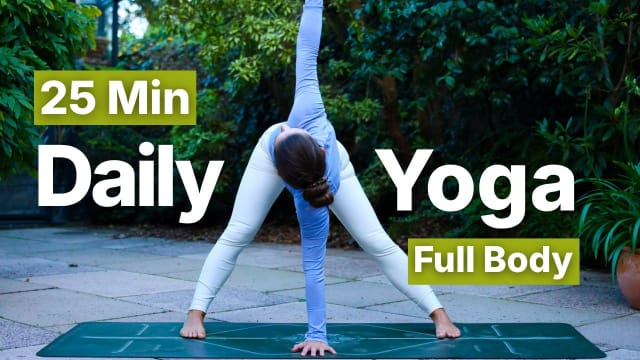
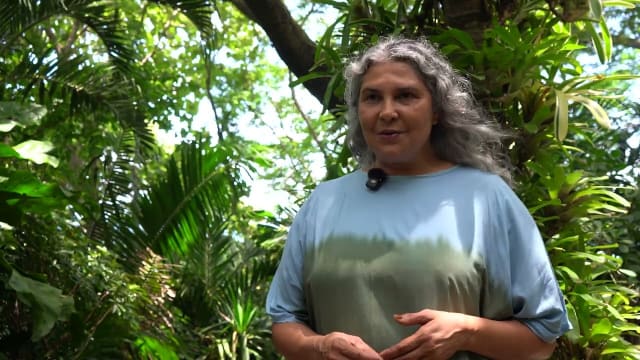
A 25-minute morning mobility flow, taught on camera by Charlie Follows, a registered yoga teacher with more than 500 hours of vinyasa training and a background in functional anatomy, begins seated with eyes closed and five slow breaths, then works the body from the spine outward. The sequence moves through seated twists, knee and hip rotation, lateral side bends, a tabletop wrist warm-up, floor-based spinal extension, downward dog, lunges and half splits, and finishes in child's pose with a slow neck circle. What makes it useful is less the individual poses than the order: each shape prepares the next, and the breath sets the tempo throughout. Read on for how the flow is built, which cues carry the most weight, and how to get the full value of a short practice first thing in the morning.
The title says "mobility," and that word is doing real work. A mobility practice is less about pushing a muscle to its end range and more about moving each joint through its available range with control, so the body feels ready to walk, bend and reach for the rest of the day. Follows frames the session this way from the first seconds: "This is a full body practice suitable for all levels where we are going to mobilize your body ready for the day ahead" (0:00).
Notice how much of the opening is about breath rather than shape. Before any movement, she asks for a few deep inhales and exhales, shoulders relaxed, jaw soft. That emphasis never really goes away. Later, during the cat-cow sequence near the 7:40 mark, she puts it plainly: "Moving at the pace of your breath. So your breath guides the movement." For a morning routine, that is a useful default. If the breath is rushed, the joints are being hurried too.
Starting seated keeps the spine long and the nervous system calm while the body is still waking. The first sequence is a rotation: inhale to lengthen up, exhale to turn, with one hand on the opposite knee and the other hand behind for support. The key alignment cue is that the head stays in line with the base of the spine, so the rotation comes from the whole torso rather than from the neck.
The most instructive detail is the shoulder cue. At about 1:47 she asks you to roll the rear shoulder back on the exhale "to help you twist a little bit further." That is a small lever with a large effect. Rotation in the thoracic spine, the mid-back, is often limited, and using the shoulder as a point of leverage lets the practitioner reach more of that range without forcing the lower back to do the work.
The flow then shifts from rotation to a flexion-and-extension sequence. Hands on the knees, she circles the belly clockwise and then counterclockwise, rolling the shoulders back as the chest lifts and rounding the back as it drops. The logic is simple: the spine has to move in both directions, and a morning practice that only twists would leave one half of the range untouched.
Seated work continues with the knees. Feet wider than hip-width, she starts knocking the knees side to side and then loads the rotation into a twist. At about 3:26 she offers the line that defines the whole practice: "There's no right or wrong way to do this. You're just looking to internally and externally rotate the thighs."
That permission matters. Many people approach hip mobility as a test they can fail. Follows treats it as information gathering. When she holds a knee-over twist, she describes what the body may report: "You may start to feel a pull down the inside of the thigh, maybe even in the front of the hip" (4:11). The instruction is to notice that pull and stay with it, not to chase a depth you do not have yet.
Then comes the diamond. Feet together, knees open, hands on the outsides of the feet, she lifts the knees up and down. Her pacing advice is worth taking literally: "You can start slow and then build this up as we start to build some heat in the body" (5:13). Warmth is the goal of this part, and it is built from the bottom up, not forced from the start.
At about 5:52 the flow turns sideways. From a wide-legged base with one leg extended and the other bent, she reaches the top arm overhead, lengthens through the fingertips, and then bends toward the floor on the side of the bent leg. The head hangs heavy so the neck can relax.
The useful cue here is about grounding. If you tip over, she asks you to "ground down through the right side of the buttocks so that you can feel that pull from the outside of your hip all the way to the right fingertips." In other words, the side stretch is not just the waist. It is a line running from hip to fingertip, and the hip is the anchor that keeps the line honest. The mirror side follows at about 6:45, and she invites you to close your eyes if the early hours need that time with yourself.
Around 7:21 the practice drops into tabletop, hands under the shoulders and knees under the hips. The first movement is a wrist warm-up: a figure-eight drawn through the body, sending weight into each hand and knee in turn. For a practice that asks for weight-bearing on the hands within minutes, this is not a formality. Wrists take load in every downward dog and plank, and warming them is the cheapest insurance the flow offers.
Cat-cow follows, then a puppy pose at about 9:01 that opens the chest and shoulders with the hips back over the knees. The floor sequence continues with two movements that target different parts of the back. At about 9:49 she introduces windscreen wipers, knees bent and falling side to side. Her note: "Doesn't have to be a big movement. A little goes a long way to help release the lower back." Then comes sphinx, where the work is deliberately aimed higher. She wants the bend to travel "through to the mid back, not just the lower back," which is a useful reminder that a lot of morning stiffness sits between the shoulder blades.
Downward dog arrives at about 10:53, and it is where Follows makes her most important point about how to listen. Heels raised, knees bent, she asks you to paddle the legs and sway the hips, exploring the backs of the legs without judgment. Then comes the line worth quoting in full: "And if something feels tight, it's not bad. Just focusing now on where needs a little more attention." At 11:11 she adds the phrase that reframes the entire practice: "It's just information."
That distinction between sensation and danger is central to any mobility practice. Tightness tells you where the tissue is currently limited. It is not an instruction to stop, and it is not a verdict on your flexibility. Treating it as information lets you move through the session without anxiety, which is exactly the state a morning practice should produce.
The standing section starts around 12:04 with a lunge-style step, the front foot planted and the back foot pressing for stability. She gives an easy modification: "If you need a little bit of support, lower the knee down." The shape opens the front hip and lengthens the back of the rear leg, and it is one of the places where a beginner can set up a stable base without losing the stretch.
Later, around 15:32, the flow moves into a half split. The safety note she gives is about choosing your bend rather than forcing the straight leg, and it is worth reading closely in the video because the wording is specific to the bent front knee and where the hips sit over it. Her broader message through this section is consistent: find the version of the shape that lets you breathe and keep the hips level.
Around 17:01 she offers a choice to revisit cobra or take up dog, which is a good example of the flow's adaptability. Instead of demanding one exact sequence, it asks you to pick the version that fits your body that morning.
After a hinge forward and a series of transitions, the sequence comes to a deep squat, then to child's pose at about 22:05, the classic resting shape that lets the body settle. Near the close, eyes still closed, she guides a slow head circle, moving anticlockwise at around 24:12, before a brief thank-you that ends the video at roughly 25:12.
The ending is short on purpose. After 25 minutes of rotation, lateral bending, floor work and standing folds, the closing moments are where the body is asked to register what changed. Even if you skip everything else, that pause is the part to keep.
Follows describes the practice as suitable for all levels, and the modifications she offers throughout make that plausible. Forearms replace hands for deeper folds, knees come down for lunges, and taller practitioners are told to adjust foot placement so they have room. She also reminds you to keep your arms bent during puppy pose if the stretch feels too intense. The principle underneath all of these is the same: the shape is a starting point, and your body decides how far to go.
The channel's disclaimer is clear and worth taking seriously. Consult a physician about whether any recommendation suits you, follow all safety instructions for your own wellbeing, and stop if something feels wrong. A video cannot assess your joints, injuries or medical history.
The fastest way to learn this flow is to practice it three or four mornings in a row. Notice where the same tight spots show up, and pay attention to which cues you lean on most: the shoulder roll in the twist, the grounding in the side bend, or the reminder that tightness is information. If you want more structured guidance, the channel description links to Follows's programs page, where her longer sequences are gathered. Start with the breath, let it set the pace, and let the body tell you what it needs.