
What is "Long Time Sun" in the context of yoga and kirtan?
"Long Time Sun" is a blessing commonly chanted in kundalini yoga communities and kirtan circles. The lyrics invoke a wish that light ("the long time sun") shine upon the listener, that love surround them, and that the "pure life within" guides them home. The song carries the quality of both a farewell blessing and an ongoing invocation—it is traditionally sung at the end of yoga or meditation classes and at departures, serving as a spiritual send-off that affirms the presence of divine light and protection in the listener's path forward.
In the context of this Zurich performance, the blessing takes on a more expanded, concert-oriented treatment. Rather than the brief closing chant typical of a yoga class, the song is developed across multiple verses and instrumental interludes, allowing each musician to contribute texture while the core blessing remains the focal point.
How do the instruments shape the devotional experience?
The arrangement features four primary instrumental voices: harmonium (Snatam Kaur's foundational keyboard), guitar (Bruno Justi), clarinet (Ram Dass Khalsa), and tabla (Sukhmani Rayat). Each instrument holds distinct roles in the overall soundscape.
The harmonium provides the harmonic and melodic foundation, rooting the performance in the classical Indian music tradition from which kirtan emerges. The guitar adds warmth and accessibility, bridging traditional Indian classical forms with Western musical sensibilities. This is a common choice in contemporary kirtan to make the music resonant with audiences who may not be familiar with purely Indian instrumental configurations. The clarinet introduces a lyrical, almost conversational voice—it weaves between vocal lines and echoes melodic phrases, creating moments of intimate dialogue. The tabla maintains rhythmic continuity and provides the embodied pulse that anchors the listener in present-moment awareness.
Together, these instruments create what might be called a "held space"—the listener is supported by multiple layers of sound, none dominating, but all working in coordination. This mirrors the principle in kirtan that the blessing or mantra is not delivered by a single voice but rather emerges from collective intention and resonance.
How are the lyrics structured across the performance?
The core blessing is repeated in variations throughout the five-minute performance:
May the long time sun shine upon you. All love surrounding you and the pure life within you. Guide your way home.
Rather than repeating the exact text each time, Snatam Kaur and her band vary the emphasis and phrasing. Early in the performance, the lyrics emerge clearly from the opening instrumental passage. As the piece develops, the singers hold individual words or syllables longer, allowing space for the music and the listener's own inner reflection. In some iterations, "Guide your way" is repeated as its own invocation, separating it from "home" to emphasize the active guidance rather than the destination.
This technique of mantra development—introducing the core phrase, then allowing it to be broken down, extended, and reassembled—is central to kirtan practice. It gives the listener multiple pathways into the blessing. Those encountering the song for the first time can grasp the full intention early on. Those familiar with the form can go deeper into the texture and feeling as variations emerge.
What role do three-part harmonies play?
The three-part vocal harmonies among Snatam Kaur, Bruno Justi, and Ram Dass Khalsa create a sense of togetherness and multiplicity within unity. As one voice carries the main melodic line, the others hold supporting harmonic notes or create countermelodies. This arrangement reflects a core principle of kirtan: that the blessing is not the property of any single singer but belongs to the collective consciousness of all who participate.
Harmonically, the voices often emphasize the major intervals and consonant relationships that create a sense of uplift and light—mirroring the textual invocation of "light" ("the long time sun") through the actual experience of harmonious sound. When all three voices align on a given moment, there is an audible sense of resonance and agreement, as if multiple expressions of the same intention are converging.
How does the live audience context affect the performance?
The description notes this was a "sold out audience" at the Betriebsgesellschaft Kongresshaus in Zurich. Live kirtan performances differ significantly from studio recordings in that the singers and musicians are responding in real time to the energy and receptivity of the gathered community. A sold-out venue suggests participants came with intentionality—not passively consuming music, but entering a shared devotional space.
Though the performance is presented as a professional recording with audio mixing by Ram Dass Khalsa and video production by Giovanni Baroni, the live context means each person in the audience brings their own relationship to the blessing. Some may be yoga practitioners familiar with the closing-class context. Others may be encountering kirtan for the first time. The musicians' task is to hold the space in such a way that the blessing can land for all participants, regardless of background.
What is the spiritual intention behind blessing language?
At its core, "Long Time Sun" functions as a wish-fulfillment prayer rather than a petition to an external deity. In kundalini yoga and contemporary kirtan contexts, the blessing is understood as an invocation of qualities that already exist within the listener. The sun does not shine at you from outside—it illuminates what is already present. The love that surrounds you and the pure life within you are not being granted by an external authority but awakened and acknowledged.
This understanding shifts the psychological and spiritual function of the blessing. Rather than dependency or supplication, there is recognition: "May you remember that light, love, and pure life are already your nature. May you be guided by these qualities as you move forward."
The phrase "guide your way home" carries particular resonance. "Home" is not a destination to reach after many years of travel; it is an orientation toward one's true nature, one's source. The blessing invokes a return not to a place but to a state of being.
How does the musical arrangement support meditative awareness?
The performance demonstrates several techniques that deepen meditative listening:
- Repetition with variation: The core blessing returns again and again, but the arrangement shifts each time. This creates a rhythmic stability for the mind while preventing monotony or mechanical recitation.
- Call and response: The instrumental interludes and vocal passages create a conversational structure, mirroring the call-and-response forms found in many devotional traditions. The listener's attention is gently guided through the passage rather than left to wander.
- Extended tones and breath: Individual syllables are often held longer than ordinary speech would dictate, inviting the listener to slow their own inner rhythm and synchronize with the singers' breath.
- Harmonic resolution: The arrangement tends toward resolution on consonant, affirming harmonies rather than dissonance, creating a sense of safety and trust in the listening experience.
Where to go from here?
For those drawn to this performance, several pathways deepen the practice:
Learn the blessing in your own voice: "Long Time Sun" is widely available in multiple recordings and settings. Learning to sing or chant it yourself, even briefly, amplifies its personal resonance. Many yoga classes still close with this blessing, and community kirtan circles regularly include it.
Explore related devotional music: Snatam Kaur's broader discography includes many other mantras and blessings set to music. Kirtan artists working in similar modes (such as Jai Uttal, Krishna Das, and others) offer comparable explorations of devotional sound.
Practice kirtan yourself: If you live near a yoga studio, ashram, or intentional community, many offer regular kirtan sessions. These are typically free or low-cost, and participants sing together in call-and-response format. The collective energy of a live kirtan circle is distinct from listening to a recording.
Investigate kundalini yoga: "Long Time Sun" originates in kundalini yoga tradition. Many yoga studios and online platforms offer kundalini classes, which often include chanting and mantra work alongside physical postures and meditation.
Reflect on blessing language: What does it mean to invoke light, love, and guidance in your own life? The blessing can be personalized and used in your own spiritual practice—at the beginning or end of meditation, as part of a gratitude practice, or as a centering moment during the day.
See Snatam live — By Thy Grace: 25 Years of Mantra
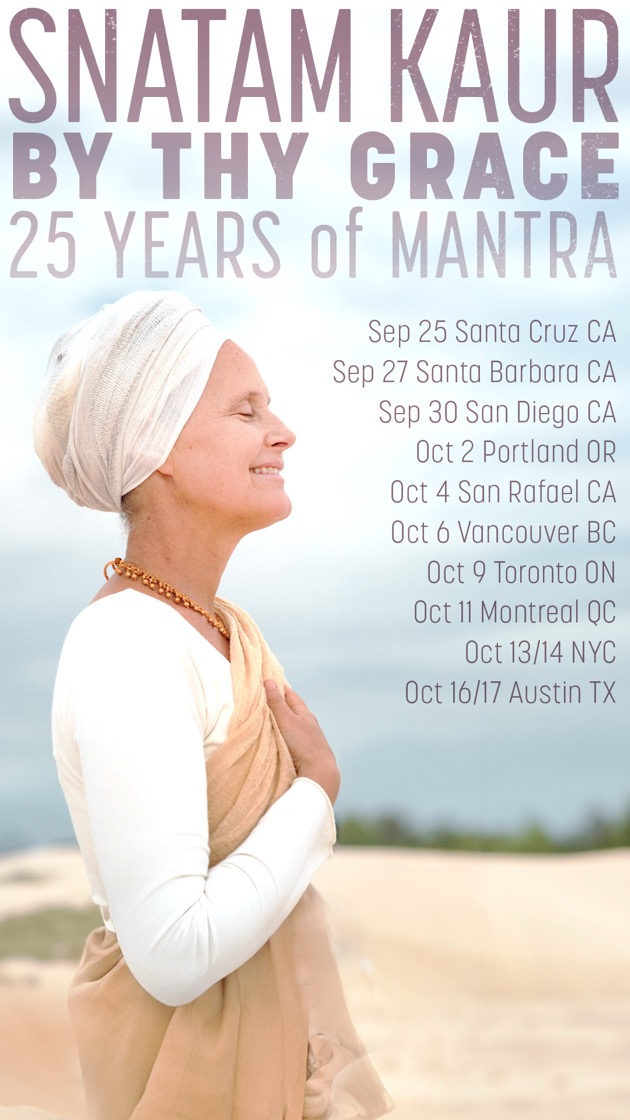
For 25 years, Snatam Kaur’s voice has been a doorway — to stillness, to devotion, to each other. This fall she celebrates with By Thy Grace: 25 Years of Mantra — ten cities across the US and Canada.
The tour begins in just a few weeks, and almost every venue is near capacity. If you’ve been waiting, this is the moment.
- Sep 25 · Santa Cruz CA
- Sep 27 · Santa Barbara CA
- Sep 30 · San Diego CA
- Oct 2 · Portland OR
- Oct 4 · San Rafael CA
- Oct 6 · Vancouver BC
- Oct 9 · Toronto ON
- Oct 11 · Montreal QC
- Oct 13 · New York NY
- Oct 14 · New York NY
- Oct 16 · Austin TX
- Oct 17 · Austin TX
Come chant with us. Some rooms only fill once.
]]>


