BrightStar

Alle Events durchsuchen

Bewusste Zusammenkünfte entdecken

events

Yoga
Meditation
Breathwork
Qigong
Tai Chi
Sacred Music
World Music
Medicine Music
Sound Healing
Ecstatic Dance
Beliebte Reiseziele
BaliSedonaLos AngelesCosta RicaNew YorkSan FranciscoAustinMiamiJoshua TreeTulum
Alle Kategorien anzeigenAlle Reiseziele anzeigen

Alle Funktionen entdecken

Leistungsstarke Tools für Ihre Veranstaltungen

Plattform-Funktionen

Intelligente dynamische Preisgestaltung
Ticket-Kategorien
Sitzplatzreservierung
Warenkorbabbruch-Wiederherstellung
Besucher-Wiedergewinnung
Spenden & Staffelpreise
Affiliate-System
Ticket-Scanner
Rabattcodes
Individuelle Fragen
Ticket-Teilen
Upsells & Extras
Analysen & Berichte
E-Mail-Sequenzen
Warteliste / Benachrichtigen / Erinnern
Menschen & Orte
Artists & TeachersEvent OrganizersVenues & StudiosKnowledge BaseGlossaryInspiration
Alle Funktionen anzeigenÜber uns
PreiseBlog
Language
Saved events
Alle Veranstaltungen durchsuchen

events

YogaMeditationBreathworkQigongTai ChiSacred MusicWorld MusicMedicine Music

Beliebte Reiseziele

BaliSedonaLos AngelesCosta RicaNew YorkSan Francisco

Menschen & Orte

Artists & TeachersEvent OrganizersVenues & StudiosKnowledge BaseGlossaryInspiration

Plattform-Funktionen

Intelligente dynamische PreisgestaltungTicket-KategorienSitzplatzreservierungWarenkorbabbruch-WiederherstellungBesucher-WiedergewinnungSpenden & StaffelpreiseAffiliate-SystemTicket-ScannerRabattcodesIndividuelle FragenTicket-TeilenUpsells & ExtrasAnalysen & BerichteE-Mail-SequenzenWarteliste / Benachrichtigen / Erinnern
Alle Funktionen anzeigenÜber uns
PreiseBlog
AnmeldenSuchendeKreative
  • Alle Events durchsuchen
  • Für Suchende
  • Yoga
  • Meditation
  • Breathwork
  • Qigong
  • Tai Chi
  • Heilige Musik
  • Weltmusik
  • Medicine Music
  • Klangheilung
  • Ecstatic Dance
  • Retreats
  • Workshops
  • Alle Kategorien →
  • Bali
  • Sedona
  • Los Angeles
  • Costa Rica
  • Tulum
  • Byron Bay
  • San Francisco
  • Austin
  • New York
  • San Diego
  • Denver
  • Seattle
  • Portland
  • Miami
  • Alle Städte →
  • Join the Movement
  • Why we list
  • Sell Globally
  • Für Kreative
  • Für Teams
  • Für Autoren
  • Für Lehrer
  • Für Kirtan-Künstler
  • Für Studios
  • Für Festivals
  • Für Retreat-Zentren
  • Für gemeinnützige Organisationen
  • Markenbotschafter
  • Kostenloses Ticketing
  • Elevate
  • Amplify
  • 500.000+ Käufernetzwerk
  • Warenkorbabbruch-Wiederherstellung
  • Intelligente dynamische Preisgestaltung
  • Ticket-Kategorien
  • Wiederkehrende Veranstaltungen
  • Sitzplatzreservierung
  • Affiliate-System
  • Warteliste / Benachrichtigen
  • Ticket-Scanner
  • Einbettungs-Widget
  • Event-Syndication
  • Nachrichten
  • Integrationen
  • Berichte
  • Alle Funktionen →
  • Über uns
  • Das Ökosystem
  • Blog
  • Glossar
  • Inspiration
  • Hilfe-Center
  • Kontakt
  • API-Dokumentation
  • Marken-Assets
  • Karriere
  • Presse
  • Nutzungsbedingungen
  • Datenschutzrichtlinie

Events

  • Alle Events durchsuchen
  • Für Suchende
  • Yoga
  • Meditation
  • Breathwork
  • Qigong
  • Tai Chi
  • Heilige Musik
  • Weltmusik
  • Medicine Music
  • Klangheilung
  • Ecstatic Dance
  • Retreats
  • Workshops
  • Alle Kategorien →

Reiseziele

  • Bali
  • Sedona
  • Los Angeles
  • Costa Rica
  • Tulum
  • Byron Bay
  • San Francisco
  • Austin
  • New York
  • San Diego
  • Denver
  • Seattle
  • Portland
  • Miami
  • Alle Städte →

Für Kreative

  • Join the Movement
  • Why we list
  • Sell Globally
  • Für Kreative
  • Für Teams
  • Für Autoren
  • Für Lehrer
  • Für Kirtan-Künstler
  • Für Studios
  • Für Festivals
  • Für Retreat-Zentren
  • Für gemeinnützige Organisationen
  • Markenbotschafter
  • Kostenloses Ticketing
  • Elevate
  • Amplify

Funktionen

  • 500.000+ Käufernetzwerk
  • Warenkorbabbruch-Wiederherstellung
  • Intelligente dynamische Preisgestaltung
  • Ticket-Kategorien
  • Wiederkehrende Veranstaltungen
  • Sitzplatzreservierung
  • Affiliate-System
  • Warteliste / Benachrichtigen
  • Ticket-Scanner
  • Einbettungs-Widget
  • Event-Syndication
  • Nachrichten
  • Integrationen
  • Berichte
  • Alle Funktionen →

Unternehmen

  • Über uns
  • Das Ökosystem
  • Blog
  • Glossar
  • Inspiration
  • Hilfe-Center
  • Kontakt
  • API-Dokumentation
  • Marken-Assets
  • Karriere
  • Presse
  • Nutzungsbedingungen
  • Datenschutzrichtlinie
BrightStar
Hol dir die App
Laden imApp StoreJetzt beiGoogle Play
© 2026 BrightStar. Alle Rechte vorbehalten.
Inspiration

Letting Go When the Mind Cannot Make Sense of Chaos

Self-Realization Fellowship
Oct 31, 2026
9 Min. Lesezeit

Von Self-Realization Fellowship

Ansehen · 7

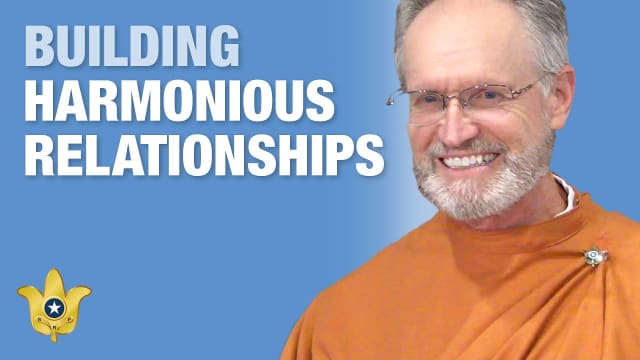
Something in the mind stalls when life stops making sense. A phone call lands badly, a plan falls apart, the news repeats itself in a loop, and the thinking starts: why did this happen, what does it mean, how do I fix it? In a ninety-second excerpt from a Self-Realization Fellowship video called "Learning to Let Go," the monk Brother Satyananda proposes a different move. Outer events, he says, are beyond our control. The inner experience of those events is not. The way out of the loop is not another explanation but a turn toward a feeling he calls santosh, inner contentment, which he describes as needing no explanation at all.

Because the clip is short, it is worth being clear about what it is and is not. It is an excerpt from a longer talk on the teachings of Paramahansa Yogananda, titled "Experience the Perpetual Contentment of Your Soul," which the video description points viewers to in SRF's Inspirational Services With Meditation playlist. What follows works from the excerpt alone. It does not attempt to reconstruct the full talk. What the ninety seconds do contain is a compact argument, and it is a more radical one than it first sounds.

Lesen · 6 Abschnitte

Can you really choose your experience when the outer world won't cooperate?

The opening claim is blunt: "It's impossible to control outer events of life, but we can control our experience from within." Brother Satyananda, speaking in the SRF video, sets the boundary before he offers any comfort. He does not say that a bad day can be wished away or that circumstances bend to a good attitude. He says the events remain what they are. What changes is the ground on which they land.

He then names the variables that are actually ours: "How we interpret, how we respond, how we experience fully the moments of our day." Those three verbs, interpret, respond, experience, are worth separating. Interpretation is the story we attach to what happened. Response is what we do next. Experience is the felt texture of the moment itself, which can be full or thin regardless of what the moment contained. A cold reception at a meeting is an event. Deciding it means I am failing is an interpretation. Shrinking into it for the rest of the afternoon is a response. Brother Satyananda's point is that the middle two steps are available to us even when the first is not.

He also insists the choice is active: "It really is our choice, isn't it? It's our choice." Then he adds a caution that gives the idea its spine. "We can hear all the truths in the world and we can ponder them, but unless we make a choice as to what we will do, how we will think, what thoughts we will entertain, what thoughts we will release." Knowing a truth is not the same as living inside it. The teaching lives in the moment of selection, in deciding which thought gets a seat and which one gets shown the door.

Why does the mind keep trying to explain chaos?

The most candid passage in the excerpt is also the most recognizable. "When my mind cannot make sense of the chaos around me, what's going on, we try to think it out, we try to explain it to ourselves." Brother Satyananda uses the word "we" deliberately. This is not framed as a personal failing. It is a reflex nearly everyone shares: when reality becomes disordered, the intellect reaches for a model that will make it coherent again.

He then names the hidden assumption behind that reflex: "We think that by understanding it in some limited way, we are going to resolve it. But it doesn't work, does it?" The phrase "in some limited way" carries the argument. A mind working from its own partial information can produce an explanation that feels satisfying and still leaves the underlying distress intact. The explanation may be accurate in part and useless as a cure. Often the effort to understand becomes its own source of agitation, because each new theory exposes another loose thread.

This is where the speaker's personal note matters. "And so, I have learned just let it go. Let it go." He does not present letting go as a technique he has mastered in theory. He presents it as something learned through the failure of the alternative. That is a modest claim, and it is more persuasive for being modest. Many spiritual teachings ask us to trust a method before we have tested it. Here the method is offered after the mind's own strategy has been seen to fall short.

What is santosh, and why does it need no explanation?

Brother Satyananda names the replacement for explanation. "Concentrate on the feeling of inner santosh, contentment." Santosh is a Sanskrit word for contentment, and the speaker uses it to point at something specific: not satisfaction with a result, not the pleasure of getting one's way, but a settled inner state that does not depend on the outcome. The clip makes the distinction implicitly. If contentment depended on the chaos resolving, it would be as fragile as the chaos itself.

He then describes what that feeling does. "And the feeling that comes then from the heart needs no explanation. Everything gets resolved in that feeling." This is the most striking claim in the excerpt. The mind wants to resolve a problem by understanding it. The speaker says the problem can be resolved by a feeling, one that arises from the heart rather than from analysis. Notice that he does not say the outer problem disappears. He says everything gets resolved in the feeling, which is a claim about where the resolution takes place: inside the person, in the quality of their presence, rather than in the external situation.

There is a practical wisdom in this. A person who has stopped demanding an explanation can still act. They can make the call, finish the project, have the difficult conversation, without needing the story to be complete first. The clip frames this as a kind of freedom: "This is very satisfying, to be able to solve the complicated problems of daily life without any mental explanation." The satisfaction he describes is not intellectual closure. It is the relief of no longer waiting for the mind to give permission.

Why does contentment grow the more you attend to it?

One sentence in the excerpt rewards slow reading. "And the more we concentrate on it, the more expansive it becomes." Brother Satyananda's verb is "concentrate," not "think about" or "believe in." Attention is the instrument. The feeling of santosh is not an idea to be checked for accuracy; it is a quality that increases under sustained attention, the way a note sustains and fills a room when a musician holds it steady.

That image is not in the excerpt, but it fits the logic of the passage. A reader can test it. Pause, notice the thought that says this should not be happening, and then turn attention toward the simple felt sense of being at ease in the body and the breath. Do not argue with the thought. Let it go, as the speaker says, and return to the feeling. Repeat. The teaching is that the feeling grows with each return, and that its growth gradually makes the chaos feel less like a verdict on your worth or your future.

The last line of the excerpt names the larger frame: "This is the power of yoga." Yoga here is not reduced to posture. It is the discipline of directing attention so that the inner life is not held hostage by outer conditions. The clip's claim is that this power is available in ordinary, unglamorous moments, not only on the meditation cushion.

What is the actual practice the speaker is describing?

Read closely, the excerpt offers a three-part sequence. First, notice the moment the mind begins trying to make sense of something that refuses to make sense. Second, recognize that the explanation will not deliver the peace you want, and let it go. Third, concentrate on the felt sense of inner contentment and let that feeling carry the situation.

Nothing in the clip claims this sequence removes difficulty. The complicated problems of daily life are still there when the speaker says he can solve them "without any mental explanation." The difference is in the posture from which you meet them. Problems that are met from a settled place tend to be handled with less thrash, and the energy that once went into rehearsing explanations becomes available for action.

It is also worth noticing what the teaching does not ask. It does not ask you to pretend that chaos is not happening, or to suppress the urge to understand altogether. The speaker's own words, "we try to think it out," acknowledge the impulse as natural. The invitation is to hold that impulse more lightly, to notice when it has stopped helping, and to offer it a different place to rest.

Where to go from here

If this ninety-second excerpt landed, the most useful next step is the longer talk it comes from. "Experience the Perpetual Contentment of Your Soul" is available through the Inspirational Services With Meditation playlist on the Self-Realization Fellowship channel, and it will give the teaching the context and development this clip can only hint at. Watch it with a single question in mind: when does my mind start explaining, and what would it feel like to let that explanation go and attend to contentment instead?

For a practical starting point, try the sequence in the speaker's own order the next time something refuses to make sense. Name the outer event as beyond your control. Notice the interpretation you are attaching to it. Choose, deliberately, which thoughts you will entertain and which you will release. Then, instead of waiting for the explanation, turn your attention to the feeling of santosh and see whether, as Brother Satyananda says, it becomes more expansive the longer you stay with it.

The excerpt is brief, but its core is clear. We cannot run the world. We can decide what kind of inner ground we stand on while it runs.
Comments

Loading the conversation…

Transcript

[0:00] It's impossible to control outer events

[0:02] of life, but we can control our

[0:05] experience from within. This is carpe

[0:08] diem.

[0:09] This is where we seize the day.

[0:13] How we interpret, how we respond, how we

[0:16] experience fully

[0:17] the moments of our day. And it really is

[0:20] our choice, isn't it?

[0:22] It's our choice. We can hear all the

[0:24] truths in the world and we can ponder

[0:26] them, but unless we make a choice as to

[0:29] what we will do,

[0:31] how we will think,

[0:33] what thoughts we will entertain, what

[0:35] thoughts we will

[0:37] release.

[0:39] This is where we can control our

[0:40] experience of life.

[0:42] So, when my mind cannot make sense

[0:45] of the chaos around me, what's going on,

[0:47] we try to think it out, we try to

[0:49] explain it to ourselves. We think that

[0:51] by understanding it in some limited way,

[0:53] we are going to resolve it.

[0:55] But it doesn't work, does it?

[0:57] And so, I have learned just let it go.

[1:01] Let it go.

[1:03] Concentrate on the feeling of [music]

[1:05] inner santosh, contentment. And the

[1:08] feeling that comes then from the heart

[1:10] needs no explanation.

[1:12] Everything gets resolved in that

[1:14] feeling.

[1:15] >> [music]

[1:15] >> And the more we concentrate on it, the

[1:17] more expansive it becomes.

[1:20] This is very satisfying, to be able to

[1:22] solve the complicated problems of daily

[1:25] life without any mental explanation.

[1:29] This is the power of yoga.

Self-Realization Fellowship
ArtistSelf-Realization Fellowship

A Self-Realization Fellowship meditation group on Calle 56 in Medellín's Barrio Boston. It gathers around the Kriya Yoga teachings of Paramahansa Yogananda, with scheduled meditati…

Profil ansehenWebsite
Themen erkunden
Letting-goSantoshInner-contentmentYoganandaSelf-realization-fellowship

Hast du Fragen?

Häufig gestellte Fragen

In the excerpt, letting go means releasing the mind's habit of trying to explain or think out chaotic circumstances. He says the explanations we construct, based on our own limited understanding, do not resolve the problem, so he has learned to simply let them go. He then redirects attention to the feeling of inner contentment.
Santosh is a Sanskrit word for contentment. Brother Satyananda uses it in the clip as 'inner santosh, contentment,' pointing to a settled inner state rather than satisfaction with a particular outcome. He says the feeling that arises from it needs no explanation.
According to Brother Satyananda, you cannot control outer events of life, but you can control your experience from within. He identifies three areas you can influence: how you interpret events, how you respond to them, and how fully you experience the moments of your day. He stresses that this is a choice you have to actively make.
Brother Satyananda observes that when we try to explain chaos to ourselves, we think understanding it in some limited way will resolve it, but it often doesn't work. Explanations built from partial information can feel satisfying without relieving the distress underneath. He suggests shifting from explanation to the felt sense of contentment.
The speaker's instruction is to concentrate on the feeling of inner contentment rather than on the mental explanation. He says the more you concentrate on it, the more expansive it becomes. In practice, that means noticing when the mind starts analyzing, letting that analysis go, and returning attention to the felt sense of ease.
The video description identifies this as a full talk on the teachings of Paramahansa Yogananda, available in SRF's Inspirational Services With Meditation playlist. The excerpt 'Learning to Let Go' is drawn from that longer talk. The ninety-second clip itself focuses on choosing inner experience and resting in santosh.
Carpe diem is Latin for 'seize the day.' Brother Satyananda uses the phrase to describe choosing how we interpret, respond to, and fully experience the moments of our day, even when we cannot control what happens to us.

Weiterlesen

More from Self-Realization Fellowship

Alle anzeigen
Reading Character Without Judging: Yogananda's Mirror Teaching
Inspire

Reading Character Without Judging: Yogananda's Mirror Teaching

A Sunday talk from Self-Realization Fellowship's Phoenix temple turns Yogananda's teaching on character study into a practical lesson in see…

9 min read
Universal Path to God: Direct Experience Beyond Belief
Inspire

Universal Path to God: Direct Experience Beyond Belief

A Self-Realization Fellowship monk explains how yoga meditation and devotion lead to direct experience of God's presence within—the experien…

8 min read
Mantra Medicine for Letting Go: Listening to "I Release"
Inspire

Mantra Medicine for Letting Go: Listening to "I Release"

A close listen to Beautiful Chorus's "Mantra Medicine: Release," a seven-minute sung affirmation built on "I release" and what repeating a s…

4 min read
Gaea's Ebb: Harp and Bansuri Riding "Cabbage" Changes
Inspire

Gaea's Ebb: Harp and Bansuri Riding "Cabbage" Changes

Harp, bansuri, voice and guitar reshape Elden Kelly's "Gaea's Ebb" over the changes of Gregg Hill's "Cabbage." A live KGNU duo preview of a …

7 min read

Weiter erkunden

Setze deinen Weg fort

Mehr Weisheit und Zusammenkünfte aus dem BrightStar-Verzeichnis.

Mehr Artikel

Durchstöbere die ganze Bibliothek an Lehren, Interviews und Leitfäden.

Zu allen Artikeln →

Lehrer & Künstler

Entdecke die Linien, Musiker und Wegbegleiter der bewussten Welt.

Künstler erkunden →

Event finden

Kirtan, Retreats, Klangbäder, Atemarbeit, Festivals — bald in deiner Nähe.

Events ansehen →