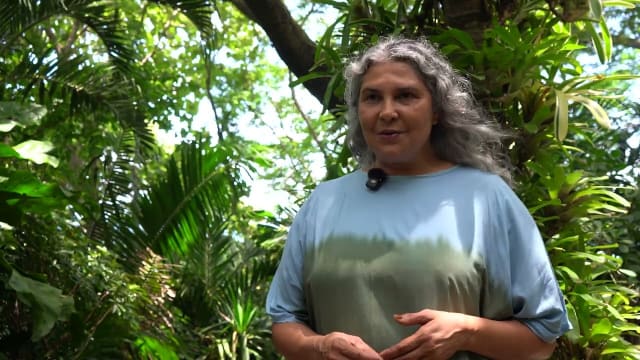
Most qigong sessions ask you to imagine energy moving. This one asks you to find a specific bone, the third cervical vertebra, and treat it as a lamp. In Robert Peng's forty-one-minute video "Jieqi 19 - LiDong," the practice moves in a deliberate arc: loosen the body, locate C3 by touch, gather qi from the surrounding space into that point with the hands and breath, let it glow outward through the spine, the skeleton, the organs and finally the whole body, then draw everything down into the lower dantian and soak it in. The instructions are conversational and sometimes garbled by auto-captions, but the structure is precise, and it is worth understanding on its own terms whether or not you ever sit through the full recording.
The session begins standing, feet parallel and as wide as the shoulders, knees slightly bent, the buttocks tucked a little under, and the spine left naturally curved. The jaw tucks slightly, the tongue rests on the palate, and the eyes close with the space between the eyebrows widened. Peng asks students to listen "to a sound that's coming from far far away" before any movement begins. That instruction matters: the practice starts with attention, not force.
Then comes a loosening sequence. Students bend the knees up and down, arms hanging "like ropes," with the neck, cheeks, forehead and eyeballs "dancing up and down your eye socket." The upper chest and back are released, and the internal organs are described as "dangling inside there, flexible." The hands shake, the arms reach toward the horizon, and the energy is sent out to meet what Peng calls "the universal energy." Smiling, frowning and looking up and down are part of it. The warm-up closes when the hands begin to tingle and the sensation is invited to spread through the body. In Peng's words: "That's the warm-up exercise. To warm up your chi."
The logic is familiar to anyone who has trained in movement disciplines: release first, then direct. A body that is braced cannot feel a subtle sensation, so the shaking and bouncing are there to make the tingling noticeable when it arrives.
Once the body is warm, the session moves to a chair or cushion and narrows its focus. Peng guides students to find C1 at the base of the skull, then "probe down" to C2, and then to feel for "another prominent" bone that is C3. The language is almost tactile, like a teacher showing you where to put a finger on a guitar neck before you learn the chord. He calls it "the intending spot," and the whole session returns to it.
This choice is the core of the practice. Many traditions describe energy centers in abstract terms that are hard to locate. Here the anchor is a specific, palpable landmark in the cervical spine. The idea is that attention has somewhere to sit, and the rest of the movement is organized around that place. Peng's framing is explicit: "So, your C3 is connected with this posture and movement. With the whole universe."
The central movement is a loop. The hands begin near the abdomen, extend out toward the horizon, then scoop the qi back toward the belly and raise it to the height of C3. The palms face the vertebra "like radiating the light." The head turns to look at the left elbow, which sits at roughly the same height. The palms then turn outward, toward "the universe," and return inward. Students repeat this for about five rounds, alternating sides, with the instruction to "keep going in your own pace."
What makes this more than arm exercise is the coordination. The eyes follow the elbows, the palms alternate between facing in and facing out, and the spine is the target of every turn. Peng asks students to "feel the feelings of your fingers that making the change of your elbows and shoulders," which pulls attention into small, mechanical details so the whole gesture stays grounded. Between rounds the hands rest on the lap, and Peng describes the result as the spine and "central meridian" opening, with universal qi flowing into the spine "especially your cervical three."
He also repeats the sequence with variations, including a version that begins and ends at the lower dantian, the energy field below the navel that appears throughout the session. The repetition is the teaching. Each pass refines the same gesture until the palms and the spine feel like one system.
Eyes close again and attention returns to C3. On the inhale, students are asked to "open all the pores of your skin" and breathe in universal qi, which gathers at the vertebra. On the exhale, C3 is described as "shining brightly." Peng offers an image to pace it: "You can follow the ocean waves. With the breathing. One wave, inhale. Another wave, exhale."
The breath becomes a tide. Inhale draws in and collects, exhale releases and illuminates. The practice then makes a notable shift. Peng tells students, "don't worry about collecting chi," and instead to use the qi already gathered at C3 "to service yourself." The emphasis changes from receiving to distributing. The gathering phase is complete, and what was collected begins to move.
This is the most distinctive stage of the session, and the one that most rewards careful attention. Students are instructed to exhale from C3 and "light up all your spine," then to make the light "as bright as you can think of." Next the whole skeleton is lit from the same point, then the internal organs. Peng gives a specific option at this stage: "If you have any organ that you feel like to do some healing, you can pay attention to that one more more." The final expansion is the whole body: "You're like a source of light glowing out beyond your body."
The sequence goes from axis to structure to interior to the surrounding field. It is a deliberate widening, with the spine as the first and most stable column. Notice that each stage keeps C3 as the reference point on the inhale. The practitioner never loses the origin of the light while the light spreads.
The session does not end in radiance. Peng brings everything back down: "collect all the energy in your lower dantian," concentrating it "like shining pearl in your lower torso." The movement is inward and settling, the opposite of the outward glow that came before.
Then he gives one of the most vivid images in the recording. "Imagine you are like a sponge soaking in a hot tub. Open every tiny pore of your cell and absorb all this universal warm chi into every tiny particle of your cell." The statement that anchors it is short and repeated: "I am in chi, chi is in me." Students are asked to say it, not simply think it. Verbal affirmation is a common way to give a meditation a fixed direction when the imagery is intangible.
The closing minutes move to small, practical body work. Peng asks students to rub their hands until they are warm, then to run a middle finger along the side of the nose and "rub it up," as if washing the face. He calls this an "ancient way of beautician." The transcript then turns to the mouth, with a line about swallowing "to irrigate the internal" that cuts off in the excerpt. He ends with a caution: "be careful, slowly stand up." That instruction is worth taking seriously, because a session this absorbing can leave you lightheaded when you rise.
The title, "Jieqi 19 - LiDong," suggests a numbered lesson in a larger series, but the transcript excerpt does not explain either term. Nothing in the material says how Jieqi is structured as a whole or what "LiDong" refers to in this context. Readers who want that background should watch the rest of the series or any introduction Peng gives in the video itself, since this article describes only what the practice itself contains. The video is recent, published November 7, 2026, and had 197 views at the time of this writing. The captions are auto-generated, so several phrases are rendered oddly. Where they affect meaning, the quotes above use the most plausible reading of what was said.
Start with the warm-up on its own. Five minutes of knee bends, loose arms and shaking hands is a complete entry point, and it shows whether the body is ready to be directed. Then practice finding C1, C2 and C3 by touch, slowly, until you can locate C3 without searching. Only after that try the palm-and-elbow gathering, keeping the breath in the ocean-wave rhythm. Watch the full Peng recording for the parts this article cannot reproduce: the pacing, the tone of his corrections and the moments where he adjusts the count. Treat the practice as a sequence to repeat, not a set of claims to accept. The most useful measure is what you notice in your own neck, spine and breath after each round.