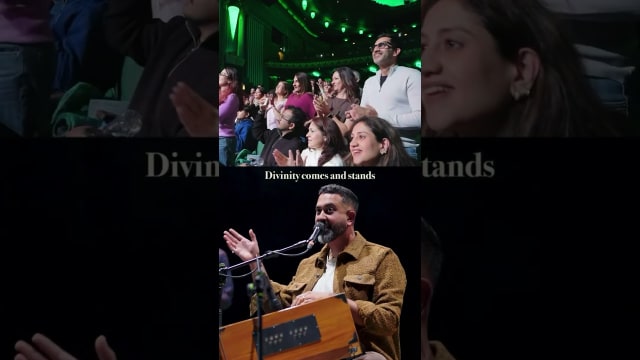
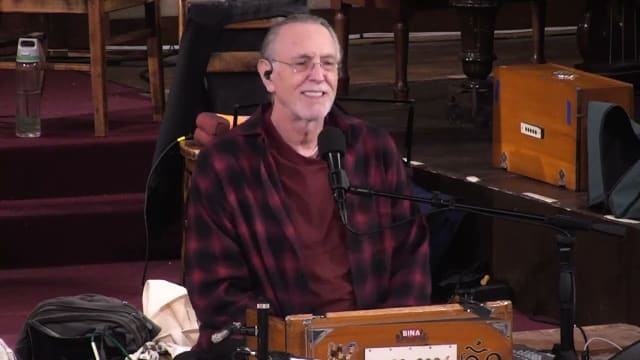
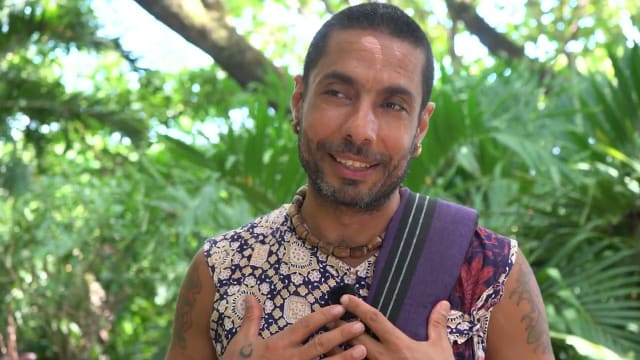
Radhika Das offers a direct and luminous kirtan: the repetition of "Jai Sita Ram"—hail to Sita and Ram—a foundational mantra in Hindu devotional life. The chant is simple, cyclical, and hypnotic, the kind of invocation that works not through intellectual understanding but through sonic immersion and the visceral rhythm of breath and voice.
"Jai" means "victory" or "hail"; Sita and Ram are the divine couple at the heart of the Ramayana, Hinduism's epic narrative of dharma, love, and righteous action. In kirtan—call-and-response devotional singing—the mantra becomes a vehicle for bhakti, the yoga of devotion. Repetition is not mindless; it is a recognized path to altered states of consciousness and direct relationship with the sacred.
The pairing of Sita and Ram carries particular weight. Sita, the embodiment of grace, loyalty, and spiritual wisdom, is inseparable from Ram's dharmic mission. Together they represent the union of masculine and feminine principle, matter and spirit, action and surrender. When a practitioner chants "Jai Sita Ram," they are not merely reciting names; they are invoking an archetype of divine love and righteous conduct that lives within the tradition and, by extension, within the chanter themselves.
Kirtan, as a practice form, has deep roots in bhakti movements that flourished across India from the medieval period onward—traditions that democratized access to the divine by placing song and repetition at the center of spiritual life. In this lineage, Radhika Das offers the mantra not as doctrine but as living transmission: an invitation to step into the sacred through sound, breath, and communal presence.
To deepen this practice, explore Radhika Das's fuller teachings on kirtan, bhakti, and the theological weight of the Ramayana's central figures. Consistent chanting—whether solo or in group—reveals layers of meaning that intellectual study alone cannot access. The mantra works through repetition and sincerity, opening the heart in ways both subtle and profound.