Transcript
[0:00] This is a message to meditators in
[0:03] Europe, UCL,
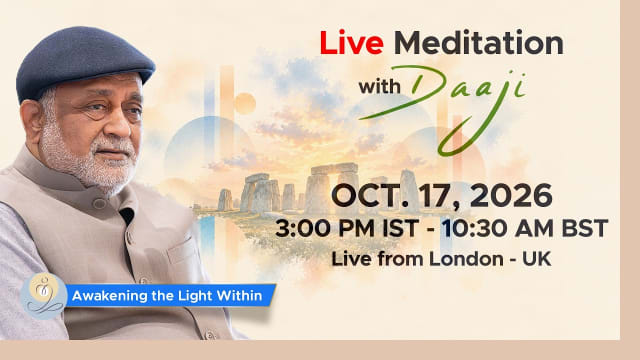
[0:05] London, 17th to the 18th of October.
[0:10] It's titled The Inner Thermostat.
[0:15] Dear friends,
[0:20] before a recent meditation at the Taj in
[0:23] London, I had come well prepared for the
[0:25] cold.
[0:27] Jackets, hat, socks, and a woolen scarf.
[0:34] But the hall was quite warm.
[0:37] First the scarf came off,
[0:39] then the jacket.
[0:42] I had
[0:43] prepared myself for the weather outside.
[0:46] The conditions inside were something
[0:48] else altogether.
[0:52] Someone quietly adjusted the thermostat,
[0:55] and soon the room became comfortable.
[0:58] Such a small adjustment, and everyone
[1:01] benefited.
[1:05] As we began meditation, this simple
[1:07] incident brought to mind a message of
[1:10] dear Babaji Maharaj.
[1:13] And the thought began to unfold.
[1:17] We take such care to regulate the
[1:20] atmosphere around us.
[1:22] What care do we take of the atmosphere
[1:25] within us?
[1:28] We know when a room is too hot,
[1:31] we open a window.
[1:33] When it is cold, we turn on the heating.
[1:38] But when irritation begins to warm the
[1:40] heart, or worry fills the mind, we often
[1:44] continue as though nothing needs
[1:46] attention.
[1:50] Then a small remark comes, and we react.
[1:55] Later we say, "I do not know why I
[1:57] became so upset.
[2:00] Perhaps the remark was small.
[2:03] The disturbance was already gathering
[2:05] within.
[2:09] Let us look at this together.
[2:12] A thermostat has a setting,
[2:14] a sensor, and a connection to the
[2:17] heating system.
[2:19] It knows the temperature we have chosen,
[2:22] notices the temperature of the room,
[2:25] and allows an adjustment.
[2:29] We can borrow this simple picture to
[2:31] understand something about ourselves.
[2:35] Of course, the heart is far more than a
[2:37] machine,
[2:38] but sometimes an ordinary object helps
[2:41] us notice what familiarity has hidden.
[2:47] What is our usual inner setting?
[2:52] When nothing particular is happening,
[2:54] where do we find ourselves?
[2:57] Are we at ease?
[2:59] Are we expecting trouble?
[3:02] Is there a quiet contentment or a
[3:04] feeling that something is always
[3:05] missing?
[3:08] And when something disturbs us, where do
[3:10] we return?
[3:14] These are useful questions. We can ask
[3:16] them with curiosity without judging
[3:19] ourselves.
[3:23] Much of our habitual condition has
[3:26] developed over time.
[3:28] Experiences have left impressions.
[3:33] Some reactions have been repeated so
[3:35] often that they now arrive before we
[3:38] have had a chance to choose them.
[3:41] We may have learned to defend ourselves
[3:43] quickly, to anticipate rejection, or to
[3:47] hold tightly to being right.
[3:52] In our tradition, we speak of
[3:53] impressions or samskaras,
[3:57] which condition our responses and
[3:59] influence the way we experience life.
[4:04] But please, do not turn this
[4:05] understanding into another reason to
[4:07] blame yourself.
[4:11] Some habits began as a way of coping
[4:13] with difficult circumstances.
[4:17] We can acknowledge that with kindness,
[4:20] while recognizing that once what once
[4:23] protected us may now limit us.
[4:28] Our past has influenced us.
[4:32] It need not decide every response we
[4:34] make today.
[4:39] This is where practice brings hope.
[4:43] Babaji directed our attention towards
[4:45] the heart as a as the field of the
[4:47] mind's activity.
[4:50] We may understand the difficulty
[4:52] intellectually,
[4:54] yet find that the same reaction returns.
[4:59] Understanding is valuable.
[5:02] Through practice, that understanding can
[5:04] become a change in our condition.
[5:10] We know [snorts] very well that we
[5:11] should be patient.
[5:13] The question is how patience becomes
[5:15] natural.
[5:18] We know that we should love.
[5:20] How does the heart become more loving?
[5:24] We begin by giving it our attention.
[5:29] During meditation, we gently turn
[5:31] towards the heart with the supposition
[5:35] of divine light already present there.
[5:39] We need not strain to see a light or
[5:41] manufacture an experience.
[5:44] We simply allow ourselves to become
[5:46] receptive.
[5:49] Thoughts may come.
[5:50] Let them come and go.
[5:54] Whenever we notice that we have followed
[5:55] them, we will return gently.
[6:00] Please notice the word gently.
[6:04] If every return becomes a struggle, we
[6:07] are practicing struggle.
[6:10] Let the return itself carry the quality
[6:13] we wish to bring into life.
[6:15] >> [snorts]
[6:19] >> With the support of yogic transmission,
[6:22] meditation offers us the opportunity to
[6:24] become familiar with a quieter, subtler
[6:27] condition.
[6:30] Gradually, we begin to recognize what it
[6:32] feels like to be inwardly settled.
[6:37] Then, during the day, we may notice a
[6:40] disturbance a little earlier.
[6:45] A reply is forming.
[6:48] The voice is becoming sharper.
[6:52] We are no longer listening. We are
[6:54] preparing our defense.
[6:57] At that moment, awareness gives us a
[7:00] possibility.
[7:03] We can pause.
[7:05] We can feel what is happening.
[7:08] We can ask,
[7:10] "What is needed here?"
[7:13] Perhaps a clear answer is needed.
[7:15] Perhaps an apology.
[7:18] Perhaps we simply need to hear the other
[7:20] person fully.
[7:25] Sometimes fear lies beneath anger.
[7:29] Sometimes hurt, fatigue, or an
[7:32] expectation we have not expressed.
[7:37] We discover these things by observing
[7:39] ourselves honestly and kindly.
[7:45] And if we notice only after we have
[7:47] reacted that awareness also has value.
[7:52] We can repair what we can. We can learn.
[7:57] The next opportunity will come.
[8:01] Spiritual progress should make us more
[8:03] willing to acknowledge our mistakes.
[8:09] Now, a thermostat can detect a change,
[8:12] but [snorts] detection alone does not
[8:14] warm the room.
[8:17] There must be a connection through which
[8:18] something happens.
[8:22] In our lives, regular practice provides
[8:25] that connection.
[8:30] Morning meditation gives the day an
[8:32] inward beginning.
[8:35] Before the demands of the world gather
[8:37] around us, we make ourselves available
[8:40] to the heart.
[8:44] After meditation, remain with the
[8:46] condition for a little while.
[8:49] Become familiar with it.
[8:53] As you enter the day, allow it to
[8:55] accompany you into the first
[8:57] conversation,
[8:58] the first task,
[9:00] the first difficulty.
[9:05] This is how the morning sitting begins
[9:07] to enter daily life.
[9:12] In the evening, cleaning helps us
[9:14] release the impressions and complexities
[9:16] we have gathered.
[9:20] We need not replay every incident or
[9:22] examine every grievance.
[9:26] Following the method we have learned, we
[9:28] allow the heaviness to leave and make
[9:31] room for simplicity and purity.
[9:36] There is kindness in this daily renewal.
[9:40] Why carry yesterday's argument into
[9:42] today's conversation?
[9:45] Why should someone we meet tomorrow
[9:47] receive the irritation we accumulated
[9:50] this afternoon?
[9:54] At bedtime, prayer brings us into a
[9:56] deeper relationship within.
[10:00] We place ourselves before that present
[10:03] with sincerity.
[10:05] We recognize where our habits obstruct
[10:08] us, and we seek help.
[10:12] The heart does not have to compose an
[10:14] impressive prayer.
[10:16] It has to be honest.
[10:20] Meditation, cleaning, and prayer
[10:23] gradually give a rhythm to our life.
[10:27] Receiving,
[10:28] releasing,
[10:30] and offering ourselves.
[10:35] Let's us consider another feature of a
[10:37] thermostat.
[10:39] It allows a small range of variation
[10:42] before the heating responds.
[10:45] If it reacted to every tiny fluctuation,
[10:49] the system would be switching
[10:50] continuously.
[10:54] How much variation do we allow in one
[10:57] another?
[10:59] Someone speaks differently from us.
[11:01] Someone takes longer to understand.
[11:04] Someone has another way of arranging
[11:06] things.
[11:08] Must our whole inner system become
[11:11] disturbed?
[11:15] Here in Europe,
[11:17] we meet across many languages, cultures,
[11:19] and histories.
[11:21] Even within one family,
[11:24] we have different temperaments. It's
[11:27] everything a person
[11:30] In Ignatian spirituality,
[11:32] these differences remain.
[11:35] Practice can help us make room for them.
[11:41] Tolerance begins in very ordinary
[11:43] situations.
[11:45] Allowing another person to finish a
[11:47] sentence,
[11:48] accepting that our preference is a
[11:51] preference,
[11:53] giving someone time to learn.
[11:56] As this space grows, affection has room
[11:59] to grow with it.
[12:03] We may discover that the person we found
[12:05] difficult becomes easier to understand
[12:08] when we stop requiring them to resemble
[12:10] us.
[12:14] The same generosity is needed towards
[12:16] ourselves.
[12:20] If we continually condemn our own
[12:22] imperfections,
[12:23] harshness can enter our dealings with
[12:26] others.
[12:29] We can be sincere about changing while
[12:31] remaining patient with the process.
[12:34] Think of how we can help a child learn
[12:36] to walk.
[12:38] We encourage the next step.
[12:41] Can we bring some of that patience to
[12:43] our own inner development?
[12:48] There is also a difference between a
[12:49] passing reaction and a mood that colors
[12:52] the whole day.
[12:55] The temperature may seem right, yet the
[12:57] room feels heavy.
[13:00] Our inner atmosphere can feel like that,
[13:02] too.
[13:05] The same task can seemed manageable
[13:07] yesterday feels burdensome today.
[13:11] At such times, take care before drawing
[13:14] conclusions about your life,
[13:17] your practice,
[13:19] or the people around you.
[13:22] Attend to the simple things.
[13:25] Rest when you need rest.
[13:28] Notice what you have been carrying.
[13:31] Continue your practice with gentleness.
[13:34] Reach out when you need support.
[13:40] Cleaning can help us release accumulated
[13:43] impressions.
[13:45] But we need not interpret every
[13:47] difficult feeling as a spiritual
[13:49] failure.
[13:51] The body, the mind, our relationships,
[13:55] and our circumstances
[13:57] all deserve care.
[14:00] A heart that is becoming sensitive also
[14:03] learns consideration for the person in
[14:06] whom it lives.
[14:10] What then is acceptance?
[14:15] Acceptance allows us to meet the
[14:17] situation that is actually before us.
[14:21] From there, we can see more clearly what
[14:24] can be changed and what response is
[14:27] needed.
[14:29] If someone is suffering, acceptance can
[14:32] lead us to help.
[14:34] If something is unjust, steadiness can
[14:37] support a firm response.
[14:41] If we have made a mistake, acceptance
[14:44] enables us to acknowledge it and put it
[14:46] right.
[14:50] Much energy becomes available when we
[14:52] stop arguing inwardly with the fact that
[14:55] something has happened.
[14:57] We can use that energy to respond.
[15:03] The Bhagavad Gita describes the ideal of
[15:06] steady wisdom.
[15:09] We may approach it through small acts.
[15:13] Listening while we are uncomfortable.
[15:16] Responsibly while we are uncertain.
[15:20] Retaining goodwill while we disagree.
[15:27] Constant remembrance supports this
[15:29] movement.
[15:32] During work, while traveling,
[15:35] while preparing a meal,
[15:38] we can gently renew our connection with
[15:40] the divine.
[15:43] Over time,
[15:45] this relationship becomes more familiar.
[15:49] We begin to feel accompanied in the
[15:51] midst of ordinary life.
[15:56] And something else becomes clear.
[15:59] Our inner atmosphere is shared.
[16:04] When one person in a home becomes
[16:06] agitated, others feel it.
[16:10] When one person listens with patience,
[16:13] a difficult conversation can take a
[16:15] different direction.
[16:19] We influence a room before we have said
[16:21] very much.
[16:25] So, the benefit of meditation extends
[16:27] beyond the person who sits with closed
[16:30] eyes.
[16:32] It can reach a child who is listened to,
[16:35] a colleague who is treated fairly,
[16:39] a stranger who is met with courtesy.
[16:44] Dear friends,
[16:46] let us ask what people experience in our
[16:49] presence.
[16:52] Do they find room to speak honestly?
[16:56] Can they make a mistake without being
[16:58] humiliated?
[17:02] Do they feel that we are listening?
[17:06] These are meaningful ways to observe the
[17:08] effect of our practice.
[17:13] Our centers and our gatherings can
[17:15] become places where people encounter
[17:17] this quality of heart.
[17:21] Across countries and languages,
[17:24] let us cultivate a belonging that is
[17:26] expressed in how we welcome and care for
[17:29] one another.
[17:33] Now we come to the limits of our
[17:35] thermostat analogy.
[17:39] The spiritual journey is greater than
[17:41] keeping ourselves comfortable.
[17:45] But heart has capacities that unfold as
[17:48] we practice love, courage, [snorts]
[17:52] discernment,
[17:54] generosity,
[17:55] and an increasing willingness to serve.
[18:00] At first, we may need considerable
[18:02] effort to regulate our reactions.
[18:06] Gradually, as the heart becomes simpler,
[18:09] appropriate responses can arise more
[18:12] naturally.
[18:15] We listen because we are interested.
[18:19] We help because we feel another person's
[18:21] need.
[18:23] We forgive because holding the grievance
[18:26] has lost its importance.
[18:31] Babuji's ideal of simplicity and harmony
[18:34] with nature points us towards this
[18:37] naturalness.
[18:40] We begin with practice.
[18:43] We nurture it through remembrance.
[18:46] And we allow its fruits to enter our
[18:49] conduct.
[18:53] So, let us take something simple from
[18:55] our gathering today.
[18:58] During meditation, give yourself
[19:01] wholeheartedly to the practice.
[19:04] Afterwards, notice what has been
[19:07] received.
[19:10] Carry it gently into your interactions.
[19:15] In the evening, release what has
[19:17] accumulated.
[19:20] At night, offer your heart in prayer.
[19:26] When you forget, begin again.
[19:31] When you become disturbed, return with
[19:34] kindness.
[19:37] And when you experience peace,
[19:40] allow someone else to benefit from it.
[19:46] Outside, the weather will continue to
[19:48] change.
[19:51] May the heart become increasingly
[19:53] steady,
[19:54] increasingly receptive,
[19:57] and increasingly generous.
[20:01] May all who come into contact with us
[20:03] feel a little more at home.
[20:07] With love, Kamlesh.
[20:15] >> Today is a special occasion
[20:18] as Daaji will be releasing his new book,
[20:21] Dharma,
[20:22] the Living Flame.
[20:30] In Dharma, the Living Flame,
[20:33] Daaji explores the meaning of Dharma
[20:36] through the wisdom of the Mahabharat,
[20:38] Heartfulness traditions.
[20:41] It asks important questions like what is
[20:44] Dharma?
[20:46] What does it mean to live according to
[20:48] one's own Dharma?
[20:50] And how do we know what is the right
[20:53] action in a particular situation?
[20:57] This book invites you to discover
[20:59] Dharma, practice Dharma, and live by
[21:02] Dharma.
[21:36] >> This book is now available for pre-order
[21:38] in Europe and also in India.
[21:41] >> [applause]
[21:51] >> The code on screen is for
[21:53] pre-ordering in India. For those of us
[21:56] here, we can avail this opportunity to
[21:59] pre-order in the bookstore outside.
[22:04] We have a short video to play on this
[22:07] book.
[22:10] >> moment Life asks us one question.
[22:19] Dharma is not a label, nor a fixed rule.
[22:24] It is a living flame.
[22:29] Drawing on the Mahabharata, the Bhagavad
[22:32] Gita, the Upanishads, and the
[22:35] Heartfulness tradition,
[22:37] Daaji shows how Dharma lives in our
[22:39] choices,
[22:42] our work, and our relationships.
[22:52] Alertness recognizes Dharma in [music]
[22:54] real time.
[22:56] And what changes within us quietly
[22:59] transforms [music]
[23:00] the world around us.
[23:04] With a companion workbook of
[23:06] reflections,
[23:08] exercises, [music] and a daily sadhana
[23:10] tracker, the teachings move from page to
[23:14] practice.
[23:28] >> [music]
[23:32] >> Dharma, the living flame,
[23:35] >> [music]
[23:35] >> by Daaji.
[23:41] >> [music]
[23:47] [music]
[23:56] [applause]
[24:02] >> Please do take the opportunity today, in
[24:05] the bookstore or online, to pre-order
[24:07] your copy, which we which will be
[24:10] released later this year.
[24:15] Daaji will now be taking a couple of
[24:17] questions from the audience.
[24:20] The first question
[24:22] will be from David.
[24:40] You can come to the front, David.
[24:43] >> Thank you.
[24:52] Hello, Daaji.
[24:54] Thank you for coming to see us in London
[24:57] and for taking my question.
[25:00] I'm a new meditator. I've been
[25:02] meditating with Heartfulness for 4 or 5
[25:05] months.
[25:06] And I've been stumbling over the
[25:07] instruction
[25:09] about source of light, source of divine
[25:12] light in the heart.
[25:15] It sounds to me like the source of
[25:16] divine light is another way of talking
[25:18] about God.
[25:20] And I'm from a Jewish tradition, Jewish
[25:23] background, and
[25:24] the word God has significant resonances
[25:26] for me, and I wondered if you could talk
[25:28] a bit more about the Heartfulness
[25:30] understanding of God
[25:32] and the use of the phrase
[25:34] the source of divine light.
[25:38] Thank you.
[25:44] >> So, you know, the recommendation
[25:48] substitute the source of awareness, is
[25:51] it the right way?
[25:54] >> [clears throat]
[25:57] >> What you find generally
[25:59] that is not enough.
[26:02] You could be aware.
[26:05] Let's say, for example,
[26:09] person in front of you has a headache.
[26:13] You become aware of it.
[26:17] Would you be compassionate enough to
[26:19] relieve that pain
[26:21] or do something?
[26:26] The awareness is just beginning.
[26:30] Next step remains.
[26:33] >> Sure. Sure.
[26:35] >> Awareness is not everything, though it
[26:38] is very special and on which this dharma
[26:41] depends.
[26:45] Awareness must complete its full circle.
[26:50] My mom has a headache. She calls me
[26:53] "My son, I have a headache."
[26:58] As a son
[27:00] with feelings
[27:03] with empathy, with love
[27:06] I must return that request.
[27:10] I must
[27:12] massage her head or give some
[27:15] what do you call
[27:17] anadin in Britain?
[27:20] Tylenol in US
[27:24] So
[27:26] becoming aware is not enough.
[27:29] And that's where the problem of
[27:31] consciousness is also there.
[27:36] Consciousness is not enough.
[27:40] Many people
[27:42] they [clears throat] believe
[27:43] consciousness is everything and
[27:45] all creation is consciousness, but it is
[27:48] not.
[27:51] Thank you.
[27:52] >> Thank you, Dadji. Thank you so much.
[28:01] >> Om.
[28:10] >> Pranam, Dadji.
[28:12] >> Pranams.
[28:13] >> Uh
[28:14] my question is in Bhagavad Gita
[28:17] Lord Krishna said, "I am time."
[28:20] So, my question has two parts.
[28:23] What did he actually mean by that
[28:24] statement?
[28:26] >> That I am time?
[28:28] >> I am time.
[28:29] I am time.
[28:30] >> I am time. Okay.
[28:32] >> And the second part is recently you
[28:34] spoke about one can transcend time.
[28:37] One can transcend time.
[28:39] >> Yes.
[28:40] >> Uh can you if you could little bit speak
[28:43] more about it?
[28:44] >> Oh, okay.
[28:45] >> Thank you.
[28:46] >> Very theoretical question, but very
[28:48] profound.
[28:50] >> Thank
[28:53] >> If
[28:57] Krishna tells Arjun
[29:01] gives him his introduction, kind of.
[29:03] I am time.
[29:06] In Sanskrit, he said, "Kala asmi."
[29:13] When you meditate over this,
[29:17] utilizing time
[29:20] appropriately.
[29:22] And if
[29:24] the maker of the universe says, "I am
[29:26] time."
[29:28] You use time properly, you're using
[29:32] source properly.
[29:36] That's one idea behind it.
[29:39] A negative aspect of it, if you don't
[29:42] use time properly,
[29:47] you're abusing the Lord, the source.
[29:51] That's another way of looking at it.
[29:55] Transcendence
[29:58] of time
[30:00] means arriving at total freedom.
[30:06] One of the definition of liberation of a
[30:09] liberated soul
[30:11] is one who is not bound
[30:14] neither by space nor by time.
[30:20] No restriction remains even
[30:23] of the source.
[30:26] So, in a way, you can say one who has
[30:28] transcended the time also has
[30:31] transcended the maker of the time.
[30:38] Then Babuji was bold enough to say,
[30:41] "You can transcend gods."
[30:44] >> You can transcend gods.
[30:48] Perhaps he is the first man on this
[30:50] planet to declare such a statement.
[30:53] Only he could do that.
[30:56] I wish you to refer to a message that he
[30:59] gave
[31:01] on 30th of April,
[31:03] 1979.
[31:06] And he talks about this transcendence of
[31:08] time.
[31:10] Thank you.
[31:12] >> Thank you, Dadiji.
[31:20] Dadiji, we have one more question
[31:22] >> [clears throat]
[31:23] >> from Smita.
[31:25] It says, "I would like to know
[31:28] if it is ever possible for me to love
[31:31] everyone universally as much as I love
[31:33] my little children.
[31:35] I love our planet and nature. I would
[31:38] never hurt an ant.
[31:40] But as compared to the ant or trees or
[31:43] indeed other human beings, I would say I
[31:46] love my children much more.
[31:51] I also remember in one of the books
[31:53] Babuji Maharaj says, 'It is possible to
[31:56] only love one guru and that love cannot
[31:59] be easily replaced in the heart with the
[32:02] love for a different guru.'
[32:04] Is there something I haven't yet grasped
[32:07] or followed in the teachings with
[32:10] regards to universal brotherhood?
[32:13] How may I develop universal brotherhood
[32:15] in me?"
[32:19] >> Here there is a problem of reality
[32:21] versus perception.
[32:25] Let us see when I have
[32:28] my two children with me,
[32:32] I have equal love perhaps
[32:35] for both of them.
[32:38] Yet
[32:41] I gave two different chocolates.
[32:44] One to one, another one.
[32:46] Why did you give him first?
[32:53] So, perception will change.
[32:58] Even your wife, when you praise your
[33:00] mother's cooking,
[33:05] reacts.
[33:07] Perception again changes.
[33:11] It was just a simple fact that you're
[33:13] mentioning, my mother was making good
[33:15] food.
[33:16] That's enough to create a war.
[33:25] So, though philosophically,
[33:28] it's profound
[33:30] when
[33:32] all the masters of the
[33:36] avatars
[33:38] they say, "Love all."
[33:40] Lord Jesus also talks about
[33:44] love all.
[33:47] Is it possible?
[33:52] Only way possible is becoming love.
[33:57] Others can perceive you differently.
[34:01] They'll complain also, but from your
[34:03] heart in your heart,
[34:06] you have no problems.
[34:12] I'll share with you
[34:15] an example.
[34:18] Consider this parallel analogy
[34:21] with electric current.
[34:25] Love and electric current,
[34:28] consider them
[34:30] having a similar function.
[34:33] Light
[34:35] is illuminated
[34:37] through electric current.
[34:41] Heating
[34:42] is provided can be provided with
[34:44] electric current.
[34:46] Cooling can also be provided with
[34:49] electric current.
[34:51] Fan rotates,
[34:54] pushes air.
[34:56] Exhaust fan pulls the air outside.
[34:59] The same current
[35:01] passing through different gadgets
[35:05] works differently.
[35:11] My love towards my mother
[35:15] reflects
[35:17] in one way.
[35:19] Love towards my girlfriend or towards my
[35:22] wife
[35:25] will
[35:27] differ
[35:28] in a very big way.
[35:32] The flow of the heart is the same.
[35:40] But the reading or the perception by the
[35:42] world will be different.
[35:46] Do you care?
[35:50] Fortunately or unfortunately, we do have
[35:52] to care about all these things if you
[35:54] want to have peace in the family.
[36:00] Sometimes you have to pretend I don't
[36:03] love that person so much.
[36:09] So, we end up being
[36:11] politically correct lovers.
[36:16] Um
[36:17] So,
[36:19] I think loving equally can be very
[36:21] dangerous.
[36:25] But maintain in your heart that level of
[36:27] love
[36:29] that whosoever passes by you
[36:31] gets the fragrance of that
[36:34] openness of your heart, generosity of
[36:36] your heart.
[36:39] In such a way that it does not create
[36:42] the ripples.
[36:47] Suppose if I say
[36:49] two of you
[36:51] you come with me, have lunch with me
[36:53] today.
[36:57] Almost 600 people will feel jealous.
[37:02] What happened to your universal love?
[37:03] Why did you choose only these two?
[37:09] So, it doesn't have to be love doesn't
[37:11] have to be understood as attention,
[37:14] equal attention towards all.
[37:18] That is practically not possible.
[37:22] But my love can flow equally through
[37:24] transmission
[37:26] without bias.
[37:33] This is a very subtle and very
[37:36] paradoxical topic.
[37:38] Everywhere you can say something about
[37:41] it, also you can say totally opposite
[37:43] also.
[37:45] And that's make philosophy very
[37:49] handy and very fulfilling in arguments.
[37:54] Practically it's very easy. You
[37:56] meditate.
[37:58] Let your love flow in your heart towards
[38:00] God
[38:01] and it will flow wherever it has to
[38:03] later on.
[38:06] Our direction, our orientation should be
[38:08] with one.
[38:13] The ultimate.
[38:15] And let the heart follow that dictation
[38:18] from above, the feelings from above.
[38:22] And we keep moving in that direction.
[38:33] Love is not a problem. Problem is the
[38:35] attention.
[38:37] And also the dosage has to be measured.
[38:42] Appropriate dose of attention.
[38:49] Thank you all. Thank you so much and
[38:51] good to be here.
[38:53] I like to make an announcement.
[38:58] At
[38:59] 2027
[39:03] It's a year when we'll be Chariji would
[39:05] have completed 100 years on this planet.
[39:10] We'll be celebrating
[39:14] Golden Jubilee celebration of
[39:17] Chariji 20
[39:20] 4th July 2027
[39:24] at Kanha Shanti Vanam.
[39:27] You are all requested to join us there.
[39:31] If you can make it, it will be
[39:32] wonderful. There will be a lot of rain
[39:34] though.
[39:36] Thank you. Thank you.
[39:38] >> [applause]
[40:15] >> We I short video
[40:17] to play on the Bexley Heath project.
[40:23] I'll just repeat the exact words that
[40:26] you just said was, "If I stay here,
[40:28] they'll give you money."
[40:29] >> [laughter]
[42:43] [applause]
[42:50] >> Thank you, Dadi.
[42:52] Thank you for your time,
[42:54] your words, and your presence here with
[42:57] us over these last couple of days.
[42:59] And thank you to one and all who have
[43:01] been here
[43:03] for this program.
[43:06] We are so grateful, and we look forward
[43:09] to welcoming you back soon.
[43:16] >> [applause]