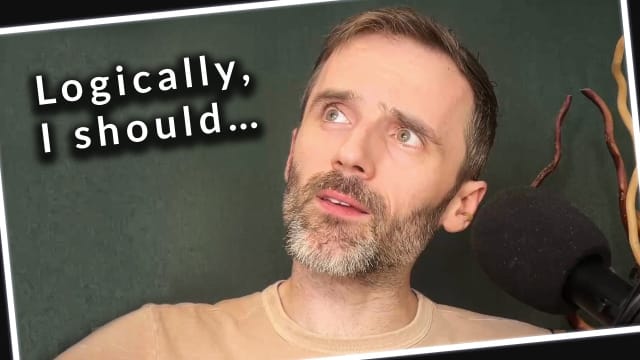
The problem with finding your life purpose, your ideal hobby, your perfect community—the thing that truly lights you up—is that most of us approach it like a treasure hunt. We sit in our heads, thinking hard, imagining the perfect scenario, waiting for the 10 out of 10 moment to arrive fully formed. But Michael Caloz, an existential counselor and transformation coach, has spent years testing a radically different approach: treat it like a scavenger hunt instead. You're not looking for the final prize yet. You're looking for the next clue.
The shift begins with permission to fail small. Most people expect their first attempt at finding something meaningful—a hobby, a community, an event that resonates—to be good. When it isn't, they abandon the whole direction. Caloz invites a different interpretation: a 2 out of 10 or a 3 out of 10 isn't failure. It's the beginning of a conversation with yourself.
"Maybe the first time you're going to find a two out of 10," Caloz explains in the video. "It's not really what you want, but it's giving you some key pieces of information to help you better understand yourself, your needs, your preferences."
That low score is actually the most useful feedback you can get—provided you know how to read it. The temptation is to write off the entire category. But Caloz's method asks you to do something harder: stay with the discomfort, get curious, and extract the signal from the noise.
The secret to moving from a 2 to a 3 to a 4, and eventually closer to what you actually want, is learning to deconstruct any event or experience into its component parts. Caloz calls these attributes or variables—the individual elements that, together, make up the whole.
Take an art gallery opening. On the surface, it's one thing. But decompose it, and you find several distinct elements: you're in a room full of people (group size); you're dressed up fancy (dress code); and the focus is on art (activity type). Each one of these variables can energize you or drain you independently. That matters.
The art gallery was a 3 out of 10. Rather than dismiss it entirely, Caloz's method is to interrogate each variable. "Well, I kind of liked being in a room full of people. Maybe this was too many people though," you might notice. "The dressing fancy, I didn't actually enjoy that. I like being more casual. Oh, but art. That was kind of cool. Something about creativity." Now you have data. The group size needs to be smaller. Dress code should be casual. But the creative element? Keep that. Adjust the others.
Next time, you try a wine and paint event—still art, still people, but fewer of them and a more relaxed atmosphere. Maybe that's a 5 out of 10. You're closer. You tweak again. Over time, by isolating which variables work for you and which ones drain you, you gradually drift toward something that actually feels like yours.
For those whose minds work more analytically—and Caloz is speaking directly to people who live in their heads—the practice can be formalized. A spreadsheet, a journal, or any tracking system becomes a laboratory notebook. After each event or outing, you record which variables were present and how they landed.
"I've kept a spreadsheet for years as I've gone to events and kind of slowly dialed them in more and more," Caloz says. "You can list like what are the different attributes, the variables of this event, and then after the event which ones worked for me, which ones didn't work for me, what did I learn about myself thanks to this event, and then how can I tweak those variables to then plot the next thing that I'm going to try."
For someone stuck in analysis paralysis—someone who has thought about what they want so thoroughly that they've never actually tested anything—this shifts the job of the analytical mind. Instead of ruminating about the "right" choice, the mind gets deployed to run experiments, record results, and identify patterns. It's a job that satisfies the need for rigor while actually moving you forward.
Caloz's own origin story with this method offers a vivid example of how the scavenger hunt works in real time. Years ago, he attended a 10-day Vipassana retreat—an intensive meditation practice rooted in Buddhist tradition. "It changed my life," he recalls. "I came out of that thinking, whoa, um there's something about deep meditation, about Buddhism that really works for me."
But here's where the method diverges from conventional wisdom. Rather than declaring "Buddhism is my path" and staying put, he did something subtler. He recognized that while the core variable—meditation and Buddhist practice—resonated deeply, another variable felt off. "This particular tradition feels kind of a bit too hardcore, a bit too conservative for me," he says. "I like the Buddhism, I like the meditation, but I think I need something that's a bit more community oriented, a bit gentler, a bit more talking involved."
He didn't abandon meditation or Buddhism. He identified which variables worked (contemplative practice, philosophical depth) and which didn't (the intensity, the hierarchy, the isolation). Then he experimented with other Buddhist traditions until he found Zen—still Buddhism, still meditation, but a different flavor. The scavenger hunt led him from one clue to the next, each iteration adding clarity.
The hardest part of Caloz's method, for the overthinking mind, is the demand to actually go. "You can't just keep sitting at home thinking about this to figure out what is my life purpose," he says bluntly. "You can start by watching videos and trying to find something that sparks you, listening to podcasts. But then eventually you have to actually go out and try things."
This is the non-negotiable piece. The analytical mind wants to solve the puzzle entirely on the interior, to construct the perfect theory and then execute it. But life doesn't work that way. Reality has information your imagination doesn't. The only way to close the gap is to move into the world, try something imperfect, and pay attention to what happens.
The invitation, then, is to make a list of potential starting points—workshops, meetups, events, classes—knowing full well they won't be 10 out of 10. Knowing they might be 2s and 3s. But committing to track them, reflect on them, and let each low score inform your next choice. Over time, the iterations compound. The 2 becomes a 3, the 3 becomes a 4, and eventually, you find yourself in spaces, with people, doing things that genuinely light you up. Not because you found the perfect answer through thinking, but because you let your lived experience teach you, one clue at a time.
Start by listing five things you've been curious about but haven't tried yet—an event type, a community gathering, a class, a meetup. Pick one and commit to going, knowing it might be a 2 or a 3. Afterward, spend 10 minutes writing down or tracking which elements worked and which drained you. What did you notice about yourself? Then, identify one variable to adjust and plan your next experiment. Repeat. The scavenger hunt begins not with perfect clarity, but with willingness to gather one clue at a time. For deeper support with this process, Caloz offers one-on-one coaching at michaelcaloz.com.