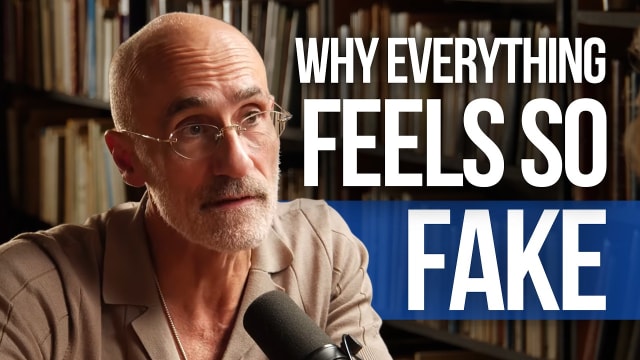
Arthur Brooks, the economist and writer who has spent years studying happiness and social science, makes a blunt claim in this clip from his podcast conversation "How to Find Love in 2026": the thing most likely to keep people from falling in love is not a shortage of options, but a shortage of nerve. He ties that claim to research on how young adults are growing up more slowly, to a 2018 study of heartbreak, to a story about a man on an airplane who finally said what he felt, and to the idea that a good partner is someone who completes you rather than mirrors you. Taken together, his argument is that love is a risk you have to keep choosing, and that the failures along the way are the curriculum rather than the penalty.
Brooks opens with what he calls a "love depression," and he diagnoses part of it through behavior rather than sentiment. He points to the work of Jean Twenge, a social psychologist at San Diego State University, who measures how slowly young adults are growing up by tracking risk-taking. The surprise in her data, as Brooks presents it, is that today's young people are not more reckless. "Younger people, believe it or not, are actually less risk-taking than people were when they were young," he says in the clip (0:00). Drinking and drug use, he notes, are down, not up, and the same pattern shows up in romance: less willingness to take personal risk goes with less falling in love and less sex.
Brooks is careful to separate kinds of risk. Driving fast and using drugs are bad risks. But the risk he cares about is the entrepreneurial kind. "Risks with your heart is another matter," he says (1:10). "That's the most entrepreneurial thing that you can do." His framing is that entrepreneurship is the deliberate placing of valuable resources at risk in search of outsized returns, and that your emotional life is the most valuable resource you have.
The clearest illustration in the clip is a small story. Brooks says he once gave a talk on Capitol Hill to staffers in their twenties, a room he describes as working in "the world's most dysfunctional dating market," a place where everyone is climbing and power is the currency. His advice was to be a real entrepreneur with your life: give your heart away and take a risk. He thought it was a clever line, and forgot about it.
Weeks later, a man recognized him on a plane and said he could not stop thinking about the talk. He was on his way, he said, to tell a woman he had been secretly in love with for two years how he felt. Brooks admits he was worried. He had only been giving a speech, and he did not want to ruin anyone's life. Months later, at a holiday party, the man found him. The woman had not returned his feelings. She had been in love with someone else, and she had introduced him to that man. Brooks says he apologized. The man told him not to be sorry.
"Because, you know, that was the thing I was most afraid of in my life... and it did and I didn't die and I'm not afraid anymore." (Arthur Brooks, recounting the story in the clip, 3:30)
That is the point Brooks wants listeners to take away: the fear was bigger than the thing feared. Rejection did not kill him. It removed the dread that had been running his choices.
Brooks does not pretend rejection is pleasant. He says he has studied the pain of social rejection, and that the brain's dorsal anterior cingulate cortex, part of the limbic system, is wired to make us hate it. He describes experiments in which people play a ball-tossing game on a screen while two others begin excluding them, and the exclusion registers as pain in that same region. "Imagine when somebody says to you, 'You love me, but I don't love you,'" he says. "It's intensely painful" (4:10).
But he insists the pain is information. "That's how you learn. That's the only way that you learn" (4:34). A failed romance teaches you what went wrong, that you survive being wrong, what you are actually looking for, and why a particular person was not the right one. The lesson he keeps returning to is a cycle: try, fail, suffer, try again. "That's why it's so critically important to get into the cycle," he says (4:58). The alternative, avoiding the pain by not trying, is the very pattern he has just described in young people.
Brooks offers a timeline most people will find reassuring. Drawing on his own data, he says heartbreak usually lasts a few months, not years. "You will actually get over it sooner than you think," he says (5:11). He jokes that six weeks from now you may be on a date with someone else, wondering how you ever loved that particular loser so much (5:20).
The more interesting claim comes from a 2018 study he cites, which followed 160 people in their twenties who broke up around age 22, the modal age for a first serious heartbreak. Those who believed they had learned something from the breakup reported much higher relationship satisfaction later and lower conflict in their next relationship (5:32). Brooks says the learning clusters into three things: social-cognitive maturity, the ability to see why you behaved as you did; romantic agency, knowing what you want; and coherence, understanding why things happened the way they did. "I know why my last relationship failed and I'm going to fix those mistakes in the future," he says. "You only get that from experience" (6:43).
He is also specific about the dose. People tend to do best in marriage after a few breakups, not fifty and not two hundred. His metaphor is a startup that matures: a couple of false starts along the way, not a string of disasters. "Mature startups, not murders. Certainly not hostile takeovers," he quips (6:56). The line is funny, but the logic is serious. Getting it wrong is part of getting better at love, and the people who do best are those who run a real postmortem afterward.
This is the second hard truth, and Brooks states it as a principle: "Don't look for your body double. Look for your complement" (7:19). Most of us assume that the safest partner is the one who thinks, earns, and feels as we do. Brooks argues that this instinct is often wrong. He describes a campus study many listeners will have heard of, in which women sniffed T-shirts worn by men and rated them. His point is that attraction runs on signals the brain reads beneath conscious choice, and that people often lean toward partners whose biological defenses differ from their own rather than matching them. The lesson he draws is not about biology as destiny. It is that a partner who completes you may be more useful than one who reflects you back, and that the mind does not always know what it is responding to.
The practical implication is that people who curate their dating lists too tightly, screening for sameness on every axis, may be filtering out the very difference that would make a relationship work. Compatibility, in Brooks's sense, is a fit between two people who each bring something the other lacks, not a mirror.
Brooks says he is interested in how technology is reshaping the way people fall in love and stay in love, and he gives one striking number: "62% of long-term relationships now are starting on the apps" (7:33). The figure matters for his argument because apps invite curation. You can sort by height, politics, habits, and photos, and it is easy to start treating a partner as a list of specifications. Brooks's second protocol pushes back on exactly that: the spec sheet tells you who is similar, not who will complement you. The apps are not the enemy, but they can reward the same caution that Jean Twenge's data describes, the preference for the safe match over the uncertain one.
The third thread in the clip is about fear, and the description of the video names it directly: fear of rejection, the courage to take healthy risks, and the willingness to get it wrong. Brooks says that people paralyzed by fear are often the ones who most need to act, and that acting in spite of fear is what changes the pattern. The limbic system, he notes, is doing its job when it warns you away from pain, but that warning is not the same as a verdict on what is good for you. You can feel the sting and still go up to the person. The clip ends before he fully unpacks the final principle, so the complete framing lives in the longer conversation.
If the clip leaves you thinking about your own patterns, start small and specific. Notice whether you are avoiding a conversation because the pain of rejection feels unbearable, or because the stakes feel real. Brooks's own test is the postmortem: after any breakup or failed attempt, write down what you learned about yourself and what you are looking for next. Then make a deliberate choice to take one risk you have been putting off. For the full argument, including the context around the third principle, watch the complete episode, "How to Find Love in 2026," on Brooks's YouTube channel. The short version of his case is simple to say and hard to live: take the risk, expect the sting, learn from the loss, and look for someone who completes you rather than copies you.