BrightStar

Alle Events durchsuchen

Bewusste Zusammenkünfte entdecken

events

Yoga
Meditation
Breathwork
Qigong
Tai Chi
Sacred Music
World Music
Medicine Music
Sound Healing
Ecstatic Dance
Beliebte Reiseziele
BaliSedonaLos AngelesCosta RicaNew YorkSan FranciscoAustinMiamiJoshua TreeTulum
Alle Kategorien anzeigenAlle Reiseziele anzeigen

Alle Funktionen entdecken

Leistungsstarke Tools für Ihre Veranstaltungen

Plattform-Funktionen

Intelligente dynamische Preisgestaltung
Ticket-Kategorien
Sitzplatzreservierung
Warenkorbabbruch-Wiederherstellung
Besucher-Wiedergewinnung
Spenden & Staffelpreise
Affiliate-System
Ticket-Scanner
Rabattcodes
Individuelle Fragen
Ticket-Teilen
Upsells & Extras
Analysen & Berichte
E-Mail-Sequenzen
Warteliste / Benachrichtigen / Erinnern
Menschen & Orte
Artists & TeachersEvent OrganizersVenues & StudiosKnowledge BaseGlossaryInspiration
Alle Funktionen anzeigenÜber uns
PreiseBlog
Language
Saved events
Alle Veranstaltungen durchsuchen

events

YogaMeditationBreathworkQigongTai ChiSacred MusicWorld MusicMedicine Music

Beliebte Reiseziele

BaliSedonaLos AngelesCosta RicaNew YorkSan Francisco

Menschen & Orte

Artists & TeachersEvent OrganizersVenues & StudiosKnowledge BaseGlossaryInspiration

Plattform-Funktionen

Intelligente dynamische PreisgestaltungTicket-KategorienSitzplatzreservierungWarenkorbabbruch-WiederherstellungBesucher-WiedergewinnungSpenden & StaffelpreiseAffiliate-SystemTicket-ScannerRabattcodesIndividuelle FragenTicket-TeilenUpsells & ExtrasAnalysen & BerichteE-Mail-SequenzenWarteliste / Benachrichtigen / Erinnern
Alle Funktionen anzeigenÜber uns
PreiseBlog
AnmeldenSuchendeKreative
  • Alle Events durchsuchen
  • Für Suchende
  • Yoga
  • Meditation
  • Breathwork
  • Qigong
  • Tai Chi
  • Heilige Musik
  • Weltmusik
  • Medicine Music
  • Klangheilung
  • Ecstatic Dance
  • Retreats
  • Workshops
  • Alle Kategorien →
  • Bali
  • Sedona
  • Los Angeles
  • Costa Rica
  • Tulum
  • Byron Bay
  • San Francisco
  • Austin
  • New York
  • San Diego
  • Denver
  • Seattle
  • Portland
  • Miami
  • Alle Städte →
  • Join the Movement
  • Why we list
  • Sell Globally
  • Für Kreative
  • Für Teams
  • Für Autoren
  • Für Lehrer
  • Für Kirtan-Künstler
  • Für Studios
  • Für Festivals
  • Für Retreat-Zentren
  • Für gemeinnützige Organisationen
  • Markenbotschafter
  • Kostenloses Ticketing
  • Elevate
  • Amplify
  • 500.000+ Käufernetzwerk
  • Warenkorbabbruch-Wiederherstellung
  • Intelligente dynamische Preisgestaltung
  • Ticket-Kategorien
  • Wiederkehrende Veranstaltungen
  • Sitzplatzreservierung
  • Affiliate-System
  • Warteliste / Benachrichtigen
  • Ticket-Scanner
  • Einbettungs-Widget
  • Event-Syndication
  • Nachrichten
  • Integrationen
  • Berichte
  • Alle Funktionen →
  • Über uns
  • Das Ökosystem
  • Blog
  • Glossar
  • Inspiration
  • Hilfe-Center
  • Kontakt
  • API-Dokumentation
  • Marken-Assets
  • Karriere
  • Presse
  • Nutzungsbedingungen
  • Datenschutzrichtlinie

Events

  • Alle Events durchsuchen
  • Für Suchende
  • Yoga
  • Meditation
  • Breathwork
  • Qigong
  • Tai Chi
  • Heilige Musik
  • Weltmusik
  • Medicine Music
  • Klangheilung
  • Ecstatic Dance
  • Retreats
  • Workshops
  • Alle Kategorien →

Reiseziele

  • Bali
  • Sedona
  • Los Angeles
  • Costa Rica
  • Tulum
  • Byron Bay
  • San Francisco
  • Austin
  • New York
  • San Diego
  • Denver
  • Seattle
  • Portland
  • Miami
  • Alle Städte →

Für Kreative

  • Join the Movement
  • Why we list
  • Sell Globally
  • Für Kreative
  • Für Teams
  • Für Autoren
  • Für Lehrer
  • Für Kirtan-Künstler
  • Für Studios
  • Für Festivals
  • Für Retreat-Zentren
  • Für gemeinnützige Organisationen
  • Markenbotschafter
  • Kostenloses Ticketing
  • Elevate
  • Amplify

Funktionen

  • 500.000+ Käufernetzwerk
  • Warenkorbabbruch-Wiederherstellung
  • Intelligente dynamische Preisgestaltung
  • Ticket-Kategorien
  • Wiederkehrende Veranstaltungen
  • Sitzplatzreservierung
  • Affiliate-System
  • Warteliste / Benachrichtigen
  • Ticket-Scanner
  • Einbettungs-Widget
  • Event-Syndication
  • Nachrichten
  • Integrationen
  • Berichte
  • Alle Funktionen →

Unternehmen

  • Über uns
  • Das Ökosystem
  • Blog
  • Glossar
  • Inspiration
  • Hilfe-Center
  • Kontakt
  • API-Dokumentation
  • Marken-Assets
  • Karriere
  • Presse
  • Nutzungsbedingungen
  • Datenschutzrichtlinie
BrightStar
Hol dir die App
Laden imApp StoreJetzt beiGoogle Play
© 2026 BrightStar. Alle Rechte vorbehalten.
Inspiration

30-Minute Beginner Yoga Flow: Why Foundations Matter

KR
Kassandra Reinhardt
Nov 9, 2026
11 Min. Lesezeit

Von Yoga with Kassandra

Ansehen · 8

Thirty minutes is a long time on a yoga mat when every pose looks familiar. Kassandra Reinhardt's beginner flow, posted to her channel Yoga with Kassandra on November 9, 2026, is built on that tension. The shapes are the ones most students meet first: tabletop, child's pose, downward dog, high lunge, tree, chair, pigeon. Yet the practice keeps asking the body to do more than the names suggest. The video runs about 27 minutes and 30 seconds despite its title, requires no props, and layers small challenges onto foundational poses to work balance, strength and flexibility at once. What makes it worth a closer look is less the sequence than the principles she returns to again and again: engage the whole body even in a pose that looks restful, take weight out of the wrists, let the spacing of your hands and feet set the shape of a pose, and treat a forward fold as a release for the neck as much as the hamstrings.

Lesen · 10 Abschnitte

Why call a flow "beginner" and still add challenge?

Kassandra explains her framing at the very start. She says the practice is labeled for beginners because she wants it to be "a good introduction" for viewers, yet she intends to add "a few little layers of challenge along the way" so students can test themselves on balance, strength and flexibility (around 0:17 to 0:35). That is a useful way to think about any foundational class. The poses stay simple. The difficulty comes from how you choose to inhabit them.

You can see this in the choices she offers within familiar shapes. In high lunge, the work is not a new pose. It is a sequence of arm sweeps, left arm up and then right, and then down, repeated with the breath. Around 7:40 she adds a second round in a hinged position where the torso is tipped parallel to the floor, and the same arm movement becomes harder because the core and upper back are working against gravity. In tree pose, once a student feels steady, she invites them to "grow the branches" by reaching the arms up and out. The first version is about stillness. The second is about adding load to stillness. For a beginner, that distinction matters: challenge is something you add when the foundation is steady, not something you chase at the start.

What does a "flat back" actually require in tabletop?

Tabletop is the first pose in the flow and the one Kassandra returns to most often. Her cues are specific. Palms sit under the shoulders, knees under the hips, and the spine is held neutral, which she describes as a flat back. Through the shoulder blades she asks students to broaden, and she asks them to engage the abdominals "just a little bit" to hold the position.

The most useful idea in this section is her insistence that a simple pose still deserves full attention. As she puts it:

"Even in a pose where it might look like there's not much going on, I really want full body engagement."

— Kassandra Reinhardt, in the video (around 3:15)

Tabletop is also where she asks students to become aware of the pelvis. When the leg extends back and the heel presses away, she invites you to notice whether the pelvis is tucking forward or backward, lifting or dropping, and to try to keep it neutral. This is a small, quiet instruction, and it is the kind that separates a pose that looks correct from one that is organized from the inside. Students who skip it often find the lower back takes over the work that the hips and abdominals should be doing.

Why take weight out of the wrists?

Almost every pose in the first third of this flow puts the hands on the floor: tabletop, plank, the cat-like rounding, the triceps stretch, and downward dog. Kassandra's guidance for all of them is consistent. She says:

"Whenever we're doing weightbearing poses on with our hands on the floor, I want you to think of pushing into your fingertips and knuckles and taking some of the body weight out of your wrists."

— Kassandra Reinhardt, in the video (around 1:26)

The cue does two things. It gives students a concrete action, pressing through the fingertips and knuckles, instead of the vague instruction to "be strong." It also redistributes the load away from a joint that is often asked to carry more than it should in these shapes. She is also explicit about pacing: she signals that the last sequence requiring this kind of wrist weight begins around 5:10, which is a useful reminder that a flow is a series of phases, and that each one asks something different of the same body. If wrist discomfort is a concern for you, the video's disclaimer advises consulting a physician before starting any exercise program.

How do you place your hands and feet in downward dog?

Downward dog is the pose most beginners set up by feel, and Kassandra offers a simpler check. She shares a tip that doubles as a method:

"A good little tip here, for the most part, usually the distance you have from child's pose to downward dog is the one you would want to keep."

— Kassandra Reinhardt, in the video (around 5:20)

From there she gives the working measurements: palms shoulder-width apart, feet hip-width apart, and knees allowed to bend. The pose is then built through breath. On the inhale the body travels forward into plank, and on the exhale it returns to downward dog. She repeats the cycle twice more, lets the hips sit low on the inhale and lift high on the exhale, and then uses a final round to finish. The lesson is that alignment in a transition is not about hitting a perfect shape. It is about moving with the breath while the shape stays consistent.

She also uses the step-by-step walk of the feet toward the top of the mat, taking "as many tiny little steps as you'd like," and widening the feet or softening the knees along the way. That willingness to let the body adjust mid-movement is one of the quieter messages of the whole practice.

What is a rag doll fold actually releasing?

The forward fold, which she calls a rag doll, begins around 6:00 as the feet walk in. The instruction is to let the upper body dangle over the legs, sometimes holding the elbows and swaying gently side to side. The stated purpose is twofold. Kassandra says the fold stretches the hamstrings, but she is more emphatic about the upper back, where she wants students to decompress.

"Try not to tighten through your neck or your jaw, the upper body."

— Kassandra Reinhardt, in the video (around 6:40)

The release then becomes a roll-up. Students bend the knees, press into the heels, and rise "inch by inch," with the head and shoulders the last to come up. Many beginners rush out of forward folds and feel the strain in the lower back. Her slow return is the correction, and it teaches something that applies beyond this class: the way you exit a pose is part of the pose.

How does tree pose teach balance without a prop?

Standing balance comes in the middle of the flow, and tree is her main instrument for it. The standing foot is planted, and the free foot is placed along the inside of the standing leg. The cue is not to press the foot into the knee, which would strain the joint, but to press the knee open while the thigh pushes back into the foot. She says it directly:

"Think of pressing and squeezing that left knee open. Pushing the thigh against the foot to maintain your balance here."

— Kassandra Reinhardt, in the video (around 9:30)

She adds two more instructions that clarify the balance. Students should avoid digging the toes into the mat, which tends to make the ankle grip rather than stabilize, and should reach the crown of the head upward. Hands come to heart center, and the breath stays slow and steady through the nose. Balance is then challenged by the branches, arms that reach up and out. It is a clean example of the video's method: one stable pose, one small, optional escalation.

What do chair and pigeon add to the flow?

Chair pose, which begins around 10:13, asks students to keep the big toes together and the heels slightly apart, send the hips back as if sitting, and keep a flat back. It is a demanding strength pose disguised as a simple one, and it prepares the legs for the hip-opening work to come.

Pigeon arrives later, around 17:45, when she has the student cross one ankle over the opposite thigh and work into the hip. The video names pigeon in its description as one of the core poses, and the transcript shows her spending real time on it. She offers a gentler variation for students whose knees or hips are not ready for the traditional version, and she repeatedly invites students to take their time and let the stretch deepen gradually. Pigeon is a useful pose to end on because the hips are where a beginner's tension often lives, and a patient approach prevents forcing a shape the body is not yet offering.

How does this practice end, and why does the breath count matter?

After the standing and hip work, the flow moves toward its final resting pose. Kassandra leads a savasana, the lying-down rest, and the closing section is as deliberate as the opening. Around 24:35 she introduces a counted breath: inhale for four, hold, exhale for four, hold again. The count gives students something to follow when the mind wanders, and it converts the final minutes from a pause into a practice.

The session closes with an invitation to chant Om together once, and a brief summary of what the practice has been: "a little mix of stretch, strength" and the rest that comes from it. The ending is modest, which is consistent with the rest of the video. Nothing is performed. Everything is meant to be felt.

What should a viewer take from this video?

This is not a biography or a lecture. It is a working class, and its value lies in how it treats the familiar. The video asks students to notice the pelvis in tabletop, to press through knuckles rather than wrists, to measure downward dog by the distance from child's pose, to release the neck in a fold, and to press the knee open in tree. None of these cues is exotic. Each one is a small piece of attention applied to a pose most people think they already know.

Because the flow is built as a beginner introduction, its strongest recommendation is the same one it makes to every viewer: start with the foundation, and add challenge only when the foundation is steady. The disclaimer in the video's description reminds viewers to consult a physician before beginning any exercise program, and that caution is worth taking seriously, particularly for anyone with wrist, knee, hip or neck concerns. The video has drawn 26,752 views since it was posted, and most of those viewers will likely come away with a clearer sense of what a foundational pose is supposed to feel like from the inside.

Where to go from here

Start by playing the flow through once without pressure, pausing at tabletop and downward dog to check your hand and foot placement against her cues. Then return to tree and chair and try the challenge layers only after your balance feels settled. The video's description also lists several free challenges from the same channel, including a 30-day morning challenge, a 7-day yoga and meditation challenge, and a 30-day flexible body, flexible mind challenge, for students who want to build on this foundation over several weeks. Keep the principles in view as you practice: whole-body engagement in simple shapes, weight out of the wrists, measured transitions, and patient hips.
Comments

Loading the conversation…

Transcript

[0:00] Hi everyone. Thank you for joining me.

[0:02] My name is Cassandra. This is Kit Kat

[0:05] and that was Daisy. And we are going to

[0:07] take you through this full body beginner

[0:09] flow. So this is a really good mix of

[0:12] strength, balance, flexibility, suitable

[0:15] for all levels, but I'm just calling it

[0:17] for beginners because I want this to be

[0:19] a good introduction to you guys. We'll

[0:21] go over a lot of the foundational poses,

[0:24] but I'm also going to add in a few

[0:27] little layers of challenge along the way

[0:31] just to I don't know, why not, right?

[0:33] Just to challenge yourself and to test

[0:35] yourself a little bit and to work on

[0:38] that balance, strength, and flexibility.

[0:40] So, no props are required. We're going

[0:42] to start in a tabletop pose just on

[0:44] hands and knees. So, we'll go through a

[0:46] lot of more, I would say, foundational

[0:50] yoga poses.

[0:52] Tabletop definitely being one of them.

[0:54] So, you want to have your palms under

[0:56] your shoulders, your knees underneath

[0:58] your hips, and I want you to find a

[1:01] neutral spine here. So, a flat back. I'm

[1:04] pushing into my fingertips and knuckles

[1:06] a little bit, broadening through those

[1:08] shoulder blades. And I'm engaging and

[1:11] squeezing my abs just a little bit here

[1:14] to hold me in the pose. Keep this flat

[1:17] back as we extend our right leg back

[1:19] behind us and push into that right heel.

[1:23] So, you're just stretching into the

[1:24] calves. Whenever we're doing

[1:26] weightbearing poses on with our hands on

[1:29] the floor, I want you to think of

[1:31] pushing into your fingertips and

[1:33] knuckles and taking some of the body

[1:34] weight out of your wrists.

[1:37] And now let's add a side bend here.

[1:39] You're going to cross your right foot

[1:41] over to the left corner of your mat and

[1:44] find like a little banana shape with

[1:46] your body as you push out into that

[1:48] right hip. And you can look back towards

[1:51] that right foot. So big side bend here.

[2:03] Coming all the way back through to

[2:04] center. Bring that right foot back so

[2:07] it's in line kind of with your right

[2:09] hand. And you're going to tuck chin to

[2:12] chest. Tailbone down. Squeeze the abs.

[2:15] And can you now lift your left knee to

[2:19] hover and touch to your nose? Round it

[2:22] out. Push the floor away from you.

[2:24] Strong through your core. Find your

[2:27] plank pose. Left foot steps back. Lift

[2:30] the back of your head up. Big breath in

[2:33] here. And then our knees come down to

[2:36] the floor. Keep the toes tucked under as

[2:39] you press your hips towards your heels.

[2:42] And find a variation of this child's

[2:44] pose. Trying to stretch through the

[2:46] bottoms of our feet. Keep your arms nice

[2:49] and straight. So, your elbows probably

[2:51] will be lifted off of the floor and

[2:54] think of almost pushing your shoulders

[2:56] and armpits down towards the mat.

[3:07] As you inhale, we find our tabletop pose

[3:10] once more. Realigning yourself so that

[3:12] you have palms under shoulders, knees

[3:15] under hips, find your flat back. So,

[3:18] even in a pose where it might look like

[3:20] there's not much going on, I really want

[3:23] full body engagement. Get the crease of

[3:26] the elbows spinning to point forward.

[3:29] And from here, stretch that left leg

[3:31] back. And then push out into that left

[3:34] heel. And just notice what happens with

[3:36] the pelvis. If it's tucking anterior or

[3:40] posterior, lifting up or down. Try to

[3:42] keep it neutral with this flat back.

[3:46] Breathing in and out through your nose.

[3:51] And we'll cross that left foot over

[3:53] towards the bottom right corner of your

[3:55] mat. Push out into your left hip. And

[3:58] you can look back towards that foot,

[4:00] finding a side bend.

[4:08] Come back through to center. Realign

[4:11] that left foot back. Start to round in

[4:14] like a little cat pose until you can

[4:17] lift that right knee off the mat and try

[4:20] to tap your nose to that knee.

[4:25] Strong through your abs. Step it back to

[4:29] plank pose. Lengthen out here. And same

[4:33] thing, let's bring our knees down first.

[4:35] Keep the toes curled under. Press your

[4:37] hips back towards your heels. This time

[4:40] we're going to bring our elbows down to

[4:42] the mat. Press your palms together and

[4:45] bend your elbows as you bring your

[4:47] thumbs towards the back of your neck.

[4:50] So stretching through our triceps here.

[5:03] And we won't do too much more with

[5:06] weight in our wrist. This next sequence

[5:09] is our last sequence that will require

[5:11] this. So, let's straighten the arms.

[5:14] We're going to come into our downward

[5:15] dog. A good little tip here, for the

[5:17] most part, usually the distance you have

[5:19] from child's pose to downward dog is the

[5:21] one you would want to keep. So, your

[5:23] palms are shoulderwidth distance apart.

[5:25] Feet are hipwidth distance apart. And

[5:27] we're going to lift those hips up and

[5:28] back.

[5:31] You can absolutely have a bend in your

[5:33] knees here. Still pushing into

[5:36] fingertips and knuckles. As we inhale,

[5:38] let's come all the way forward into your

[5:41] plank pose. And then exhale back into

[5:45] downward-facing dog. Twice more like

[5:47] this here. Inhale forward. The hips are

[5:50] low. Exhale down dog. The hips go up

[5:53] high. Last time. Inhale.

[5:58] And exhale. And now we'll walk our feet

[6:01] to the top of the mat. Take as many tiny

[6:03] little steps as you'd like. Here you can

[6:05] widen your feet along the way and bend

[6:07] your knees a little bit. This is your

[6:09] ragd doll forward fold. So I'm going to

[6:11] let my upper body dangle over the legs.

[6:14] Maybe grabbing a hold of the elbows,

[6:16] swaying a little bit side to side.

[6:20] Try not to tighten through your neck or

[6:22] your jaw, the upper body. So we are

[6:25] stretching through our hamstrings, but

[6:26] we're also really looking to decompress

[6:29] through the upper back.

[6:37] And we'll release our hands down to the

[6:38] mat. Bend your knees even more. Push

[6:41] into your heels to slowly roll up to

[6:44] stand inch by inch with head and

[6:47] shoulders being the last to make their

[6:50] way up. Rolling those shoulders down. So

[6:53] into our standing poses. From here,

[6:55] you're going to keep that right foot

[6:57] forward and step your left foot all the

[7:00] way back into your high lunge. So, my

[7:03] feet are hipwidth distance apart. I'm

[7:06] going to bend into my right knee. I need

[7:08] to bend into the back knee a little bit,

[7:10] otherwise I curve too much through my

[7:12] lower back. I want to keep my shoulders

[7:16] over my hips, sinking down. Once you

[7:19] have your balance, go ahead and reach

[7:21] your arms up.

[7:27] Let's extend our arms back as we tilt

[7:31] forward. Now I am straightening my back

[7:33] leg. Roll the shoulders away from the

[7:37] floor. Nothing changes in the leg in the

[7:40] legs. Let's just reach our left arm up

[7:44] then the right arm up.

[7:47] Left arm down and right arm down. We'll

[7:50] do that a few more times. So inhale

[7:52] left,

[7:54] right,

[7:57] left

[7:58] and right. Last one. Working on building

[8:03] up that strength through the upper back.

[8:06] Arm down and down. Push into the floor.

[8:11] Lift yourself up. Inhale.

[8:14] And let's bring our hands onto our hips

[8:16] just so that we can step that foot in a

[8:19] little bit and narrow our stance. With

[8:21] both legs nice and straight,

[8:24] hips facing forward, everything facing

[8:27] towards the top of the mat. You're going

[8:28] to lift and lengthen from here. And then

[8:31] start to hinge forward from your hips

[8:34] until you're about halfway and parallel

[8:37] to the floor.

[8:39] If you need to bend a little bit through

[8:40] that right knee, that's perfectly fine.

[8:43] Notice how that left hip is going to

[8:44] want to open up. Pull it forward. We're

[8:47] going to repeat that same arm sequence.

[8:50] It can be a little bit more challenging

[8:51] here. So, drop the arms down. Let's

[8:54] bring left arm up, right arm up, left

[8:59] arm back, right arm back. Two more

[9:02] sequences like this. Left,

[9:05] right,

[9:07] left,

[9:09] right. We go up,

[9:12] up,

[9:14] down,

[9:16] down. And now lift yourself all the way

[9:20] up. We stand at the top of the mat.

[9:22] Let's find tree pose to work on our

[9:24] balance here. So on our right leg,

[9:27] you're going to place that left foot

[9:29] somewhere along the inside.

[9:32] Think of pressing and squeezing that

[9:35] left knee open. Pushing the thigh

[9:38] against the foot to maintain your

[9:40] balance here. Hands can come together at

[9:43] heart center. Trying not to dig our toes

[9:46] into the mat. Reaching the crown of the

[9:48] head up. If you're feeling pretty good,

[9:51] you can grow the branches of your tree.

[9:54] Reaching your arms up and out.

[10:00] Still breathing slow and steady in and

[10:02] out through your nose.

[10:06] Hands come back

[10:09] at heart center. Before we do the

[10:11] sequence to the other side, find your

[10:13] chair pose. Big toes together. Heels a

[10:16] little bit apart. Bend your knees. Send

[10:18] your hips back as if you were sitting in

[10:21] a chair. Really lengthen out. Flat back

[10:24] here. And we're going to pulse. Right

[10:26] heel up and down. left heel up and down.

[10:30] So we go right,

[10:33] left,

[10:35] right,

[10:37] left. One more time. Right,

[10:42] left. And press to stand. Reach your

[10:46] arms up towards the sky. Half sun

[10:48] salutation. Exhale. Fold. Feel free to

[10:52] bend your knees on the way down. Halfway

[10:54] lift. Flat back. Fingertips to your

[10:56] shins. Lead with the heart. Exhale to

[11:00] fold.

[11:02] Press to stand. Reverse swan dive. So

[11:04] you push the floor away from you.

[11:06] Leading with the chest.

[11:09] And hands come together. Let's repeat

[11:12] the entire thing to the other side. So

[11:14] I'm separating my feet hipwidth distance

[11:16] apart. I'm going to step that right foot

[11:19] all the way back. Finding my high lunge,

[11:23] bending into my front knee. I'm going to

[11:26] bend a little bit into my back knee as

[11:28] well. Once I feel secure and stable, my

[11:32] arms will extend up.

[11:39] Let's reach our arms back as we tilt

[11:42] forward. So, big diagonal line. And this

[11:46] time we're going to reach right arm,

[11:50] left arm, right arm back, and left arm

[11:54] back. Two more cycles like this. Right

[11:57] arm up, left arm up. Right arm back.

[12:02] Left arm back. Last one. Up.

[12:06] Up.

[12:08] Down.

[12:10] Down. Push the feet into the mat. Lift

[12:13] all the way back into this high lunge.

[12:18] Hands to your hips. And we're going to

[12:20] step that back foot in a couple inches

[12:22] so that you can bring that heel and

[12:24] really anchor it on the mat. Still

[12:26] keeping your feet hipwid distance apart,

[12:29] facing forward, squaring everything off.

[12:32] Pull the shoulders back. And then lead

[12:35] with the chest until you're roughly

[12:38] parallel to the floor. Maybe a little

[12:41] bend in that left knee. Arms come down.

[12:46] We go. Right arm up. Left arm up. Right

[12:50] arm back. Left arm back.

[12:54] Right.

[12:56] Left.

[12:58] Right.

[12:59] Left. One more time. Up.

[13:03] Up.

[13:05] Back.

[13:07] Back. And we come all the way up. Hands

[13:10] at the heart. We set ourselves up for

[13:12] our tree pose. We're going to balance on

[13:14] our left leg. Bringing that right foot

[13:17] wherever feels the most appropriate

[13:20] here.

[13:22] So, hugging to the midline and trying to

[13:26] lengthen and grow taller from there.

[13:32] Maybe the arms expand.

[13:47] Hands come back at heart center

[13:51] into our chair pose. We'll bring big

[13:54] toes together, heels apart. Bend your

[13:57] knees. Reach your hips back. Lean

[13:59] forward slightly here. Come down as low

[14:02] as you possibly can. We lift the left

[14:04] heel up and down.

[14:08] Right and down. Left.

[14:13] Right. One more time. Left.

[14:18] Right. Press to stand. Circle the arms

[14:22] up.

[14:24] Halfs salutation. Exhale. Fold all the

[14:28] way down. Halfway lift. Flat back.

[14:33] Exhale. Fold.

[14:36] And we circle to reach all the way up

[14:39] towards the sky. Hands at the heart.

[14:43] We're going to find our downward dog.

[14:45] So, let's use our venyasa to get there.

[14:47] Inhale. Circle up.

[14:50] Exhale. Fold down.

[14:53] Halfway lift. Just like what we did

[14:55] before, but this time plant the palms

[14:57] and step back. Downward-facing dog. So,

[15:00] my hands are shoulderwidth distance

[15:02] apart. My feet are hipwidth distance

[15:04] apart as I press and lift my hips up and

[15:07] back. Bending the knees is perfectly

[15:09] fine. Don't worry about whether or not

[15:11] your heels are touching the floor.

[15:15] All right, let's stretch a little bit

[15:17] from here. Reach your right leg up

[15:18] towards the sky. Bend that right knee.

[15:21] Open up your hip.

[15:25] And we'll come into pigeon pose. So your

[15:27] right knee will go somewhere behind your

[15:30] right wrist. And you can stretch that

[15:33] back leg further out. You want to try to

[15:35] get yourself evenly

[15:38] distributing the weight through both

[15:40] hips so that you're not fully leaning on

[15:42] one side more than the other. And I'll

[15:44] show a different way to modify this. But

[15:46] from this pigeon pose, we're just going

[15:48] to come down either on the elbows or you

[15:51] might go all the way down. If this is

[15:53] not working for your knees, your hips,

[15:55] your low back. If it's just a little too

[15:57] intense, you can do the exact same pose

[15:59] lying down on your back, crossing your

[16:02] right ankle over your left knee and

[16:05] pulling that in. It's the exact same

[16:07] stretch. You'll get the same benefit of

[16:10] the pose. It's just gentler and easier

[16:13] on the joints.

[16:15] So, whichever pose you have chosen,

[16:18] let's take a good five slow, steady

[16:21] breaths here,

[16:26] inviting the hips to soften a little

[16:29] bit.

[16:31] And if you're in this traditional

[16:33] variation of pigeon, see if you can

[16:35] relax your arms, your upper back.

[16:51] Two more deep breaths.

[17:02] And if you were folded all the way down,

[17:04] start by slowly lifting yourself back

[17:06] up. And we find our downward dog once

[17:09] more. Stepping that right foot back.

[17:14] Any movements and adjustments here that

[17:16] feel good.

[17:18] Noticing the effects of the pose.

[17:22] And we'll get ready for the second side.

[17:23] Left leg rises. Bend your left knee.

[17:26] Open up your hip. Big thigh stretch here

[17:30] before finding pigeon pose the other

[17:32] way. So my left knee goes somewhere

[17:34] behind my left wrist. I'm going to

[17:37] stretch my right leg further back behind

[17:39] me. Squaring off the hips, squaring off

[17:42] the pelvis. If you want to do this on

[17:44] your back, you're going to lay down,

[17:46] crossing left ankle over your right

[17:48] knee.

[17:50] Otherwise, if you're here, maybe start

[17:52] easing yourself down onto your elbows or

[17:56] all the way. You can also just stay up

[17:58] onto the hands.

[18:04] So, the benefits of the poses are always

[18:06] the same regardless of how deep we might

[18:09] go into them.

[18:11] There's never any sort of idea of a goal

[18:14] that we're trying to accomplish or like

[18:16] an ultimate pose variation.

[18:22] We want to make these shapes work for

[18:24] us.

[18:29] And this will change a lot for better or

[18:33] worse with time.

[18:37] So we don't want to get too attached to

[18:39] an ideal.

[18:44] Two more deep breaths here.

[19:00] and we'll lift ourselves up. This will

[19:02] be our last downward dog.

[19:06] So, take your time. Stretch everything

[19:08] out here in a way that feels good.

[19:16] And we'll come to take a seat.

[19:22] Extending the legs out in front of us,

[19:25] we'll come into a twist. So, you can

[19:27] bend your right knee. We're going to

[19:29] cross our right foot over that left

[19:31] thigh. Think of lifting up, growing

[19:34] taller through your spine. And you can

[19:36] just hug your right knee with your left

[19:38] arm. Right fingertips go behind you for

[19:41] support. Open into your twist. So, we

[19:44] don't want to slouch or round and

[19:47] contract. Really try to lift up nice and

[19:50] tall. Keep pushing into that big right

[19:52] toe

[20:02] and we'll release. Let's go. Do the same

[20:05] thing the other way. Bend into your left

[20:07] knee. Cross that left foot over. Use

[20:10] your right arm to hug that thigh in

[20:13] closer towards you. Left fingertips

[20:16] offer support as we rotate. So, both of

[20:19] my hips are still facing forward. I'm

[20:22] really trying to twist from my midback

[20:24] and up

[20:38] and facing forward. Let's lower all the

[20:42] way down onto our backs.

[20:45] And I'm going to lower slowly here. So,

[20:47] arms reaching out. Find a C curve

[20:50] through your spine. Really rounding.

[20:53] Keep pushing into your heels. Nice and

[20:56] slow. Getting the lower back down first

[21:00] and then the mid back. And finally, the

[21:03] upper back. Big stretch. If it feels

[21:06] good, we're coming into shavasana. Our

[21:08] final resting pose. So, after shavasana,

[21:12] I will take you through a very simple

[21:14] breathing technique.

[21:18] But first, we'll have about three

[21:20] minutes here.

[21:23] Think of this as an opportunity to

[21:26] process and integrate all of the work

[21:28] that you've done.

[21:34] Allowing your eyes to close or the gaze

[21:36] to just be soft.

[21:42] Coming back to a normal natural

[21:44] breathing rhythm that does not need to

[21:47] be forced.

[21:58] So, a few minutes here and I'll let you

[22:00] know when it's time for us to rise.

[23:52] Let's reawaken. Moving a little.

[23:57] Deepening your breath.

[24:00] Opening and closing the hands. Rolling

[24:03] through your ankles. Maybe stretch your

[24:06] arms up overhead.

[24:11] We'll come to take a seat. So, you can

[24:13] roll over to one side and just come up

[24:16] and sit however is comfortable for your

[24:19] hips and for your lower back

[24:22] before we completely finish today's

[24:25] class. We'll just do a simple box

[24:29] breathing technique. So, you want to

[24:31] inhale for a count of four. Hold the

[24:35] inhale for a count of four. Exhale for

[24:38] four. And hold the breath out for that

[24:41] same count of four. And you can kind of

[24:42] visualize tracing a box a square as you

[24:46] do this. So sitting up tall, exhale

[24:50] fully

[24:52] all in and out through the nose. Breathe

[24:55] in. 2 3 4. Hold. 2 3 4. Exhale.

[25:04] 2 3 4. Hold. 2 3 four. Keep going.

[26:02] One more cycle.

[26:22] breathing normally

[26:28] in and out through your nose.

[26:31] Let's bring our hands together

[26:34] at the heart.

[26:39] We'll chant Om together one time.

[26:43] Let's inhale to chant. Breathe in.

[26:50] Oh.

[27:02] Thank you so much everyone for doing

[27:04] this beginner flow with me. I would love

[27:06] to know what you thought of this class,

[27:08] how it felt for you. We had a nice

[27:10] little mix of um stretch, strength,

[27:15] balance, really focusing on stability, a

[27:17] little bit of breath work, a nice

[27:19] shabasana. Hopefully you enjoyed it.

[27:22] Please subscribe before you go and

[27:24] hopefully we'll meet on the mat again

[27:26] very soon.

KR
Artist
Kassandra Reinhardt

Watch more from Kassandra Reinhardt on YouTube.

Website
Themen erkunden
Beginner-yogaFull-body-flowDownward-dog-alignmentTree-posePigeon-pose

Hast du Fragen?

Häufig gestellte Fragen

The teacher labels it beginner because it is meant as an introduction to foundational poses like tabletop, child's pose, downward dog, tree and pigeon, with no props required. The video actually runs about 27 minutes and 30 seconds, and its description advises consulting a physician before starting any exercise program.
No. The video description states that the practice is a full-body flow with no props required, so a mat and open floor space are enough for most of it.
Kassandra suggests using the distance between your hands and feet in child's pose as a guide, and keeping that distance for downward dog. The working measurements she gives are palms shoulder-width apart, feet hip-width apart, with knees allowed to bend.
She advises placing the free foot on the inside of the standing leg and pressing the knee open while the thigh pushes back into the foot. Students should avoid digging the toes into the mat, keep the crown of the head reaching up, and breathe slowly through the nose.
In this video, a flat back means holding a neutral spine with palms under the shoulders and knees under the hips. Kassandra also asks students to broaden the shoulder blades, engage the abdominals lightly, and notice whether the pelvis tucks or lifts as the leg extends.
Kassandra's cue is to push into the fingertips and knuckles and take some body weight out of the wrists during weight-bearing poses. If wrist discomfort persists, the video's disclaimer recommends checking with a physician before continuing.
Around the closing savasana, Kassandra leads a counted breath: inhale for a count of four, hold, exhale for four, and hold again. The count gives students a steady rhythm to follow as the practice settles.

Weiterlesen

More from Kassandra Reinhardt

Alle anzeigen
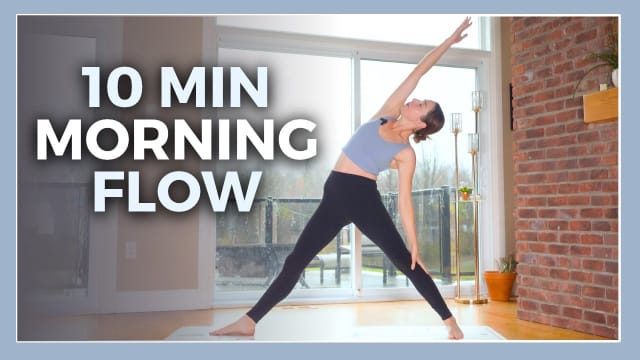
10-Minute Morning Yoga Flow: Hips, Hamstrings and Backbends
Inspire

10-Minute Morning Yoga Flow: Hips, Hamstrings and Backbends

A ten-minute, no-props morning yoga flow built on hip circles, side bends, and a mirrored run of pigeon and warrior poses. Here is how the s…

8 min read
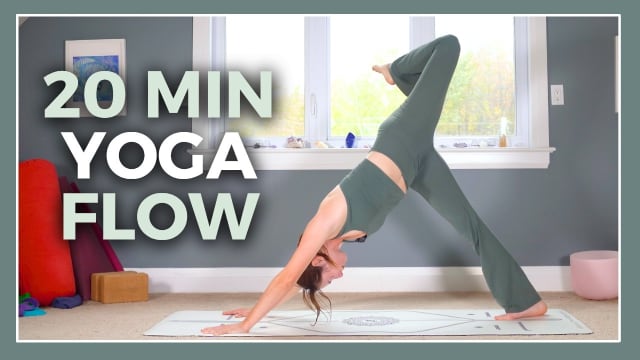
Inside a 20-Minute Full-Body Vinyasa Flow for Flexibility
Inspire

Inside a 20-Minute Full-Body Vinyasa Flow for Flexibility

A 21-minute intermediate vinyasa class built on breath, flexibility, and balance. Here is how its sequence works, from mountain pose to the …

8 min read
Kirtan Camp in Costa Rica: Bhakti, Chant and the Blue Zone
Inspire

Kirtan Camp in Costa Rica: Bhakti, Chant and the Blue Zone

A week of kirtan, yoga and ocean swims at a Costa Rica retreat set for July 2027. This clip shows what Jai Uttal's camp is built to do: gath…

6 min read
New Moon Meditation for Deep Exhaustion and Stress Relief
Inspire

New Moon Meditation for Deep Exhaustion and Stress Relief

A guided new moon meditation that leads listeners into a crystal healing chamber for rest. Here is how to approach its imagery, its energy c…

8 min read

Weiter erkunden

Setze deinen Weg fort

Mehr Weisheit und Zusammenkünfte aus dem BrightStar-Verzeichnis.

Mehr Artikel

Durchstöbere die ganze Bibliothek an Lehren, Interviews und Leitfäden.

Zu allen Artikeln →

Lehrer & Künstler

Entdecke die Linien, Musiker und Wegbegleiter der bewussten Welt.

Künstler erkunden →

Event finden

Kirtan, Retreats, Klangbäder, Atemarbeit, Festivals — bald in deiner Nähe.

Events ansehen →