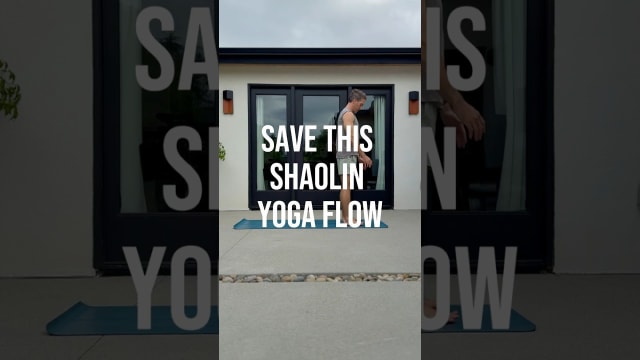
Before the first pose there is a breath. Standing at the top of the mat in mountain pose, feet about shoulder-width apart and arms released at the sides, the teacher asks for a deep inhale through the nose, to "the bottoms of the lungs," and then a sigh out through the mouth. It is the most ordinary instruction in yoga, and nearly everything that follows in this 16-minute class hangs from it. Travis Eliot, who co-founded Inner Dimension Yoga, builds a full-body sequence out of side bends, a lean back with the hands at the lower back, forward folds, plank, cobra, downward dog, the warrior family, reverse warrior, and a yogi squat. He repeats the core loop on both sides so the body gets strength and mobility evenly. The subject of the class is less the poses themselves than how a short sequence can be designed to be practiced every single day.
The class opens with a warm-up that teaches the grammar of the whole session. From mountain, the arms sweep overhead with fingers interlaced and palms turned out, and the body folds to the right and then to the left, lengthening each side in turn. Then the hands drop to the lower back, fingers down or, if the shoulders allow, fingers up, and the chest opens into a gentle backbend. The hands slide down the legs for a forward fold, then the spine lengthens with a flat back and the hands rest on the shins.
Eliot frames the whole thing as a practice for ordinary life. Early on he says:
"This is a practice meant to do every single day. It's all levels for your whole entire body."— Travis Eliot, 0:00
That promise shapes the choices. Nothing here requires a particular flexibility to begin. The side bends, the lean, and the fold are available to nearly anyone, and the sequence asks for only enough effort to change how the body feels in fifteen minutes.
The flow is built as a loop: arms up, side bend, middle, side bend, middle, hands to the low back, lean, fold. It runs once, then again, and then it becomes the transition into the standing work. From downward dog, the right leg lifts, steps forward, and the back foot spins flat into warrior one. Warrior two opens to the left. Then the right palm turns up into reverse triangle and reverse warrior, followed by a spread-arm twist in which the practitioner presses down through one hand while pulling the opposite arm up and away from the floor. The whole sequence then runs again on the left side, with the same architecture reversed.
The symmetry matters because it keeps the practice from building a dominant side. Eliot is particular about alignment in the standing poses. In warrior one he asks the student to notice "both hips facing forward," and he names the result a "neutral neutral rotation in the hips." Square hips are the reference point that lets the same pose be done correctly on either leg. A good way to hear the class is as a set of checks: is the back knee tracking over the heel, are the hips level, is the spine tall before the next fold.
The loop also serves the spine. Plank, cobra, and downward dog come in a steady sequence each time through, moving the spine from extension to flexion and back. Eliot calls the cobra "another massage for the spine," which is a practical description: the back arches and releases in a rhythm the body learns quickly.
Every movement in the class is paired with an inhale or an exhale, and the cues function less like instructions than like tempo markings. Lifting the arms overhead is an inhale, folding is an exhale, and the transitions into plank, cobra, and downward dog each have a breath attached. By the middle of the class the cues have become a kind of chant, and Eliot leans into the meter. He sings the sequence out loud, in lines that scan:
"Inhale rise light like the wind. Exhale arms back. Inhale breath in the flow. Exhale mind in that yoga zone."— Travis Eliot, approx. 8:40
There is a practical reason for this. When the breath is the timekeeper, a student does not need to think about when to move, and attention can settle into the body instead of racing ahead to the next cue. For a practice designed around a busy schedule, that is the efficiency the class promises: the session moves on its own momentum, so the mind has less to manage.
One of the most useful moments in the class comes in the middle of warrior two. Eliot stops to make a point that many teachers skip. Poses, he suggests, carry an emotional tone as well as a physical shape, and he asks the student to find it:
"A lot of these poses... there's also an emotional signature to it. So, in a warrior two, what's the emotion you feel? Might be courage. Might be strength. Might be empowerment. What is it for you?"— Travis Eliot, approx. 8:56
The question is a small act of attention. A warrior is a shape that asks for stability through the legs and openness through the arms, and the feeling it produces can be named, which gives the student something to return to. The class does not insist on one answer. It treats the feeling as the student's own, which is consistent with a practice meant for all levels.
The closing standing sequence slows down. The feet spread to the outer edges of the mat, the toes turn out, and the body drops into a yogi squat. Eliot names what the position is for:
"So good for the ankles and the hips, the lower back, the knees."— Travis Eliot, approx. 11:44
From the squat he adds a diagonal reach and a twist, opening the chest and rotating through the spine, then returns to a series of forward folds and a standing reach. The class ends with the hands at the center of the chest, the stillness of a closing gesture, and a thank-you. The last minute is the part that a busy practitioner can learn to rely on: the sequence arrives back at neutral, and the student stands up from the mat having done the whole thing.
Three things stand out. First, the class builds in options. In plank Eliot says, "Always have the option to drop your knees if you want," which signals that the sequence is a template rather than a test. Second, the loop is learnable. Once the side bend, lean, and fold are familiar, the rest of the class becomes a matter of matching breath to movement. Third, the repetition is the point. The same poses come back on the other side, and the body learns the sequence the way a musician learns a riff: by playing it through until the hands know where to go.
The description promises strength, mobility, and focus, and the transcript supports those in a plain way. Nothing in the class overreaches into medical claims. It is a short, honest flow for people who want their body moved and their breath organized before the rest of the day begins.
If the sequence appeals, the most useful next step is to practice it slowly, at the pace of the breath, for a week before adding speed or depth. Then try naming the emotional signature of each warrior, as Eliot suggests, and notice whether the feeling changes between the right and the left side. The class description points viewers to longer programs and guided calendars at Inner Dimension Yoga, and to the teacher's online trainings, for anyone who wants to go deeper than fifteen minutes.
The video is a single short class, but its design holds a lesson for anyone building a daily habit: keep the sequence repeatable, let the breath set the tempo, and make both sides equally important.