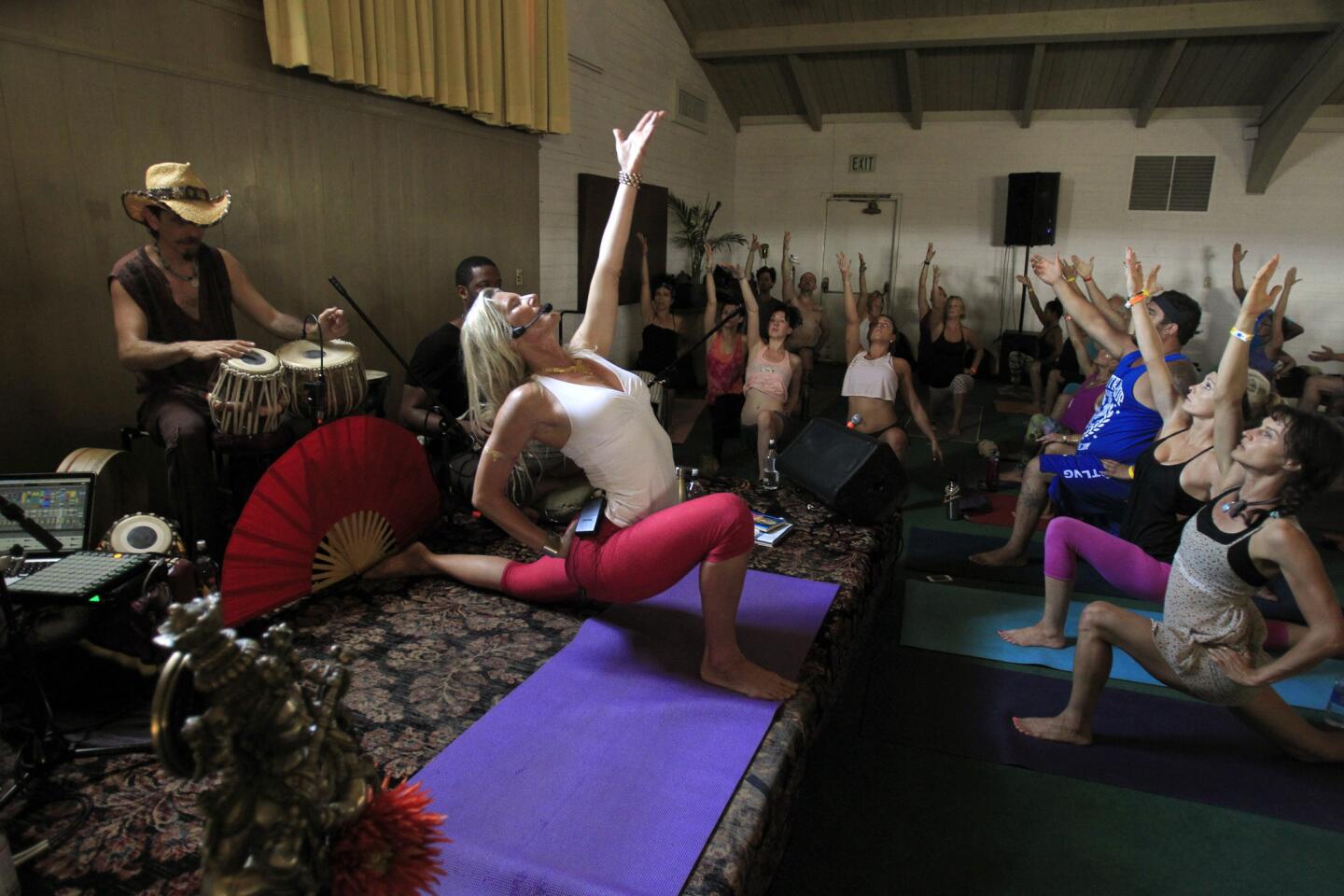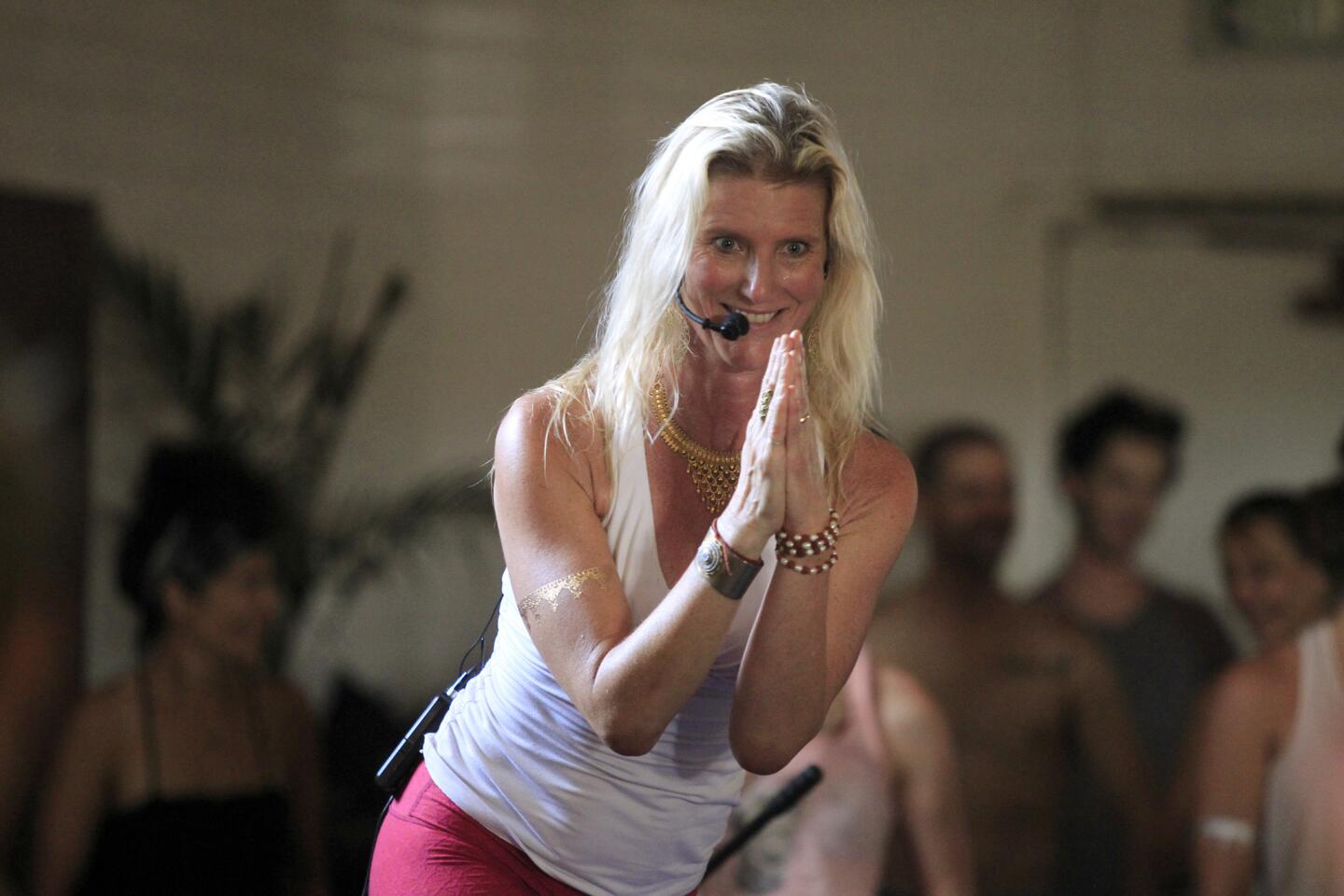

A Shiva Rea session unfolds less like a choreographed sequence and more like a guided improvisation within traditional form. Students don't receive detailed alignment cues or hold poses for anatomical correction. Instead, Rea leads through rhythm and breath, inviting continuous motion that ebbs and flows between standing sequences, floor work, and stillness. Her retreats and workshops often sync practice to environmental cycles—dawn sessions timed to circadian activation, evening flows designed to settle the nervous system, full moon gatherings that incorporate chanting and longer meditation intervals.
The structure is permissive in a way that unsettles practitioners accustomed to precise instruction. Rea may introduce a vinyasa theme—spiraling, grounding, pulsing—and then step back, allowing students to interpret the pattern through their own bodies. This demands a degree of somatic literacy. Newcomers can feel lost without external scaffolding; experienced movers often describe a sense of liberation, finally permitted to honor their body's intelligence rather than conform to a template.
Rea returns again and again to the concept of prana vayu—the directional flow of life force through the body. She frames yoga not as a discipline of perfecting shapes but as a practice of cultivating energetic awareness. Her language invokes tides, spirals, waves: metaphors drawn from natural systems that operate in cycles rather than linear progressions. She speaks frequently of Shakti—the divine feminine principle of creative power—and positions yoga as a technology for awakening this force in daily life, not just on the mat.
The questions she pushes are existential rather than technical. Not "Am I doing this correctly?" but "Where am I resisting flow in my life?" Not "How do I deepen this stretch?" but "What rhythm does my body need today?" She challenges students to abandon the project of mastery and instead develop a listening practice. This can frustrate goal-oriented practitioners who want measurable progress. For those drawn to introspective, process-based work, it opens a different doorway into self-knowledge.
Rea's voice carries the cadence of ritual speech—measured, slightly dreamlike, often synced to the rhythm she's establishing in the room. She uses story sparingly but effectively, drawing on Tantric cosmology, seasonal myths, and occasional personal anecdotes about studying in India or observing natural phenomena. Her humor is gentle, almost absent; she doesn't break tension with jokes or self-deprecation. This creates an atmosphere of sustained attention that some find meditative and others find overly earnest.
Music plays a significant role. Live drums, tabla, or curated playlists provide a sonic scaffolding that directs the flow more than verbal cues. In longer workshops, she incorporates silence—not as pause, but as active space where the group's collective breath becomes the primary instruction. She rarely demonstrates full sequences herself, preferring to move through the room, embodying fragments, letting students piece together the larger pattern.
Rea's teaching lands most powerfully for students who already possess body awareness and can self-regulate within open-ended frameworks. Dancers, martial artists, and those with somatic training often thrive. Her emphasis on intuitive movement appeals to practitioners fatigued by rigid alignment dogma or the competitive edge of athletic vinyasa.
It tends to bounce off beginners who need clear guidance, students recovering from injury who require specific modifications, and anyone skeptical of spiritual language in fitness contexts. Her invocations of Shakti and prana aren't metaphorical flourishes—they're the conceptual foundation. Practitioners seeking a secular, body-mechanics approach will find themselves in the wrong room.
The accessibility rhetoric—"Embodying the Flow for All"—can ring hollow for larger-bodied students or those with limited mobility, as the fluidity she teaches still presumes a baseline of ease in transitions that not every body possesses.
Rea positions herself within the Krishnamacharya lineage, having studied with Pattabhi Jois, but diverges significantly from Ashtanga's fixed series. Her vinyasa krama approach shares philosophical roots while rejecting standardization. She draws equally from Tantric traditions that Western yoga often sanitizes or ignores, recentering the practice on energy work and ritual rather than postural achievement.
Her work exists in the gap between traditional transmission and contemporary adaptation—too rooted in Indian philosophy for the wellness industry's comfort, too individually expressive for orthodox lineage holders. This liminal position defines both her innovation and her limitations. She offers students permission to practice yoga as a living, responsive art, provided they're willing to do the introspective work that makes such freedom sustainable.