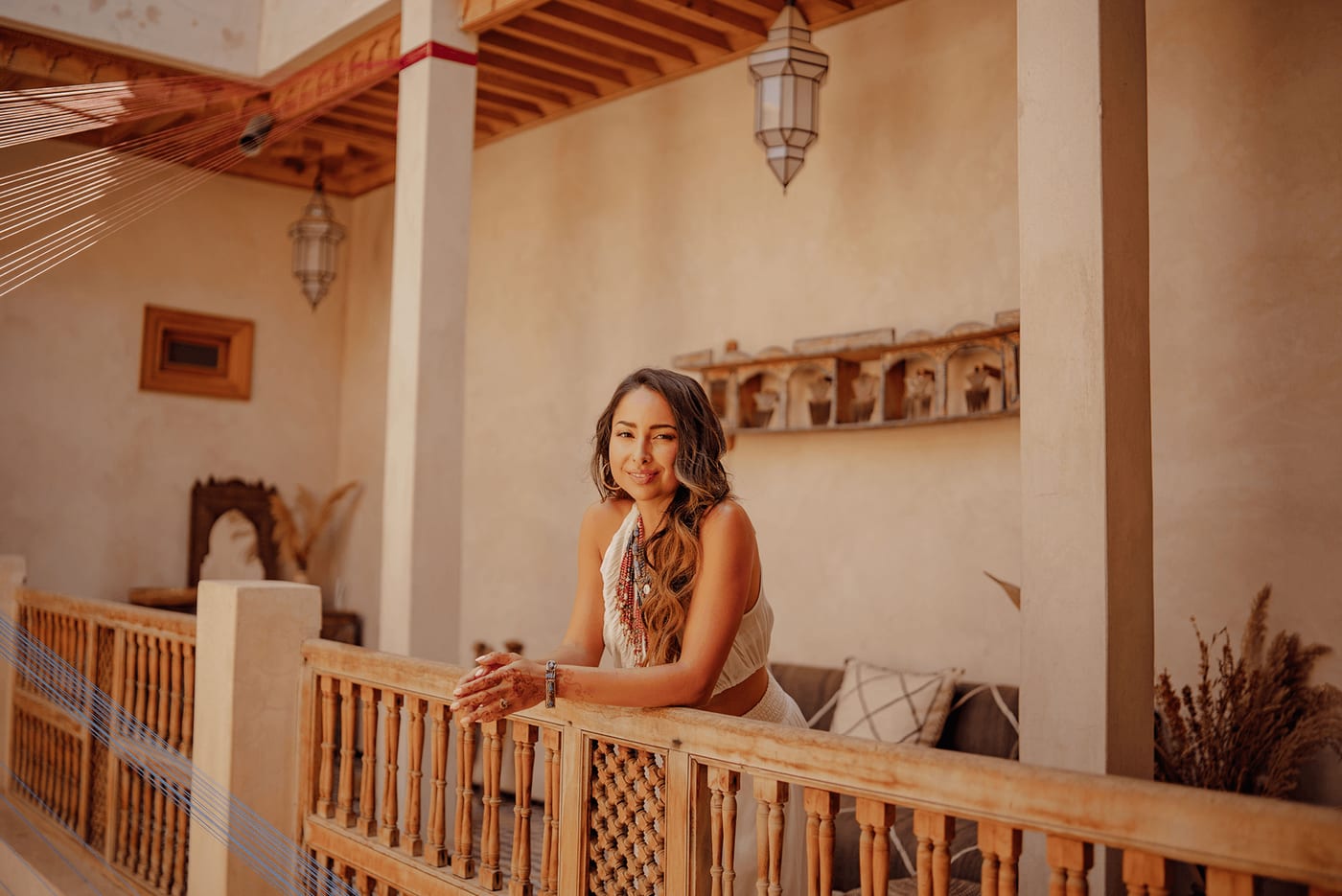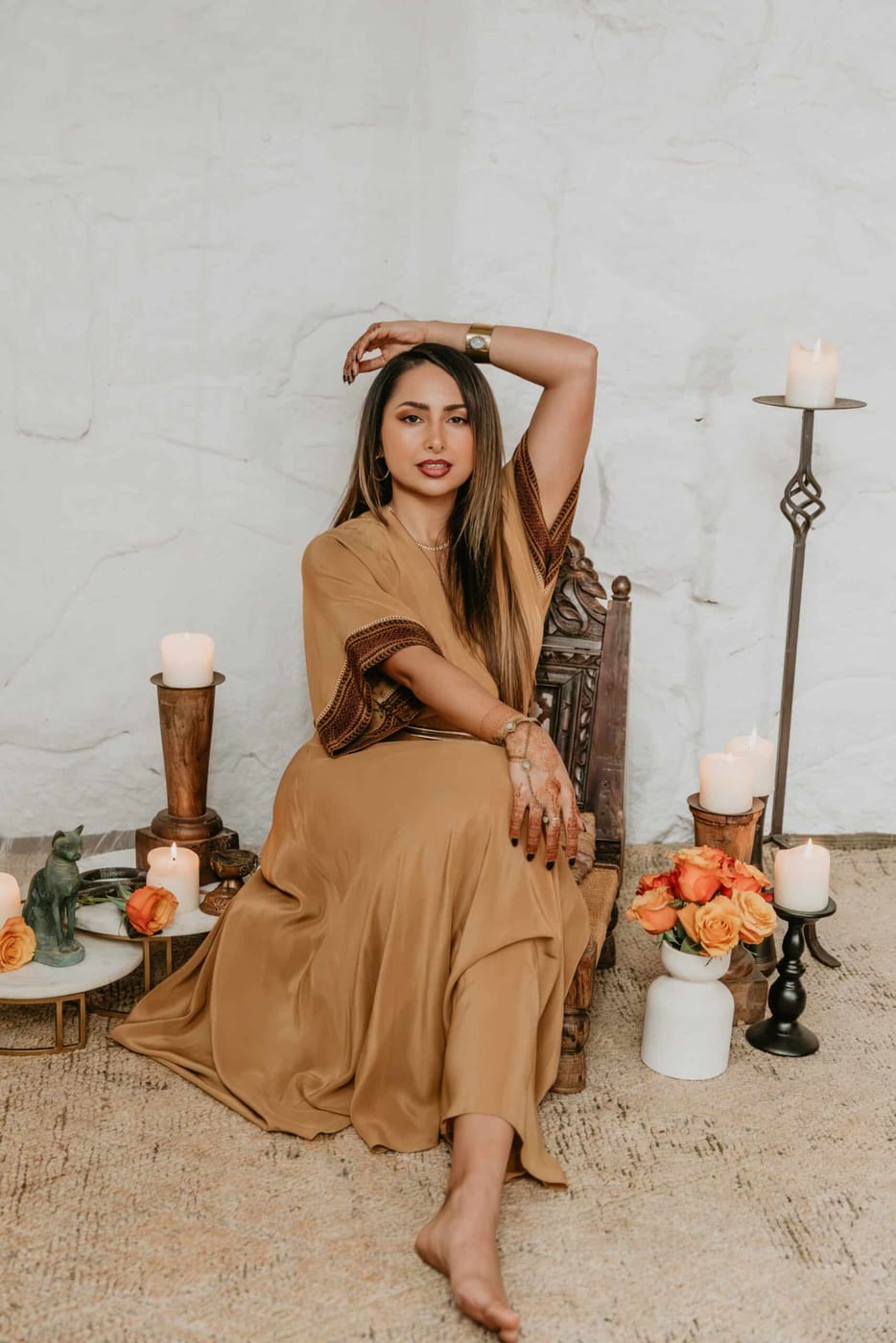

The documentation of Sahara Rose's sonic architecture is thin, and it would be dishonest to pretend otherwise. No source on hand specifies her instrumentation, production credits, vocal technique, or tempos. What can be said comes from the shape of her catalogue and from how she frames it. Her music sits in a contemporary, pop-accessible space rather than the ambient, healing-music, or monastic-chanting space that a "meditation teacher" might suggest. The track titles carry the clearest signal: "Wine Ya Waistline," "Naughty Girl," "Tall, Dark and Handsome," and "Sexy Dark Night Of The Soul" point to rhythmic, playful, sensual material, with an ironic, contemporary tone rather than a reverent one. Titles like "Trust Flow," "Trust The Path," and "Just By Feeling" suggest a more introspective, grounded register. The reasonable inference is music built to be moved to and felt in the body, not music designed to quiet the mind. That is an inference from titles, and the recordings are the real authority.
Her teaching draws on the Ayurvedic and dharmic traditions of India, approached through the divine feminine and embodied practice rather than renunciate or ascetic paths. Her bio describes work that bridges Eastern philosophy, embodiment practices, and creative expression, with "lived wisdom over theory" as the guiding principle. She does not claim membership in a formal guru-shishya lineage, and no guru or teacher is named as the source of her music. Nor is her music framed as bhakti, kirtan, or mantra. If you arrive expecting call-and-response chanting or Sanskrit devotional repertoire, the material points elsewhere. The sacred here is located in the body, desire, heartbreak, and everyday life.
What distinguishes her sound is less a specific instrument or scale than a stance: sensuality and spirituality are not separated. Where much conscious music tends toward soft reverence, her song titles treat desire, heartbreak, and playfulness as legitimate sacred subjects rather than distractions to be transcended. The 2024 album My Body Is An Altar (12 tracks) states the premise in its title, proposing the body itself as the site of devotion. The songs work as an extension of her teaching, practicing in sound what her podcast and books say in words. That consistency of message across media is her real contribution, more than any single production signature.
I can't responsibly name music collaborators, producers, or featured vocalists, because none are documented in the material available. What is documented lies in adjacent territory. Deepak Chopra wrote the foreword to her book Discover Your Dharma, and her Highest Self Podcast has hosted guests ranging from Sadhguru to Michael Beckwith. Those relationships shape her public platform and teaching, but they are not credited musical partnerships, and treating them as such would be inventing a lineage the record doesn't support. Anyone interested in who played on or produced these tracks should check the release credits directly.
Start with the album. My Body Is An Altar is her most cohesive full-length statement and the clearest entry point. From there, sample the singles. "Trust Flow," "Divaneh," and "Be The Vibe" date from 2023, and "Trust The Path" and "Just By Feeling" come from the more recent run. Her earlier release Thoughts on Time (2019) shows she has been bringing music into her work for some years.
What to expect. Expect a contemporary song format with sacred themes in the lyrics and titles, not a long-form meditation soundtrack. Her own sources suggest it is music to dance to, move through, and inhabit.
What may surprise. The tone. Listeners who know her primarily as an Ayurveda and dharma teacher may be startled by the cheek and sensuality of titles like "Naughty Girl." Those seeking reverent devotional sound or monastic chanting may find it alienating. Those who want to practice silent sitting should treat these as movement and ritual pieces, not meditation tracks. Her titles suggest "Trust The Path" and "Trust Flow" may suit more contemplative or restorative moments, but that is a guess worth testing by ear.
A practical note. If you want to hear her voice before her singing voice, the Highest Self Podcast, especially the biweekly channeled solocasts, gives the clearest sense of her cadence and temperament. The music then reads as the same personality set to rhythm.
Conscious music often divides into camps: the devotional (kirtan, mantra, bhajan), the ambient and healing (sound baths, meditation scores), and the ceremonial or ecstatic (medicine-song, dance journeys). Sahara Rose does not sit squarely in any of them. Her closest neighbors are artists who use pop forms to carry spiritual content, and her closest philosophical kin are the teachers reclaiming the Shakti principle and the sacred body against masculine-dominated narratives of the path. With 79,300 Spotify followers, her music reaches an audience positioned between mainstream pop and niche spiritual markets, many of whom likely arrive through the podcast first.
The catalogue is a deliberate counterweight to the genre's quieter conventions: a body-forward, desire-aware, humorous approach to the sacred. It won't satisfy listeners seeking classical devotion or stillness. For those who want their spirituality to dance, flirt, grieve, and trust, it offers something the quieter camps largely leave out.