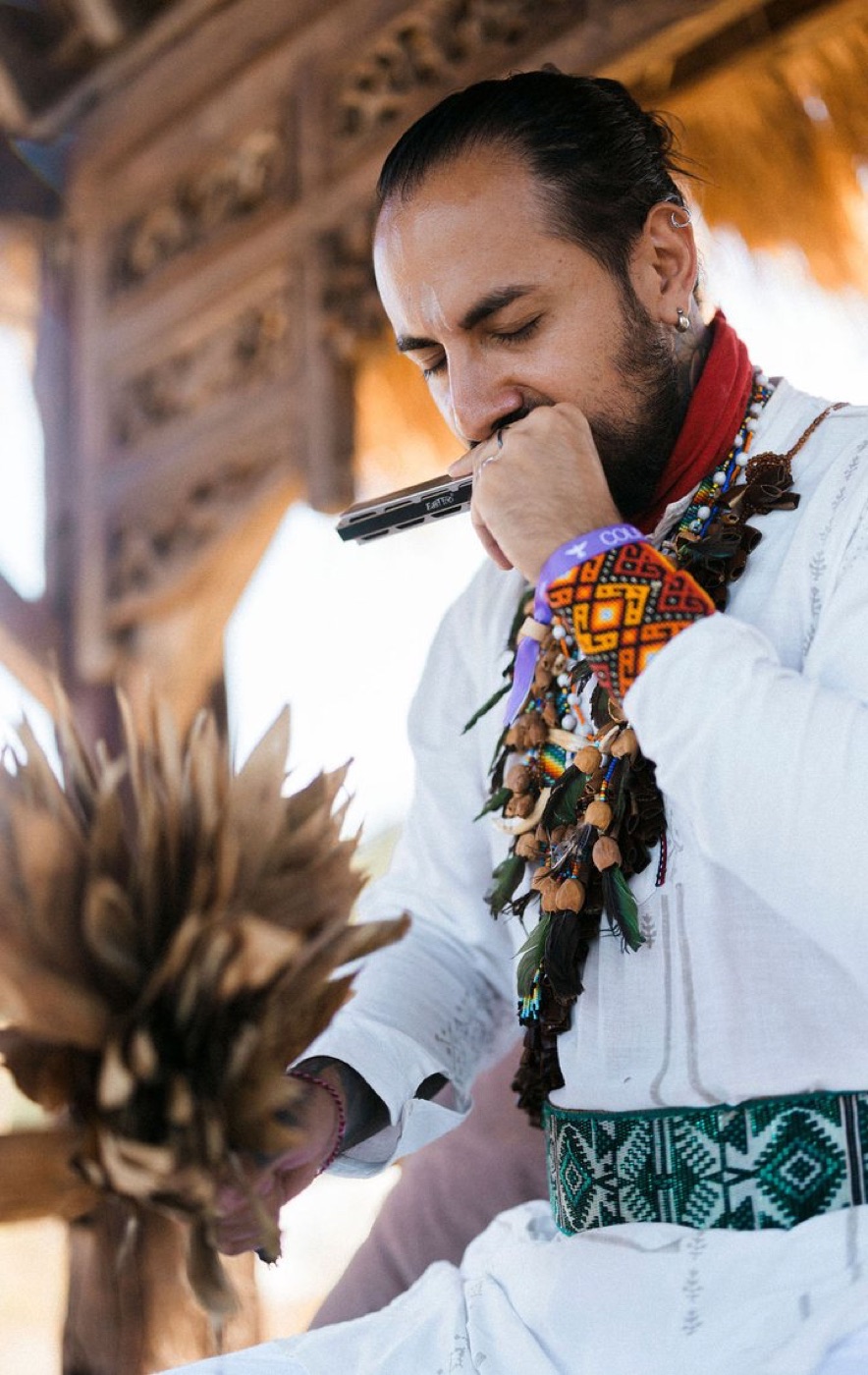

Nicolas Canon emerged from a family where art wasn't simply appreciated—it was the language of daily life. Born to parents who were both practicing artists, his childhood unfolded in an environment saturated with creative expression. This wasn't the kind of household where art hung quietly on walls; it was made, discussed, lived. His parents fostered an atmosphere where experimentation was encouraged, where multiple artistic mediums coexisted naturally, and where creativity was understood as both practice and philosophy.
These formative years set Canon on a path of exploration that would become characteristic of his entire approach to art and spirituality. Rather than settling into a single discipline, he allowed himself to move fluidly between music and visual arts, treating each as a different dialect of the same fundamental language. This period of his life was marked by restlessness in the best sense—a driving need to understand not just how to create, but why creation matters at all.
His quest for answers led him beyond the familiar. Canon traveled extensively, immersing himself in diverse cultural contexts and absorbing different artistic traditions. These journeys weren't tourist excursions but deep dives into how various communities use art to express the ineffable, to mark the sacred, to facilitate transformation. Each destination added layers to his developing artistic perspective, building toward a synthesis that would define his mature work.
The turning point in Canon's trajectory came through his growing recognition that art and spiritual practice weren't separate pursuits running parallel in his life—they were fundamentally the same endeavor. This realization shifted everything. Where others might see music as entertainment or visual art as decoration, Canon began to understand creative expression as a vehicle for consciousness exploration and personal transformation.
This integration became the cornerstone of his teaching philosophy. Canon didn't simply want to make art; he wanted to help others discover how the creative process itself could become a spiritual practice, a path toward self-discovery and healing. This conviction transformed him from an artist who worked in solitude to a teacher committed to sharing these insights with broader communities.
Canon's primary contribution lies in his work at the intersection of sound, consciousness, and healing. He approaches music not merely as aesthetic experience but as a technology for transformation—a means of accessing states of awareness that might otherwise remain closed. His exploration of how sound interacts with human consciousness has become central to his identity as both artist and teacher.
Through his workshops and classes, Canon has developed a methodology for helping others access their own creative potential as a spiritual resource. His teaching isn't about technique in the conventional sense—how to hold a brush or play an instrument—but about understanding creativity as a portal to deeper aspects of self. Participants in his workshops often describe the experience less as learning skills and more as remembering something fundamental they'd forgotten.
His discography reflects this philosophy throughout. Each album serves as both artistic statement and practical guide, offering listeners sonic environments designed to facilitate healing and inner exploration. The music resists easy categorization, drawing from traditional spiritual practices while remaining firmly contemporary in its execution. Themes of transformation recur across his body of work, approached from different angles but always returning to the central question: how can we use creative expression to become more fully ourselves?
Canon's work emerges from a rich tapestry of influences spanning ancient and modern, Eastern and Western, traditional and experimental. He situates himself within a lineage of spiritual teachers who understood the creative process as sacred journey rather than mere production. This connection to established wisdom traditions grounds his work, preventing it from floating into vague New Age platitudes.
Yet he's equally informed by contemporary artistic movements, creating a synthesis that speaks to modern practitioners while honoring time-tested principles. This balance—between innovation and tradition, individual expression and collective wisdom—characterizes his approach and helps explain why his work resonates across different audiences.
Canon reaches people who sense that creativity means something more than they've been told, who intuit that making art might be less about making things and more about becoming someone. His work matters particularly in a cultural moment when many feel disconnected from sources of meaning, seeking frameworks that integrate rather than separate the various dimensions of human experience.
His emphasis on community reflects an understanding that transformation happens not just in isolation but through connection. By creating spaces where people can explore creativity as spiritual practice together, Canon addresses the contemporary hunger for authentic community built around shared values rather than shared consumption.
In treating the creative process as a path toward healing and self-discovery, Nicolas Canon offers something increasingly rare: a vision of art that takes both art and spirit seriously, insisting that each needs the other to fulfill its highest potential.