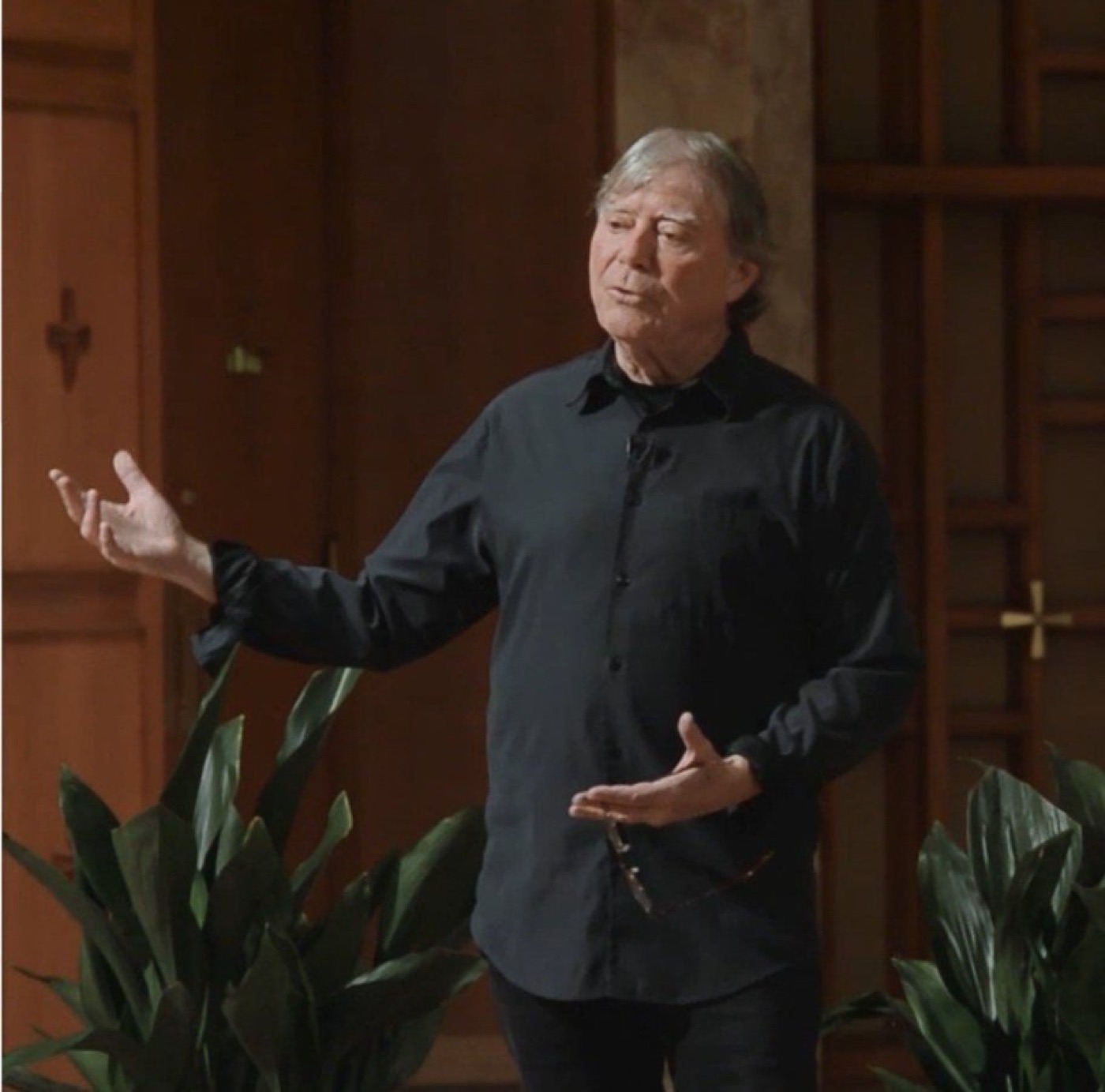

For more than four decades, Michael Meade has occupied an unusual position in American cultural life: part storyteller, part scholar, part ritual keeper. At a time when mythology is often treated as entertainment or escapism, Meade approaches ancient narratives with the seriousness of a physician consulting diagnostic texts. In his hands, Greek tragedies, African divination systems, and Indigenous cosmologies become instruments for understanding contemporary crises—tools not for retreat, but for engagement.
His work exists at the intersection of multiple traditions: Jungian psychology, comparative mythology, and oral storytelling practice. But Meade is neither academic nor entertainer in the conventional sense. His methodology is experiential, built around workshops and retreats where spoken-word performance, drumming, and collective conversation create what he views as necessary conditions for mythic thinking to take root.
Meade's central proposition is direct: myths are not metaphors to be interpreted from a distance, but living structures to be inhabited. This distinguishes his work from purely literary or anthropological approaches. Where Joseph Campbell mapped the hero's journey as universal structure, and James Hillman explored the psychological depth of mythic images, Meade focuses on activation—how ancient stories can function as practical frameworks for navigating personal identity, social conflict, and community breakdown.
His teaching draws from a remarkably wide range of sources: Celtic lore, Greek tragedy, Native American creation stories, African wisdom traditions. Yet the approach remains consistent: stories are presented not as artifacts of distant cultures but as emergency instructions for the present moment. Political division, ecological collapse, the erosion of meaning—these contemporary concerns are, in Meade's framework, precisely the territories myth was designed to illuminate.
Meade's published books form a sustained meditation on resilience and renewal. The World Behind the World: Living at the Ends of Time (2008) positions mythic consciousness as essential for navigating civilizational uncertainty. Fate and Destiny: The Two Agreements of the Soul (2010) explores the tension between what we're given and what we choose, using cross-cultural narratives to distinguish predetermined circumstance from self-authored purpose.
Why the World Doesn't End: Tales of Renewal in Times of Loss (2012) addresses apocalyptic anxiety through the lens of cyclical time and mythic regeneration. His more recent Awakening the Soul: A Deep Response to a Troubled World (2018) synthesizes his thinking on initiation, meaning-making, and what he terms "soul work"—the cultivation of interior resources necessary for external action.
Beyond books, Meade has produced extensive audio recordings of storytelling performances and lectures, treating the spoken word as primary medium. These recordings preserve something books cannot: the rhythmic, incantatory quality of his delivery, the way drumming punctuates narrative, the sense of ritual occasion.
The Mosaic Voices podcast represents a more recent evolution in Meade's practice. These long-form conversations engage mythology, ecology, and social justice through dialogue rather than monologue. The format allows Meade to explore how mythic frameworks intersect with contemporary activism, environmental thought, and justice movements—demonstrating that his interest in ancient stories has always been oriented toward present necessity.
The podcast's title itself signals his methodology: mosaic, not monolith. Truth arrives through assembled fragments, multiple traditions in conversation, the collision of perspectives rather than any single authoritative voice.
Meade's workshops and retreats are where his approach becomes fully embodied. These gatherings combine storytelling with drumming, silence with conversation, individual reflection with collective process. Participants don't simply hear about myth—they're invited into mythic time through ritual structure and communal practice.
This experiential dimension draws explicitly on initiation traditions from various cultures, adapted for contemporary secular contexts. The goal is not to replicate Indigenous ceremonies but to recover the principle that transformation requires structured encounter with difficulty, symbol, and community witness.
His work shows clear lineage to the Men's Movement of the 1980s and 90s, though it has expanded considerably beyond that initial context. While early work focused on masculine initiation, his current teaching addresses broader questions of purpose, calling, and social renewal across all demographics.
Meade's audience spans multiple communities: depth psychology practitioners, social justice organizers, spiritual seekers unattached to institutional religion, artists and educators looking for narrative frameworks outside dominant paradigms. He attracts those skeptical of both fundamentalist certainty and postmodern relativism—people searching for meaning structures that honor complexity without collapsing into nihilism.
His significance lies partly in what he models: serious engagement with tradition that isn't reactionary, multicultural fluency that isn't appropriative, spiritual practice grounded in justice rather than escape. In an era of increasing fragmentation, Meade offers what might be called radical continuity—insisting that ancient wisdom remains not just relevant but essential, while refusing nostalgia or cultural fundamentalism.
Ultimately, Meade's legacy may rest on a simple insistence: that we need stories not as decoration but as survival equipment. In his framing, mythology isn't a luxury for stable times but a necessity for catastrophic ones—precisely when literal thinking fails, symbolic thinking becomes crucial.
Whether that proposition holds depends on questions larger than any single teacher's work. But for those who have found in Meade's storytelling a way to make sense of personal crisis or cultural chaos, the proof is experiential, not theoretical. The world behind the world, as he might say, remains available to those willing to listen.