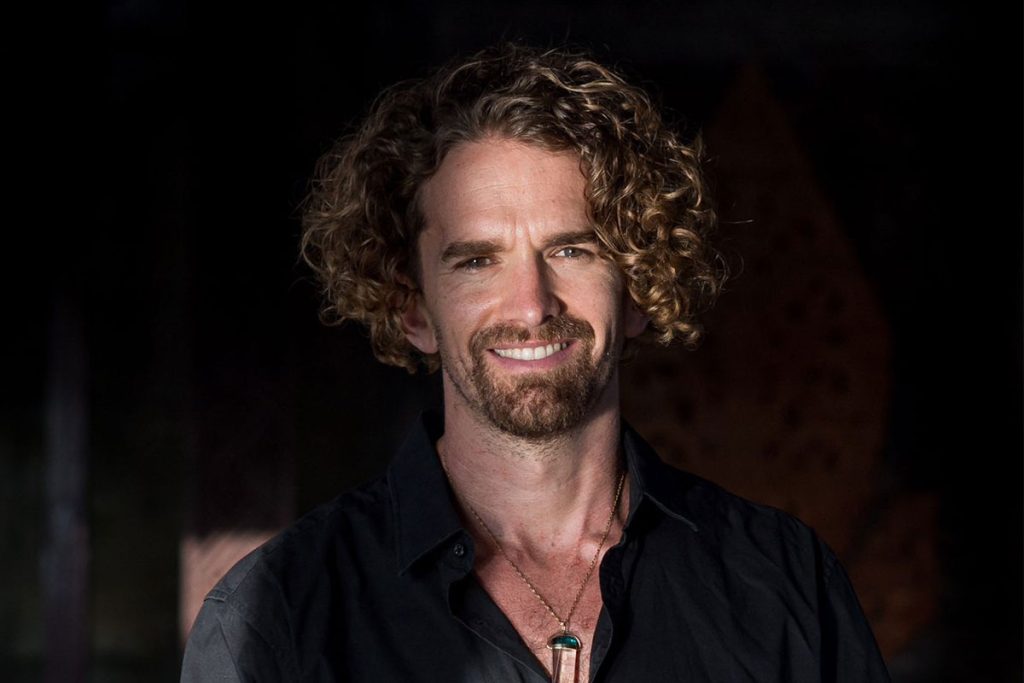

A session with Matías De Stefano unfolds like a hybrid architecture lecture and cosmological mapping exercise. He stands before diagrams—geometric patterns, temple floor plans, planetary grids—and speaks in a cadence that assumes you've already decided the material is credible. There's no preamble justifying his claims to remembering past lives or accessing a "Planetary Consciousness Network." He begins in the middle, as if continuing a conversation interrupted only by your absence. The teaching moves quickly between scales: from the arrangement of molecules to the purpose of civilizations, from the function of chakras to the geopolitical positioning of pyramids. The aesthetic is part TED Talk, part sacred geometry seminar, delivered with the production values of contemporary online education but the content of mystery school instruction.
His delivery relies heavily on visual language. De Stefano draws constantly—circles within circles, triangles intersecting spheres, timelines that curve back on themselves. These aren't illustrations of concepts; they are the concepts. The teaching happens through spatial reasoning rather than scriptural exegesis. Where a Buddhist teacher might return repeatedly to a sutra, De Stefano returns to the temple, to the artifact, to the geographic coordinate. His pedagogy assumes consciousness operates geometrically, that ancient builders encoded organizational principles into stone, and that understanding these patterns allows students to "remember" their own position within cosmic architecture.
The recurring themes circle around memory, organization, and network. De Stefano insists students are not learning but remembering—accessing information already embedded in consciousness itself. He frames human history as a series of organizational experiments, with different civilizations tasked with holding different frequencies or functions within a planetary system. Egyptian cosmology serves as his primary reference point, not as historical curiosity but as practical manual. The Egyptian concern with ma'at (cosmic order), with the precise function of each deity, with the relationship between above and below—these become templates for understanding contemporary consciousness work.
The questions he pushes students toward are structural rather than devotional. Not "What is my purpose?" but "What organizational principle am I expressing?" Not "How do I become enlightened?" but "What frequency does my geographic location need to stabilize?" He asks students to consider themselves as nodes in a network, to identify what he calls their "mission" not through introspection but through recognizing patterns—where they were born, what they're drawn to, which ancient sites call to them. The approach depersonalizes spiritual seeking while simultaneously making every detail of biography cosmically significant.
De Stefano employs minimal silence. His sessions fill space with information, moving from one concept to the next with confidence bordering on urgency. There's humor, but it's incidental—a brief lightness before returning to the complex business of explaining how consciousness organizes itself across dimensions. Story appears primarily through his own narrative of remembering, which functions as both credential and teaching method. He recounts memories of past lives not as spiritual autobiography but as case studies in how consciousness works.
This teaching lands for those who think systemically, who want frameworks rather than practices, who are drawn to ancient Egypt and sacred geometry, and who find the concept of accessing cosmic memory more compelling than the slow work of meditation or ethical refinement. It appeals to people frustrated with purely psychological approaches to spirituality but uncomfortable with devotional religion. It offers a middle path: esoteric knowledge presented through educational formats, spirituality that feels like learning.
It will bounce off those who need empirical grounding, who require teacher accountability to established lineages, or who find the leap from ancient temple architecture to personal consciousness too speculative. The lack of contemplative practice—of sitting, of silence, of working through resistance—will feel like a gap to students from meditative traditions. The confidence of the claims, presented without the usual hedging or epistemological humility, will strike some as grandiose.
De Stefano belongs to the lineage of modern esoteric educators who synthesize ancient wisdom traditions outside academic or religious institutions. His predecessors include Drunvalo Melchizedek, Manly P. Hall, and the sacred geometry teachers who interpret monuments as encoded teachings. He updates this tradition for digital distribution, making mystery school content available through subscription platforms. His work sits in the space between alternative history, consciousness studies, and spiritual education—a contemporary iteration of Hermetic teaching adapted for students who learn through screens and conceive of spiritual work as decoding rather than devotion.