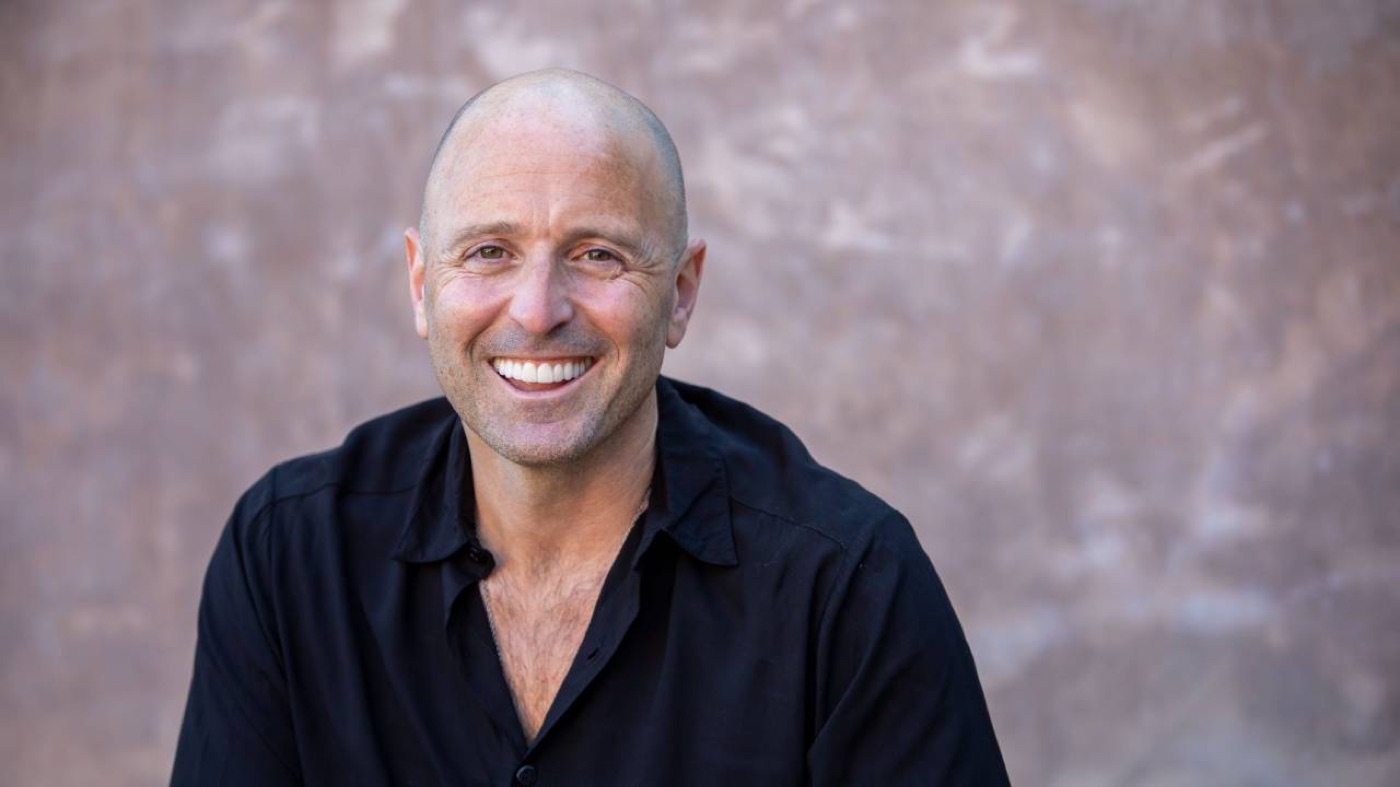

Sacred Fire arrived on April 17, 2026, an eight-track album from Lee Harris, the London-based energy intuitive, channeler, author and musician. It is a useful record to sit with because it shows what happens when a teacher's two public voices, the one that speaks and the one that sings, are given equal room.
Harris has been writing and producing music since 1998, beginning with solo work such as Shapeshifting (2001) and Phoenix. Over the years his music settled into a sustained partnership with composer Davor Bozic, which runs through Transmissions, Awaken, Timelines, Medicine Mantras, Mantramorphs and Rising in Love: Medicine Mantras 3. Sacred Fire is part of that line, released through his own Golden World Music label, and arrives a few months after the December 2025 Rising in Love. It is among his most recent work, and it points to where his thinking is moving in 2026.
Harris's music is vocal-forward and built on mantra and affirmation. His voice is the main melodic instrument, and it carries warmth and presence rather than ethereality. Around it the arrangements are deliberately spare: layered guitar, subtle synth textures and occasional percussion that supports the voice without crowding it. The pacing is slow and contemplative. There are no sudden dynamic shifts and no crescendos that demand attention, which leaves the space open for the listener to settle.
Expect repetition. A phrase is stated, returned to and gently varied, which is the method rather than a limitation. Listeners used to pop production may find it undersaturated at first. For those who practise meditation or mantra, that restraint is the point. The mood is grounded and sincere rather than grand, and the music avoids orchestral excess.
I can't responsibly name individual tracks from Sacred Fire, because the track listing isn't part of the information I have beyond the fact that there are eight. Inventing titles would do you a disservice. Open the album on Spotify and let the sequence guide you.
What I can offer is a way to listen for the moments that tend to land in this style of music:
- The first entrance of the voice. Notice how quickly the arrangement makes room for it. This sets the album's emotional temperature.
- The point where a phrase stops being words. In repetition-based music, there is usually a moment when a line shifts from statement to sensation. Mark where it happens for you.
- The quietest track. In a compact eight-song set, the most stripped-back piece often shows the album's intent most plainly.
Harris's work sits outside traditional lineage structures. It does not descend from a particular teacher or school, and it does not use Sanskrit chants or guru-initiated mantras. It draws instead on contemporary energy work, Western channeling practice, sound healing and the transformation-coaching vocabulary of modern wellness culture. Its mantras are plain-English affirmations, in the vein of the "I Am Peace" and "I Allow My Soul to Rise" lines found elsewhere in his catalogue, rather than devotional texts in an inherited language.
So Sacred Fire is better heard as contemporary sacred music than as kirtan or bhakti. It shares their function, repetition in service of presence, without borrowing their forms. Compared with typical New Age ambient, it is more song-shaped and more personal.
This album is for sensitive, intuitive listeners who already have some comfort with ideas like energy, intention and heart-centred living. It suits people in a season of change, rebuilding, or deliberate inner work, and it suits practitioners, such as meditators, somatic workers and yoga teachers, who want music that supports practice rather than competes with it.
It will land less well for anyone seeking a formal lineage, ceremonial precision, instrumental virtuosity or avant-garde composition. Listeners who prefer confrontational, deconstructive spiritual work may find the affirmational tone too gentle.
Give it a full, uninterrupted sitting, since the album works best as a whole rather than as scattered tracks. Evening suits it well. Use headphones or a quiet room, dim the lights, and put the phone out of reach. Eight tracks gives you a manageable arc, so let it run start to finish without skipping.
Try it once simply listening, then again with a practice of your own: breathwork, stillness, journaling or gentle movement. The second pass is where music built for practice reveals what it is for.
If you are new to Harris altogether, you might first watch one of his free monthly Energy Update videos to hear his voice in speech. It makes the singing voice on Sacred Fire feel more familiar when you arrive.