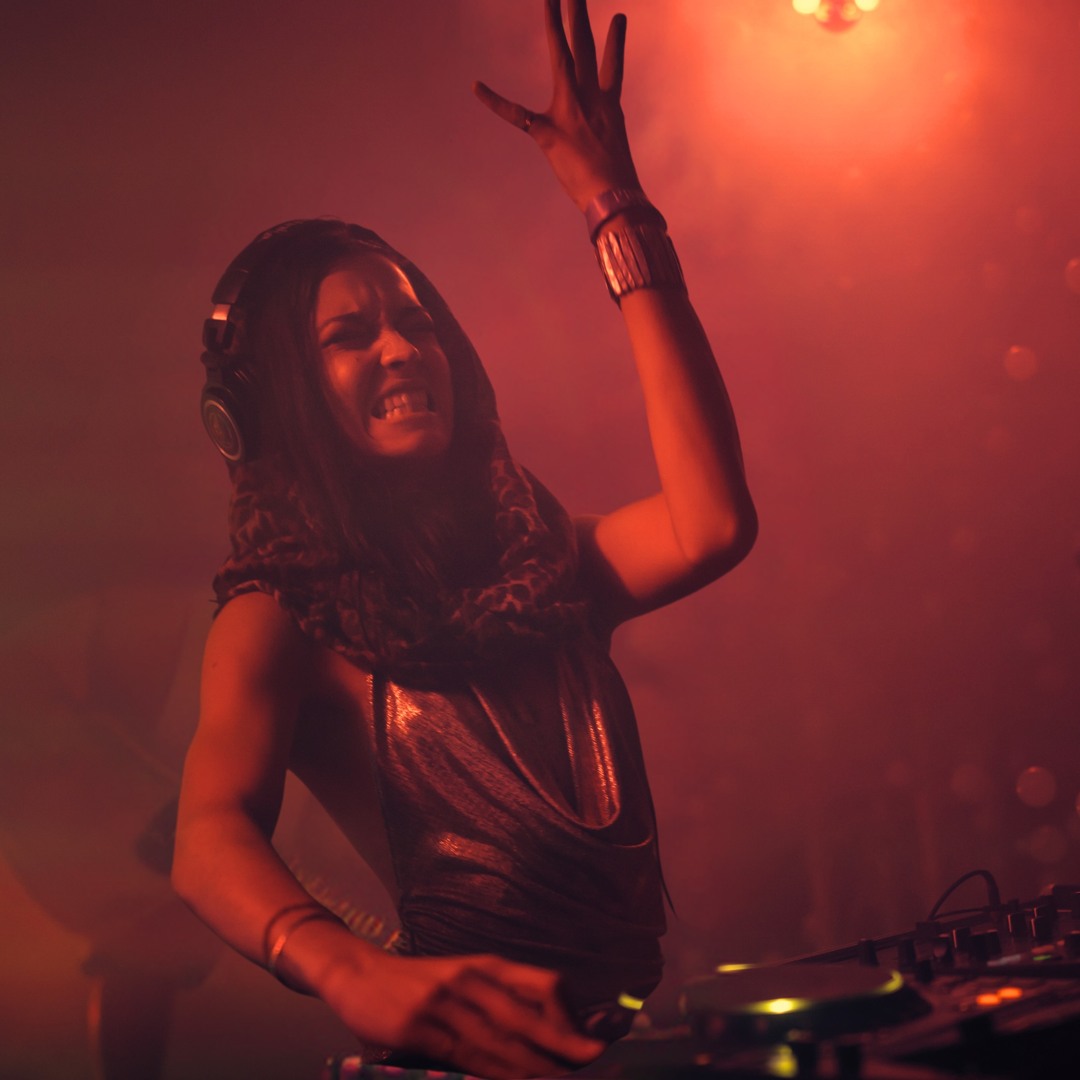

Leah Luna operates in a territory that didn't have a name until recently. She's a DJ and electronic music artist whose work refuses the old divisions—between party and practice, between bass-heavy dance floors and somatic awareness, between losing yourself and finding yourself. In an era when electronic music has split into a thousand micro-genres and wellness culture has become its own industry, Luna builds her sets in the overlap, where both can coexist without contradiction.
Her sound is rooted in bass house's visceral low-end punch, layered with the cyclic patterns of tribal percussion and woven through with oriental textures. But the technical description doesn't quite capture what she's after. Luna treats the DJ booth not as a spotlight but as a facilitation tool—a way to hold space for collective experience that's equal parts euphoria and embodied presence. Where many electronic artists choose either peak-time energy or downtempo ceremony, she's interested in the full spectrum, using tempo shifts and textural layering to move dancers between states.
Luna's performance history traces a specific geography: Berlin, Bali, New Zealand. These aren't random tour stops. They're nodes in a global network where underground electronic music scenes and wellness tourism infrastructure have grown into each other, creating something neither rave culture nor retreat culture could have anticipated alone. In these places, it's not unusual for a yoga teacher to play techno or for a festival lineup to include both sound healers and house DJs.
She's played at Morph Festival in New Zealand, an event that explicitly programs this overlap, treating conscious culture and dance music not as separate tracks but as variations on the same impulse. It's in these contexts that Luna's approach makes the most sense—where the audience arrives already familiar with the idea that a dance floor can be a container for transformation, not just a place to blow off steam.
One of Luna's notable contributions is the Ecstatic Boiler Room, a concept that borrows its structure from the UK's influential Boiler Room live-stream series but reframes the entire premise. Where Boiler Room built its reputation on performance—DJs playing to cameras as much as crowds, with the audience watching and judging—Luna's version centers embodiment. The format is the same, but the intention shifts. It's not about being seen; it's about being present.
This reframing is more than a branding exercise. It speaks to a larger argument Luna is making about what club culture can be when it's divorced from the performance anxiety that has come to define so much of social media-era nightlife. Ecstatic dance, with its emphasis on free movement and non-verbal expression, has traditionally existed in yoga studios and community centers, far from the bass bins and strobes. Luna's work asks: what happens when you bring those principles into a context that still sounds and feels like a party?
Luna's technical toolkit draws from bass house—a genre known for its warped, wobbling basslines and four-on-the-floor momentum—but she treats it as raw material rather than a fixed template. She layers in deep percussive grooves that reference tribal rhythm traditions, using repetition and polyrhythm to create trance-inducing patterns. The oriental textures add a third dimension, pulling the ear toward something older, less easily categorized.
The result is music designed to do more than soundtrack movement. Luna builds her sets to evoke memory and feeling, using the tools of electronic music production—loops, filters, builds, drops—to create emotional arcs. Her approach treats repetition not as monotony but as ritual, a way to move listeners past thought and into sensation. The goal is that state where you lose track of time, where the boundary between self and sound starts to blur.
Luna's work arrives at a moment when the contradictions in both club culture and wellness culture are becoming harder to ignore. Dance music has always promised transcendence, but somewhere along the way, many scenes became more about consumption—of image, of status, of the next release. Meanwhile, wellness culture has offered tools for presence and embodiment, but often in contexts that feel sanitized, expensive, or disconnected from joy.
Luna's contribution is to hold both at once. She argues, through her sets and her projects, that the rave and the retreat are not opposites but variations on a theme. That losing yourself and inhabiting the present moment aren't contradictory experiences—they might even be the same thing. That a room with a sound system can be as conducive to self-expression and emotional release as any ceremonial space.
Her audience is global but specific: people moving between cities and islands, between dance floors and yoga mats, between wellness and wildness. They're looking for experiences that don't ask them to choose between feeling good and feeling everything. In serving that search, Luna has carved out territory that didn't quite exist before—or at least, didn't have anyone naming it so clearly. She's building a practice that treats electronic music as a tool for collective presence, and in doing so, she's helping to redraw the map of where transformation can happen.