
Don Reed Simmons is not a songwriter in the conventional sense, and his catalog is better approached as sound practice than as songcraft. He is a meditation teacher, shamanic practitioner, hypnotherapist and therapeutic sound practitioner, and his recordings follow from that work. The public record does not itemize his discography, so this piece describes what the sources support and says plainly where they stop.
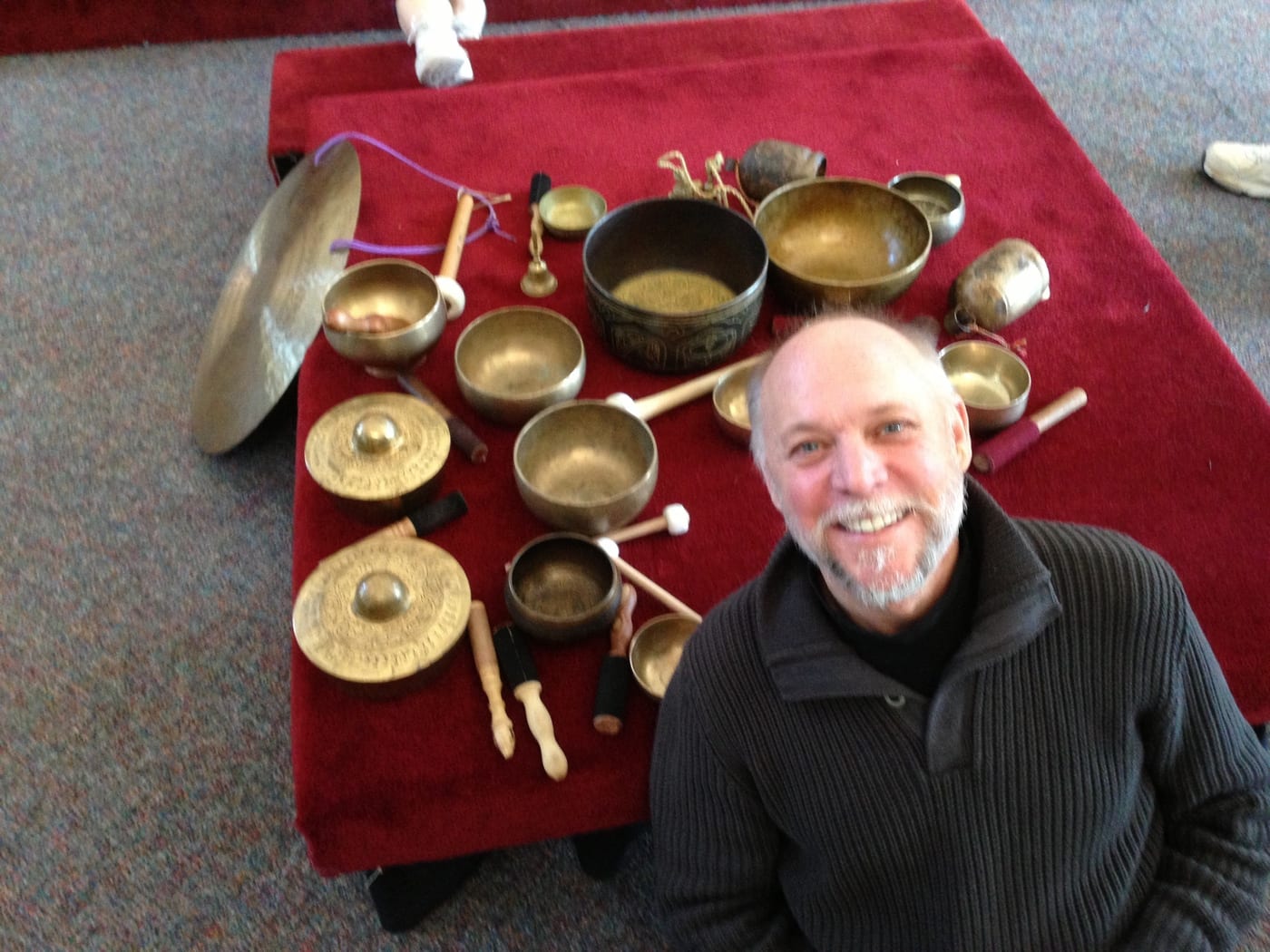
The core instruments are Tibetan bowls and crystal bowls, the tools of his therapeutic sound sessions. The defining quality of that palette is the sustained tone: a struck or played bowl blooms, holds and decays slowly. Music built on it is closer to a sound bath than a song, with overlapping resonances in place of melody and verse. His other recorded material is spoken: guided meditations and teaching talks on mindfulness and loving-kindness, available through his YouTube channel and website.
That means two textures sit side by side in his work: the bowl tones, which act on the body, and his teaching voice, which gives direction. The available sources do not document specific tempos, keys or vocal styles, and nothing suggests chanting or rhythmic song. Expect slow, unhurried material in which the sound does much of the work.
His music does not belong to a single devotional tradition. The bio names no bhakti or kirtan lineage, and none should be assigned to him. What it does name is several streams:
- Meditation study with Zen Master Thich Nhat Hanh and with Jon Kabat-Zinn, founder of Mindfulness-Based Stress Reduction.
- A Hawaiian kahuna who became his teacher and spirit guide in meditation, the foundation of "The Shamans Path to Awakened Living," which he has taught since 2005.
- Ho'oponopono, loving-kindness and compassion practices, which he has led as meditations.
- Clinical hypnotherapy since 1993, and Past Life Regression certification from Dr. Brian Weiss in 2009.
He is also president of the International Sound Therapy Association, where he created the Sacred Sound Ministry. The sound work sits inside that institutional frame, and the meditation and shamanic threads inform how he uses it.
If one thing distinguishes him, it is the combination: bowl-based sound work held within an accountable professional structure and a multi-tradition teaching practice. Many sound practitioners work alone. He leads an association and built the Sacred Sound Ministry program. His background also includes nearly 30 years in film and video production, including producing the docu-series "Mystic Lands," which likely shapes the polish of his recordings, though the sources do not describe the production details.
His outlook comes from a farm childhood in the South, two serious childhood illnesses, and a near-fatal scuba dive in Hawaii in the 1970s. Crisis counseling in New York, Los Angeles, Atlanta and Honolulu followed. The result is sound offered without spectacle, in a pragmatic register rather than a performative one.
He has performed and recorded with Steven Halpern and Jonn Serrie, both established figures in therapeutic and ambient sound. The sources do not say which recordings or events these involved, so it is best to treat them as confirmed associations rather than as a credited track list. They do place him within a community of sound-healing artists and not outside it.
Start with the voice. His own recommendation for newcomers is mindfulness and loving-kindness material, so begin with a guided meditation on YouTube. You will hear his teaching presence before you commit to anything longer.
Then try the bowls. Sound work can be an easier way in for people who find seated meditation difficult. Listen with nothing else competing for attention, because this is not background playlist music in the usual sense.
What may surprise you:
- The absence of beats, hooks or songs. If you want rhythm and momentum, this will not provide them.
- Sustained tones can be difficult for some listeners, and they are not for everyone.
- The tone around the sound is practical and grounded, not ornate. He does not dress the work in spiritual grandeur.
- The catalog is modest. He is not a mainstream-published artist, so you will probably need to seek the work out through donreedsimmons.com and YouTube.
On Spotify he has 25,650 followers under the mindfulness genre. That places him in the part of the conscious-music landscape where ambient, new-age, singing-bowl and sound-bath work overlaps with guided meditation. He is not part of the kirtan and devotional-song world, nor the festival circuit of rhythmic, participatory chant. His neighbors are the ambient sound-healing artists he has worked with, and teachers whose recordings serve a practice more than a listening session.
What sets him apart within that field is range. He draws on Zen-derived mindfulness, clinical mindfulness, Hawaiian shamanic practice, hypnotherapy and sound therapy, and keeps their distinctions intact instead of blending them into one vague spirituality. The music is one expression of that work, spare and slow, and meant to be used.