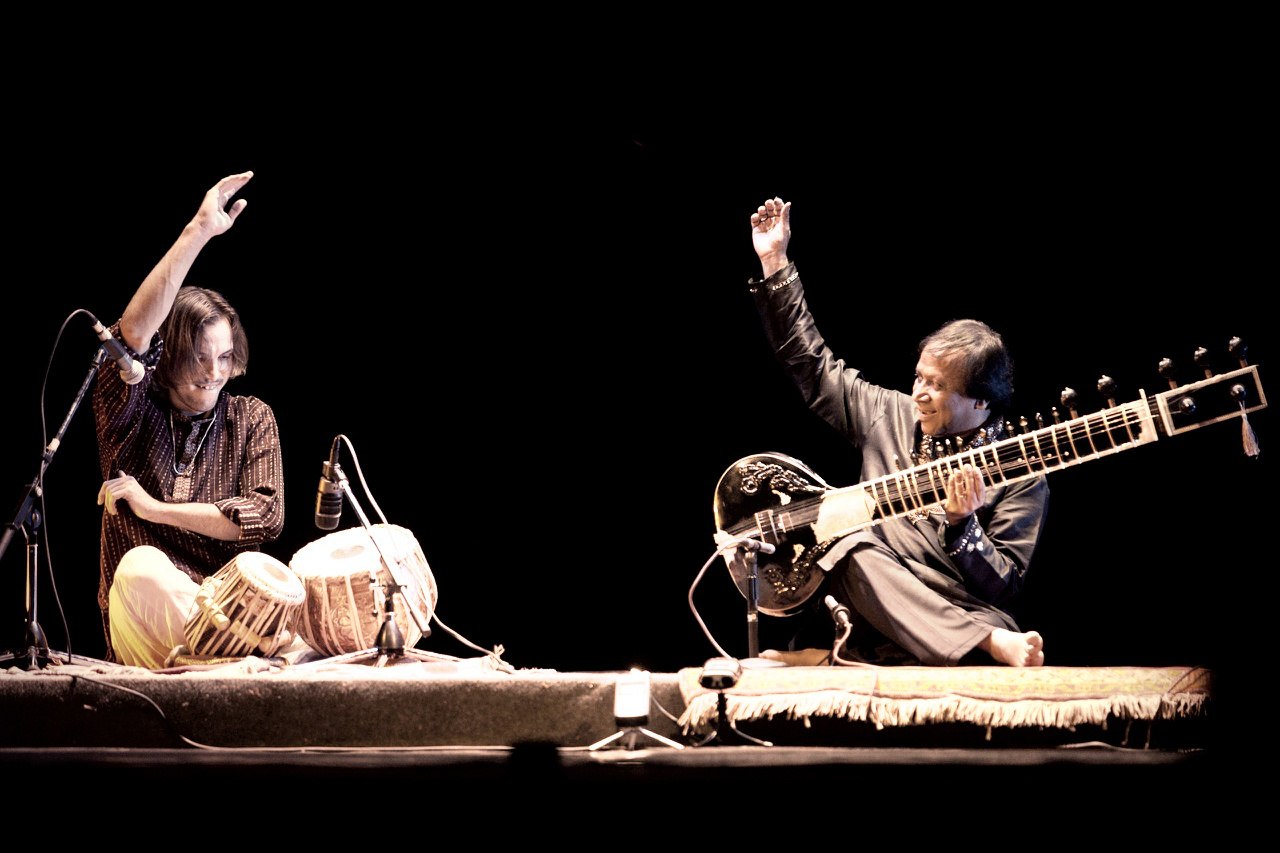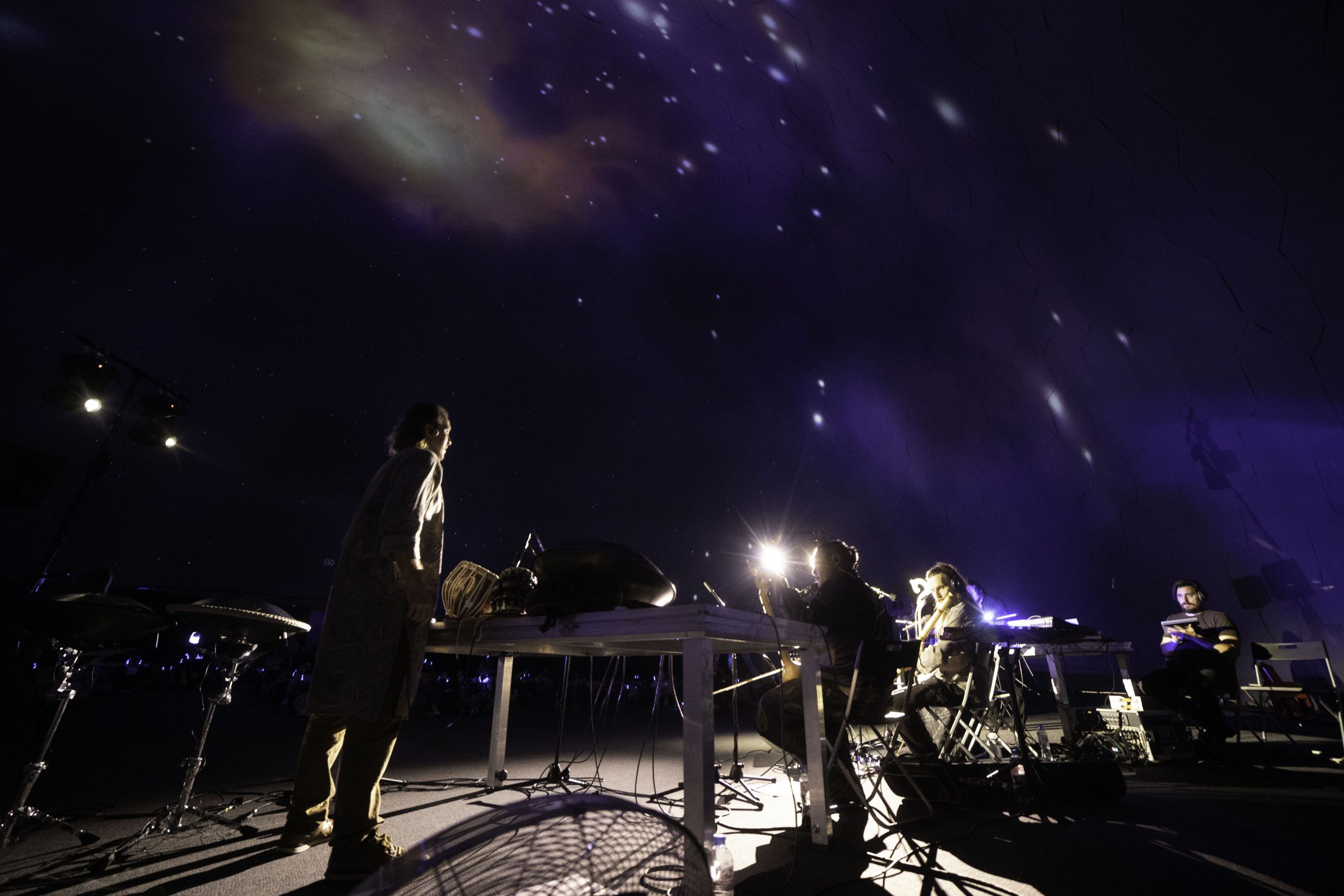

Denis Kucherov's music exists at the intersection of two distinct percussive worlds: the ancient rhythmic grammar of North Indian tabla and the lunar shimmer of the handpan, an instrument barely twenty years old. What emerges from this pairing is neither fusion nor juxtaposition, but rather a sustained conversation between wood and metal, between codified tradition and open experimentation. His compositions unfold in cyclical phrases, the tabla's crisp bols—the onomatopoetic syllables that define each stroke—punctuating the handpan's blooming sustain like punctuation marks in a sentence made of bells.
The first thing a listener notices is texture. Kucherov's work privileges acoustic resonance over rhythmic density. The handpan, with its convex steel body and tuned tone fields, generates cascading overtones that hang in the air long after the strike. Against this shimmer, the tabla enters not as accompaniment but as architectural frame—building taals (rhythmic cycles) that give the handpan's melodic wandering both structure and breath.
Tempos vary, but rarely rush. Much of Kucherov's composed work sits in meditative territory, with pieces that might sustain a single rhythmic cycle for five or six minutes, allowing micro-variations in attack and decay to become the primary content. When he does accelerate, it's through gradual intensification rather than sudden shift—think of water moving from stillness to boil rather than a gear change.
His voice as a composer is minimalist in the best sense: patient, committed to negative space, willing to let a single phrase repeat until it shifts from pattern to mantra. The handpan's scale limitations—most are tuned to specific modes—push him toward modal exploration rather than harmonic progression, creating soundscapes that feel less like songs and more like sonic environments.
Kucherov draws directly from the North Indian classical tradition, where tabla is not merely percussion but a complete language of rhythm. The tradition of tabla solo performance, with its elaborate compositions (qaidas, relas, tukras) and improvisational forms, provides the backbone of his rhythmic thinking. Yet he doesn't perform traditional tabla repertoire in the conventional sense. Instead, he extracts its principles—the concept of taal as cyclical time, the relationship between composition and improvisation, the idea that rhythm itself can be devotional practice.
The handpan, by contrast, has no ancient lineage. Born in Switzerland in 2000 with the creation of the Hang by PANArt, it belongs to a generation of "new acoustic" instruments that have found home in wellness spaces, busking circles, and sound healing practices. Kucherov approaches it with both reverence and rigor, refusing the New Age drift toward ambient wash while honoring the instrument's inherent meditative quality.
What places his work within a broader spiritual music context isn't lyrical content—there are no mantras, no bhajans, no sung devotion—but structural intent. Like kirtan's reliance on repetition to induce states of presence, or Sufi music's use of rhythm as pathway to dhikr (remembrance), Kucherov's compositions use cyclical time and acoustic immersion as contemplative technology.
Kucherov's particular innovation is treating these two instruments as a single expanded percussion system. Where most handpan players remain melodic and most tabla players remain rhythmic, he builds compositions where both roles blur. The handpan becomes percussive through staccato phrasing and rhythmic emphasis; the tabla becomes melodic through pitch bending and tonal variation. The result is music that feels whole rather than hybrid, a genuine third language rather than translation between two.
First-time listeners accustomed to devotional music with vocals may find Kucherov's instrumental focus unexpectedly demanding. Without lyrics to anchor attention, the music asks you to follow rhythm and timbre as primary text. But this is also its strength: the absence of semantic meaning allows the sound to work pre-verbally, affecting breath and nervous system before engaging interpretation.
What may surprise: the precision. This isn't background music or sound-bath ambience. Kucherov's tabla training means even his most meditative work carries rhythmic exactitude. Each stroke matters. Each cycle completes. The spaciousness is intentional, not vague.
In the conscious-music ecosystem, Kucherov occupies rare territory. He's too rhythmically sophisticated for the sound healing world, too devotionally oriented for the contemporary classical percussion scene, and too instrumentally focused for the kirtan circuit. He shares aesthetic ground with artists like Manu Delago (who also bridges handpan and broader compositional ambition) and tabla innovators who work outside pure classical contexts, but his commitment to acoustic-only performance and retreat-based listening environments sets him apart from studio-centered production.
His music is best encountered live or in settings designed for attentive listening—precisely the environments he curates through his retreat work. In an age of algorithmic playlists and distracted streaming, Kucherov's practice insists on music as temporal commitment, as shared duration, as something that asks you to arrive and stay.