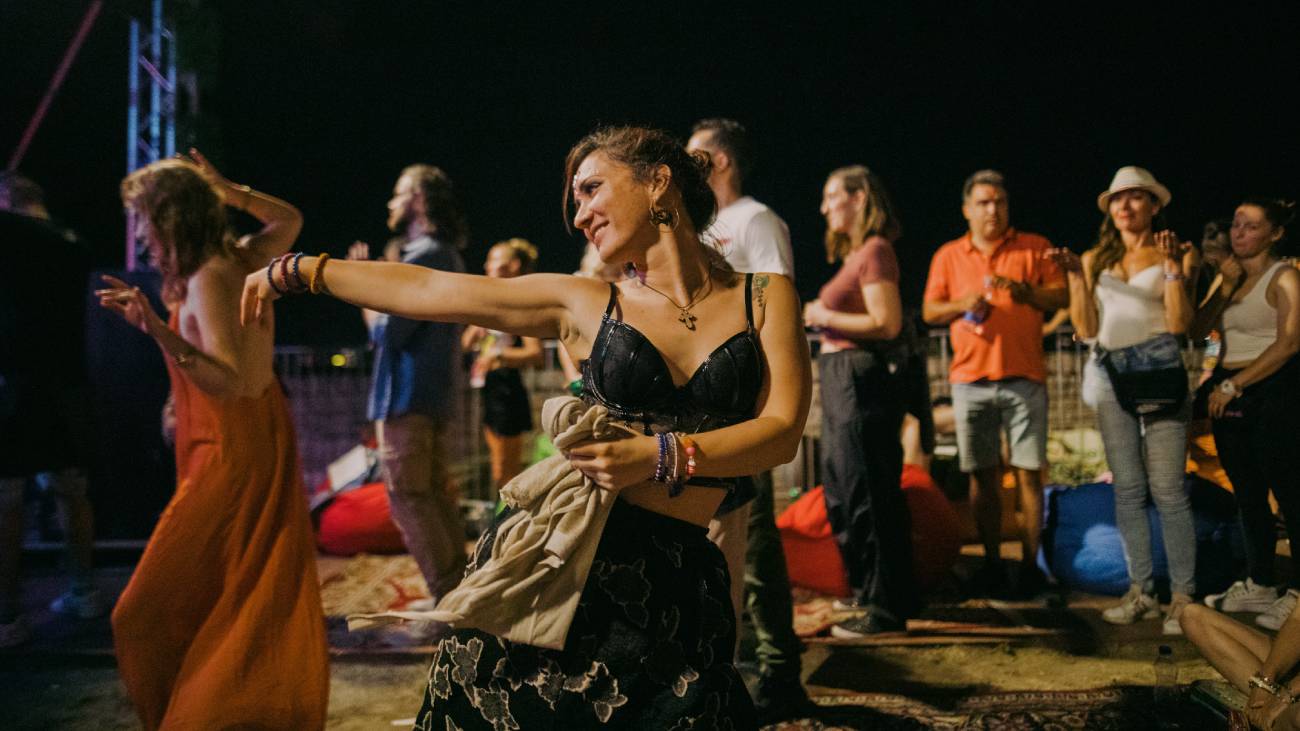

In an era when meditation apps and wellness retreats proliferate endlessly, Bruna Bortolato has carved out a distinctive space as a movement artist and experience curator whose work refuses easy categorization. Her practice sits at the intersection of rhythm, somatic movement, and ceremonial gathering—a place where the body becomes both instrument and archive, and where collective presence emerges not through instruction but through carefully structured improvisation.
Bortolato's work centers on a deceptively simple premise: that rhythm functions as what she calls a "vehicle for embodied connection and shared ritual." Rather than treating movement as performance or percussion as entertainment, she approaches both as technologies of transformation—tools for accessing states of awareness that evade purely intellectual or verbal practices.
While the specifics of Bortolato's early life remain undocumented, what emerges clearly from her work is a practice shaped by years of direct participation in ceremony and retreat settings across South America and Europe. This isn't the résumé of a weekend workshop enthusiast, but rather the deep familiarity of someone who has spent significant time in contexts where rhythm and movement serve purposes far removed from the commercial wellness circuit.
Her background includes training in contemporary dance and contact improvisation, along with engagement with various lineages of sacred movement. She has studied with teachers working in established modalities of ecstatic and authentic movement, though her mature practice deliberately resists strict adherence to any single system. This eclecticism isn't dilettantism—it's a considered choice to draw from multiple streams while maintaining her own coherent vision.
What distinguishes Bortolato's work from both traditional dance and conventional wellness offerings is her specific use of rhythm as what she describes as "scaffolding for group coherence." In her sessions, rhythm isn't background music or a beat to follow—it's structural architecture, creating conditions under which participants can enter trance states or heightened awareness without force or artifice.
Her approach integrates improvised movement with both live and recorded percussion, often building experiences around cyclical patterns that allow groups to synchronize without explicit choreography. The effect, according to those who have participated, is less like attending a class and more like entering a temporary autonomous zone where normal social hierarchies dissolve and bodies find their own intelligence.
Bortolato emphasizes that her work creates spaces where "participants access presence through the body rather than the intellect"—a crucial distinction in a culture that has intellectualized even its attempts to escape intellectualization. Her sessions attract trained dancers and complete novices alike, offering what she frames as an accessible alternative to talk-based or seated meditation practices.
Bortolato works across multiple formats, from intensive workshops to one-off immersive evenings. She frequently collaborates with sound healers, vocalists, and other somatic practitioners, creating layered experiences that draw on multiple sensory and energetic registers simultaneously. These aren't performances with audiences, but participatory containers where everyone present contributes to the collective field.
Her work has taken her across Brazil, Portugal, and other Portuguese-speaking communities, often operating in multilingual contexts that reflect the increasingly globalized nature of somatic and spiritual practices. She draws participants from overlapping circles—the wellness community, the contemporary dance world, and those involved in various spiritual traditions—creating temporary communities united less by shared beliefs than by shared embodied experience.
In a landscape increasingly dominated by branded methodologies and trademarked techniques, Bortolato's resistance to systematization matters. She offers something rarer than another certified program: a practice that honors lineage without calcifying into dogma, that creates structure without imposing rigidity.
Her emphasis on accessibility is significant. In contexts where "sacred movement" can carry connotations of exclusivity or require expensive training certifications, Bortolato maintains that rhythm and embodied presence should be available to anyone willing to show up. Her sessions welcome both trained dancers and those who have never moved consciously in their lives, creating containers where technical skill matters far less than willingness to be present.
Bortolato continues to facilitate experiences that bridge somatic movement, percussion, and ceremonial gathering, maintaining her focus on rhythm as a vehicle for transformation rather than entertainment. Her work represents an ongoing inquiry rather than a finished system—a practice that evolves as she evolves, shaped by each group she works with and each context she inhabits.
What she offers ultimately is not a method to be learned but an invitation to remember what bodies already know: that rhythm can synchronize groups, that movement can dissolve isolation, that presence emerges not from effort but from the right conditions. In a fragmented world increasingly mediated by screens and abstraction, this is work that matters—not because it promises transcendence, but because it offers the more modest and more radical possibility of simply being here, together, now.