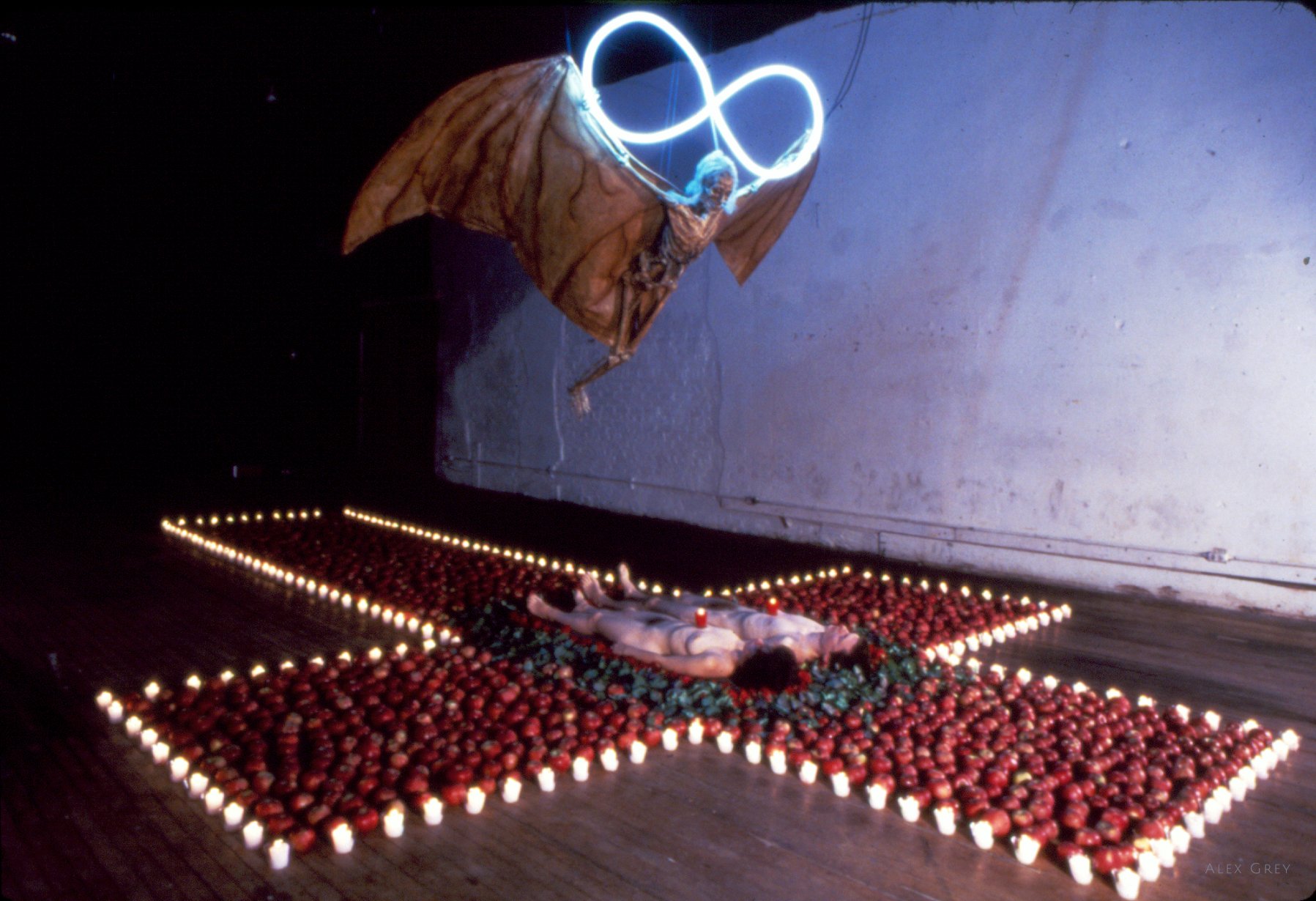
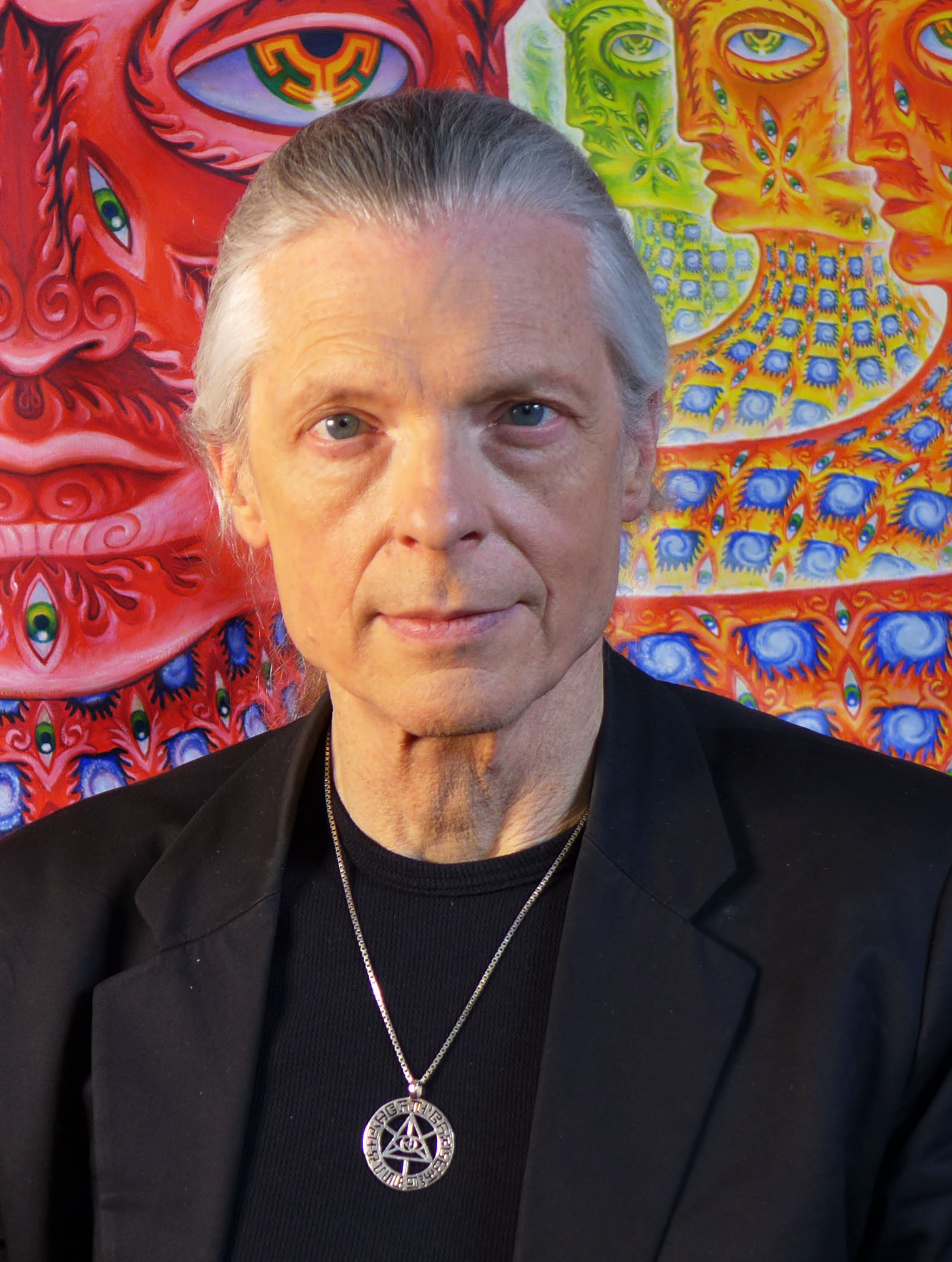
Alex Grey occupies a singular position in contemporary American art: a painter whose canvases function simultaneously as medical illustration, religious devotional object, and map of transcendent experience. Born in 1953, Grey has spent four decades developing a visual language that renders the human body not as solid flesh but as translucent architecture—skeleton, muscle, organs, and luminous energy fields existing in a single layered frame. His work has become something more than art in the conventional sense; for many viewers, it serves as a mirror for inner experience, a visual grammar for states of consciousness that typically resist representation.
This is painting in service of something larger than aesthetics. Grey's canvases ask to be encountered as aids to meditation, tools for self-recognition, doorways into what he calls "visionary consciousness." They sit uneasily in the white-cube gallery system, finding more natural homes in psychedelic culture, yoga studios, transformational festivals, and the private altars of those seeking visual language for mystical experience.
The trajectory of Grey's practice pivots on a single catastrophic moment. In 1975, Grey attempted suicide. The attempt failed; resuscitation brought him back. What returned, by his own account, was fundamentally altered. The experience shattered and reconfigured his understanding of consciousness, embodiment, and the relationship between physical form and whatever animates it.
This near-death experience became the generative wound from which his mature work emerged. Grey had already studied painting at the School of the Museum of Fine Arts in Boston, learning the technical foundations of his craft. After his resuscitation, he moved to New York and began the difficult work of translating what he had experienced into visual form. The question became: how do you paint the body when you've seen beyond it? How do you render flesh when you've experienced it as temporary shelter for something larger?
Grey's answer arrived in 1979 when he began the Sacred Mirrors series, the body of work that would establish his reputation and define his contribution to contemporary visionary art. These large-scale paintings depict the human figure in serial progression: skeletal system, cardiovascular system, nervous system, organs—but they continue beyond conventional anatomy into territory medical illustration cannot map. Paintings show chakra systems, energy meridians, psychic anatomy, the subtle body described in tantric philosophy but rarely visualized with such anatomical precision.
The innovation lies in Grey's technique of layering. His signature approach renders these systems not as separate images but as translucent overlays, creating compositions where skeleton, muscle, and luminous energy field occupy the same space. The effect is not abstract; Grey insists on anatomical accuracy even as he pushes beyond material form. This precision distinguishes his work from other visionary artists who favor abstraction or pure symbolism. Grey's bodies are specific, medical, verifiable—and simultaneously transcendent.
The Sacred Mirrors function, as their name suggests, as reflective surfaces. Life-sized, positioned at standing height, they invite viewers to recognize their own structure in the painted figures. This isn't representation to be admired from a distance but identification to be inhabited.
In 1993, Grey completed Transfiguration, a monumental canvas that would become one of his defining works. The painting has found permanent installation in the chapel Grey would later establish—a space designed specifically for contemplative encounter with visionary art. Transfiguration extends the Sacred Mirrors' logic into vertical ascent, depicting consciousness expanding beyond individual form into universal radiance.
Grey's practice expanded beyond painting into articulation of philosophy. His 1998 book The Mission of Art stands as the clearest statement of his understanding: that visionary art is not decoration but spiritual discipline, that the artist's role is to map and transmit direct experience of consciousness. The text has circulated widely in communities exploring the intersection of art, meditation, and psychedelic experience, becoming a kind of handbook for those seeking to understand creativity as contemplative practice.
Additional writings appear in Art Psalms and documentary films that chronicle both his technical process and the theological framework animating it. Grey teaches as well as paints, positioning himself explicitly as spiritual teacher alongside visual artist.
Grey's work has found its audience outside conventional art world structures. His paintings appear on album covers, festival stages, and in the personal collections of those navigating consciousness through meditation, plant medicines, or other technologies of transcendence. He has become, almost accidentally, the house painter of contemporary psychedelic culture—the artist whose imagery provides visual vocabulary for experiences that fragment language.
This positions him in an unusual place: too mystical for the mainstream art market, too technically accomplished and philosophically serious to dismiss as subcultural novelty. His influence flows through multiple streams—transformational festival culture, the mindfulness movement, contemporary explorations of psychedelics in therapeutic contexts, and among practitioners of yoga and tantric philosophy seeking imagery that reflects their practice.
Grey's significance lies precisely in this bridging function. He has created a visual language that makes the invisible visible, that insists consciousness can be mapped with the same precision as cardiovascular systems, that treats mystical experience as empirical observation rather than fantasy. Whether or not viewers share his cosmology, the paintings function—and that functionality, that usefulness to people navigating the vast interior territories of consciousness, constitutes his enduring contribution.
