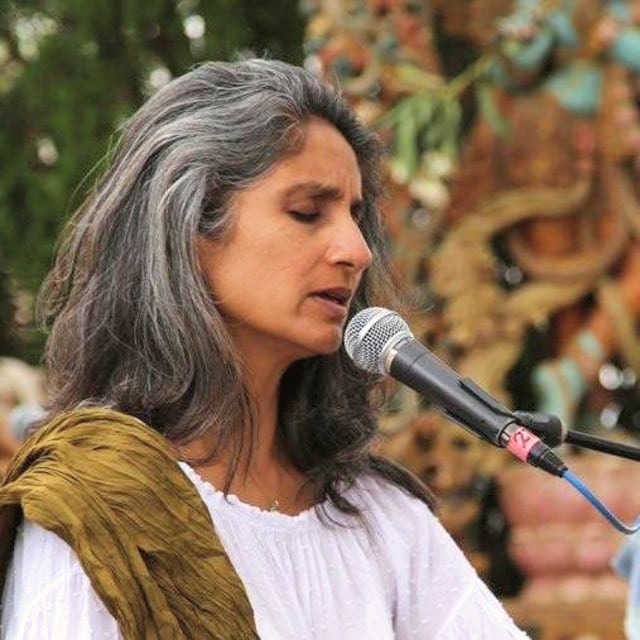
Shyama Chapin
Co Vocalist
Über
Shyama Chapin was born into a musical family, where the sounds of devotional music filled her early years. Growing up in a nurturing environment that celebrated creativity and spirituality, she was introduced to the rich traditions of kirtan and bhajan from a young age. Her early experiences shaped her understanding of music as a form of spiritual expression, leading her to explore various genres and styles. This foundation laid the groundwork for her lifelong journey in music, where she would eventually find her voice as a co-vocalist in the spiritual music community.
Shyama Chapin was born into a musical family, where the sounds of devotional music filled her early years. Growing up in a nurturing environment that celebrated creativity and spirituality, she was introduced to the rich traditions of kirtan and bhajan from a young age. Her early experiences shaped her understanding of music as a form of spiritual expression, leading her to explore various genres and styles. This foundation laid the groundwork for her lifelong journey in music, where she would eventually find her voice as a co-vocalist in the spiritual music community.
In her work, Shyama Chapin has collaborated with numerous artists and has been a prominent figure in the kirtan scene. Her discography reflects a deep commitment to creating music that resonates with the heart and soul. Through her powerful vocals and heartfelt performances, she invites listeners to connect with their inner selves and the divine. Shyama's music often features traditional chants and mantras, infused with contemporary melodies that make them accessible to a wide audience. Her teaching style emphasizes the importance of community and collective singing, fostering a sense of belonging among participants.
Shyama's influences are deeply rooted in the teachings of her spiritual lineage, which emphasizes the transformative power of sound and devotion. She draws inspiration from various traditions, including Hinduism and the teachings of her guru, who instilled in her the importance of bhakti, or devotional love. This lineage has shaped her approach to music, encouraging her to explore the depths of spiritual expression through song. The impact of her influences is evident in her performances, where she seamlessly blends traditional elements with her unique artistic vision.
Today, Shyama Chapin stands out as an important figure in the spiritual music landscape. Her ability to connect with audiences on a profound level makes her performances not just concerts, but transformative experiences. In a world that often feels disconnected, her music serves as a reminder of the power of community and the sacredness of sound. As she continues to share her gifts, Shyama inspires others to embrace their own spiritual journeys through the universal language of music.


Questions
Shyama Chapin is a co-vocalist and kirtan artist rooted in devotional music traditions, known for blending classical Sanskrit chants with contemporary melodic sensibilities to create accessible spiritual experiences. Born into a musical family where devotional music was foundational, she grew up immersed in the sounds of kirtan and bhajan—traditions that emphasize communal singing and the transformative power of sacred sound. Her work stands out not for novelty but for her ability to honor traditional lineage while making these practices relevant to contemporary audiences seeking genuine spiritual expression rather than commodified wellness. What draws listeners and students to her performances is her commitment to bhakti, the devotional love that animates her vocal work and her teaching approach. She functions as both performer and spiritual music teacher, which means her concerts operate as participatory events rather than passive consumption—audiences are invited into collective singing, not just observation. Her presence in the kirtan scene has made her a trusted guide for people exploring devotional practice through sound and community.
Shyama Chapin's practice emerges from bhakti traditions—the Hindu devotional lineages that prioritize emotional surrender and divine love expressed through sound and mantra. Her work is deeply informed by her guru and the spiritual teachings passed through her lineage, which emphasize that sound itself is a sacred technology for transformation and connection to the divine. The kirtan and bhajan practices she centers are anchored in centuries of Sanskrit devotional poetry and melody, yet her approach updates these forms for contemporary practitioners without abandoning their ritual integrity. Her lineage specifically stresses the importance of bhakti—heartfelt devotion—as the animating force behind all authentic spiritual music, which shapes both how she performs and how she teaches others to engage with these practices. This is not a casual or experimental adoption of Eastern music; her training and upbringing positioned her within an actual transmission of these traditions, making her a conduit rather than an outside interpreter. The emphasis on community and collective singing that defines her work is itself a lineage principle—these are not soloistic concerts but group devotional events in the bhakti model.
The most direct entry point is her 2018 album *Love's Door*, a 10-track collection that demonstrates her full range as a co-vocalist while remaining cohesive in its devotional sensibility. This album balances accessibility—contemporary melodic structures and production choices—with traditional content, making it ideal for listeners unfamiliar with Sanskrit mantras or kirtan conventions but ready to engage seriously with the material. Newcomers should listen with the understanding that this is not background music or meditation soundtrack material in the ambient sense; *Love's Door* invites active listening and, ideally, participation or singing along. For those drawn to specific deities or practices, the live single *Sarasvati Hanuman Chalisa (Live)* from 2022 offers a window into how her work functions in real performance contexts, capturing the communal energy that defines kirtan practice. Her website at shyamachapin.com likely contains additional resources, teaching offerings, or upcoming performance dates that can provide context for her current work. The key is approaching her music not as entertainment but as an invitation into a spiritual practice—newcomers who resist that frame may miss what makes her work distinctive compared to other devotional artists trading in similar sounds without the lineage grounding.
Shyama Chapin's distinction rests on her dual commitment to rigorous lineage transmission and genuine accessibility—she doesn't dilute traditional practice to reach wider audiences, but she also doesn't gatekeep behind obscure Sanskrit or performative austerity. Having grown up immersed in devotional music within a spiritual family, she carries an authenticity of upbringing that differentiates her from practitioners who came to these traditions later as adults seeking spiritual identity; this early foundation informs both the technical precision of her singing and the emotional depth of her performances. Her specific strength as a co-vocalist is her ability to hold space for collective participation without ego—she's designed to facilitate group singing, not to dominate as a featured performer, which is philosophically aligned with bhakti principles in a way that many contemporary spiritual music artists unconsciously resist. The selection of pieces she returns to—*Sarasvati Hanuman Chalisa*, *Prarthana Sri Durga Chaleesa*, the material on *Love's Door*—suggests a focus on goddess-centered and protective devotional content, a specific theological emphasis that shapes her artistic identity. Unlike kirtan artists who blend world music production aesthetics or electronic elements, her work maintains a more traditional sonic palette while still sounding contemporary, which appeals to purists and newcomers alike. Her teaching approach, rooted in community singing rather than individual achievement or transformation narratives, positions her differently in a market where many spiritual music teachers emphasize personal transcendence.
Listeners seeking high-production-value, genre-hybrid spiritual music with electronic elements, world-music fusion, or pop-influenced arrangements will likely find her work too traditional and sonically restrained. If you're looking for devotional music as ambient background content—sleep soundtracks, yoga class underscore, or passive wellness consumption—her emphasis on participatory, active listening and community singing creates friction with that use case. Audiences uncomfortable with Sanskrit language, Hindu theological frameworks, or explicit devotional framing (invoking specific deities like Durga and Hanuman) will find the content less accessible than secular mindfulness music or generic "spiritual" recordings. Those who prefer virtuosic vocal displays or soloistic performance models may experience her co-vocalist approach, which prioritizes group participation over individual artistry, as diminishing rather than elevating. Kirtan practice itself demands something from participants—it's not passive entertainment, which means listeners seeking music that doesn't require anything from them will feel the work's demands as a barrier rather than an invitation. Finally, practitioners from non-Hindu traditions or those seeking religiously neutral spirituality will encounter a specifically Hindu-rooted practice in her lineage, which is honest transparency rather than an attempt at universal appeal.
Shyama Chapin's voice is a clean, well-trained alto that prioritizes clarity and emotional directness over virtuosity or elaborate ornamentation; she sings with restraint, allowing the mantras and devotional poetry to carry weight rather than using her voice as a vehicle for technical display. Her arrangements favor acoustic instrumentation—particularly harmonium, which is traditional to kirtan practice—alongside strings and minimal percussion, creating a sonic landscape that is intimate and spacious rather than lush or layered. The pacing of her work is deliberate and often contemplative, with melodies that allow for group participation and call-and-response patterns central to bhakti singing, meaning her songs function as communal events rather than fixed compositions meant for passive reception. What distinguishes her sound from generic New Age devotional music is the absence of background atmospheric pads or ethereal production; instead, there's a grounded, almost chamber-music aesthetic where each element—voice, harmonium, strings—occupies distinct sonic space. Her pieces tend toward moderate tempos that invite singing along rather than either meditative slowness or ecstatic acceleration, reflecting the bhakti principle that devotion is steady rather than effusive. The overall effect is reverent without being cold, accessible without being dumbed down, and rooted in tradition while remaining sonically present to contemporary ears.
*Love's Door* (2018) remains her primary full-length album and the most comprehensive introduction to her artistic vision, containing ten tracks that showcase both her range as a co-vocalist and her commitment to blending traditional mantras with contemporary melodic structures. The single *Prarthana Sri Durga Chaleesa* (2018) is essential listening for understanding her theological focus on goddess-centered devotion, specifically the protective and fierce aspect of the divine represented by Durga—a thread that recurs throughout her work. *Sarasvati Hanuman Chalisa (Live)* (2022) captures her work in a live performance context, offering insight into how she facilitates kirtan as participatory community practice rather than staged performance; this recording demonstrates the difference between her studio work and her role as a spiritual music teacher and group facilitator. Together, these three recordings—the full album, the studio single focused on Durga, and the live single featuring Saraswati and Hanuman—create a coherent picture of her artistic priorities and devotional commitments. Listeners seeking to understand her work comprehensively should start with *Love's Door*, then explore the singles to understand her specific deity-focused practice. Her Spotify catalog remains modest, which reflects either selective recording choices or limited commercial distribution, but what exists is consistent in quality and intentionality.
While Shyama Chapin's work is rooted in devotional traditions that include meditative and contemplative elements, it's important to note that her approach is fundamentally different from secular meditation or yoga music—her pieces are designed for active participation in kirtan and bhajan practice, not for passive background listening during asana or meditation. *Love's Door* as a full album contains material suited for personal spiritual practice and reflection, though the songs function best when engaged with actively rather than absorbed unconsciously. The *Sarasvati Hanuman Chalisa (Live)* single captures a ritual chant context that could absolutely support ceremonial or devotional practice, particularly for those already grounded in Hindu traditions or familiar with the specific deities and their associations. Her work is most authentically used within kirtan circles—group singing events designed specifically for spiritual transformation through collective sound and devotion—rather than as accompaniment to other practices. If someone is seeking to integrate her music into yoga classes or meditation sessions, they should understand they're extracting the material from its designed context; the integrity of her practice is in community participation and conscious engagement with mantras, not in providing sonic ambiance. For anyone serious about using her music ceremonially or meditatively, the more authentic approach would be to engage with her as a spiritual music teacher and join her in actual kirtan or devotional singing events rather than consuming her recordings in isolation.
Shyama Chapin's teaching approach is fundamentally rooted in community and collective singing rather than individual instruction or transformation narratives—she functions as a facilitator and guide for group kirtan practice, emphasizing that the power lies in shared devotion and community resonance rather than in her individual expertise. Her teaching style draws directly from her lineage emphasis on bhakti, meaning she prioritizes heartfelt engagement and emotional openness over technical perfection or intellectual understanding of Sanskrit meanings. Those studying with her or attending her kirtan sessions should expect participatory events where singing together is the primary practice—this is not lecture-based teaching or passive learning but active engagement in the mantras and devotional songs themselves. Her background in a musical family and her training in traditional kirtan mean her teaching likely includes technical guidance on melody, call-and-response patterns, and how to engage physically and emotionally with the chants, but always in service of deepening devotional connection rather than achieving musical proficiency. The experience of working with her would involve learning specific chants, understanding the deities or practices associated with them, and experiencing how group singing creates a field of collective spiritual resonance. Her emphasis on community means sessions are likely open to all levels of experience—there's no assumed background in Sanskrit, Hinduism, or music theory required, only openness to participatory devotional practice.
Goddess-centered devotion emerges as a primary theological focus across her recorded work, particularly through pieces devoted to Durga (*Prarthana Sri Durga Chaleesa*) and Sarasvati (*Sarasvati Hanuman Chalisa*), suggesting a specific lineage emphasis on the protective, creative, and fierce aspects of the divine feminine. Protection, grace, and the power of sacred sound to invoke and embody divine attributes appear as recurring themes, consistent with traditional bhakti theology where mantras and chants are understood as direct invocations capable of transformation and blessing. Her work emphasizes devotion not as intellectual belief but as felt, embodied practice—the consistent choice to facilitate group singing rather than deliver teachings suggests her commitment to bhakti as something lived and experienced collectively rather than understood theoretically. The presence of both warrior-goddess energy (Durga) and wisdom-goddess energy (Saraswati) indicates a theological framework that honors multiple dimensions of divine power and blessing, rather than a one-note approach to spirituality. Her choice of traditional chalisa and devotional texts points toward a lineage grounded in Vedic and puranic Hindu traditions rather than syncretistic or universalized spirituality, which is a specific theological commitment worth noting. The emphasis on community singing and shared participation reflects the bhakti principle that collective devotion amplifies the transformative power of sound, making the gathering itself sacred rather than treating the music as means to individual enlightenment.


Bist du das? Diese Seite beanspruchen ›
There's more where this came from.
BrightStar is the global directory of artists, teachers, and healers in the wellness and spiritual movement. Find your next experience — or add yourself.
Discover More Artists
Browse 14,000+ curated profiles across kirtan, yoga, meditation, and beyond.
Explore directory →Find an Event Near You
Kirtan, retreats, sound baths, breathwork, ceremonies — happening this week.
Browse events →Add Your Profile
Are you an artist, teacher, or healer? Get listed — free, AI-assisted, live in minutes.
Get started →