The opening lines of "Starchild" settle into the listener's chest like a recognition: "You know I'm here / Everywhere and always, all the time." It's a declaration of presence so familiar it borders on intimate—the voice of someone who has returned to us across a distance we never quite measured, and yet always knew was there. What follows is not a song of answers but a song of navigation, a map drawn by feeling rather than certainty.
At its core, "Starchild" grapples with one of the oldest questions in mystical tradition: the sense of exile from something we've never truly left. The lyrics reveal a speaker caught between two simultaneous realities. There is presence—absolute, eternal, here-now—and there is longing. There is purpose and the forgetting of it. There is driving force and the inability to name it. This is not contradiction; it is the actual texture of the spiritual journey, the gap between what we know to be true and what we can feel in our bodies.
The refrain "Sweet the sadness in my aching soul / Longing for the home that I used to know" is the emotional lynchpin. Notice the word "sweet." This is not bitter exile. The longing itself is recognized as a precious thing—a proof of connection, a tuning fork that still resonates. In mystical language, this ache is often understood as viraha, the Sanskrit term for the pain of separation from the beloved, from the divine. It's not pathology; it's a kind of remembrance that keeps the soul awake.
The second verse shifts ground: "You know I fear / Everything and nothing, most the time." Here the song moves from loss into the texture of daily life—the ambient anxiety that comes with consciousness itself. Yet even fear is met with a particular spiritual literacy. To fear everything and nothing simultaneously is to recognize that fear is fundamentally about perspective, about the stories we tell about what can harm us.
"Praying for those better days that I remember" introduces another layer: these "better days" are not entirely in the future. They exist in memory, in the "higher mind," which suggests they exist outside time altogether. This is a sophisticated spiritual understanding—that the solution, the wholeness, the home we seek is not a destination we're traveling toward but a dimension of awareness we're traveling back into.
The chorus—"But I'm holding on / I'm loving hard / I'm living for a better world"—is the turning point. It moves from lamentation and fear into active choice. This is where the song reveals its true teaching. Despite the ache, despite the fear, despite the forgetting of purpose, there is a decision being made: to hold on, to love with intensity, to orient the whole life toward collective healing.
This three-fold commitment—holding on (persistence), loving hard (vulnerability and intensity), living for a better world (service)—is a complete spiritual practice in miniature. It doesn't require enlightenment. It doesn't require answers. It requires only the choice to remain in relationship with hope, with each other, and with the vision of something better. The song repeats this refrain with increasing insistence, as if the repetition itself is an incantation, a mantra that rewires the nervous system toward possibility.
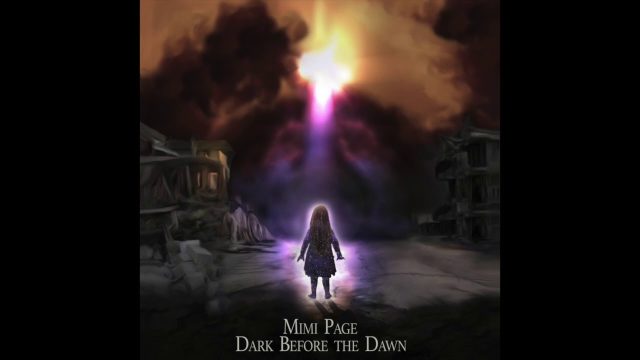
"Starchild" appears on the EP Dark Before the Dawn, a title that itself carries spiritual weight. The image invokes the darkest hour before sunrise—that moment when faith is most tested because the morning is not yet visible. This is the context in which the song operates: not in the clarity of day but in the willingness to love and hold on when the darkness is most complete.
The musical setting—Page's contemplative vocal style paired with compositional depth—creates a space where these words can land with their full weight. The production serves the message: this is not entertainment disguised as spirituality, but genuine inquiry given form.
The final repetition of "Better World / Better World" is not naive optimism. It's insistence. It's the kind of repetition that appears in prayer, in protest, in the sustained practices of cultures that have learned to survive and transcend oppression through the power of vision. The refrain becomes a vow renewed, a promise renewed, a commitment renewed—moment by moment.
"Starchild" ultimately teaches that the spiritual path is not about achieving perfect presence or eliminating fear or recovering a lost home in any literal sense. It's about what we do while longing. It's about the choice to hold on, to love, to build toward a better world—not someday, but now, in the midst of the darkness, with the ache still in our soul and the memory of home still alive in our higher mind.
To sit with "Starchild," listen as you would a chant. Notice where the words land in your own experience—where the longing is real, where the fear is real, where the commitment to love becomes tangible. The full EP Dark Before the Dawn is available across major platforms: Bandcamp, Spotify, and iTunes. The song invites not passive consumption but active participation in the vision it holds.