Transcript
[0:00] 501c3
[0:02] Consciousness and Healing Initiative, an
[0:05] international collaborative of
[0:06] scientists, healing practitioners,
[0:09] educators, and artists who lead humanity
[0:12] to heal ourselves. Dr. Shamini Jain also
[0:15] serves as an adjunct professor at
[0:18] University of California, San Diego's
[0:20] Department of Family Medicine, where she
[0:23] supports whole health education within
[0:26] the
[0:27] UCSD
[0:28] Centers for Integrative Health.
[0:31] Dr. Shamini Jain is a clinical
[0:34] psychologist and an award-winning
[0:36] researcher and author in psycho neuro
[0:40] immunology, integrative health, [snorts]
[0:42] and biofield science. Dr. Shamini Jain
[0:45] is a sought-after speaker and teacher
[0:48] with ample media experience related to
[0:51] biofield healing research and education,
[0:54] including national television placements
[0:58] to TED talks and regular talks at
[1:00] universities as well as leading health
[1:03] conferences and retreat centers. Her
[1:06] two-time award-winning book, Healing
[1:08] Ourselves, Biofield Science and the
[1:11] Future of Health is available from
[1:14] booksellers worldwide. Dr. Shamini Jain
[1:17] is also a singer with a background in
[1:20] bel canto and musical theater, rock,
[1:23] metal, and mantra. Nice combination.
[1:29] And her breakthrough debut album, Kali
[1:33] Yuga Blues,
[1:34] can be found on your favorite music
[1:36] streaming platform.
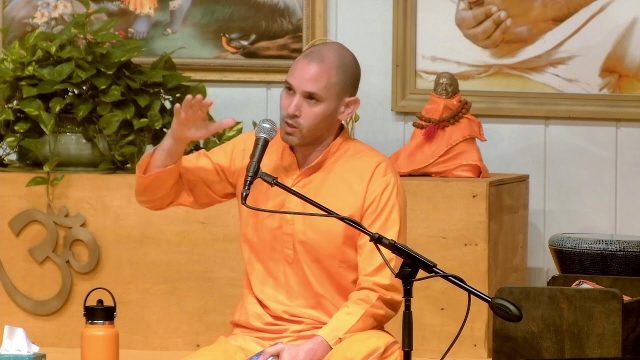
[1:38] So tonight we begin this program, The
[1:41] Graces of Power, which will be for
[1:42] several evening satsangs and several
[1:45] midday workshops. So let's give a very
[1:47] big hand to Dr. Shamini Jain.
[1:50] >> [applause]
[2:00] >> Swami Ji, I must give a much shorter
[2:02] bio. [laughter] Thank you.
[2:06] First, I just want to express um
[2:10] what a joy and an honor it is for me
[2:12] every time I come to the ashram.
[2:15] And it's so nice to see friends and I
[2:18] feel so grateful and connected every
[2:21] time I come here.
[2:22] So thank you for having me come here and
[2:26] um
[2:27] the the reason I wanted to do this
[2:29] particular program
[2:31] is because
[2:33] uh from my point of view
[2:35] both as a of course as a singer, which
[2:37] is what brought me to the work and the
[2:39] study of energy, which I've spent uh I
[2:42] guess a couple of decades now forwarding
[2:45] this science of Shakti, you can say.
[2:50] I
[2:52] remain convinced
[2:54] that this is
[2:56] still our biggest untapped resource for
[2:59] humanity.
[3:01] And that is part of what fuels uh my
[3:03] passion for educating, whether it's on
[3:06] the science or in the embodiment
[3:09] of Shakti.
[3:10] And um
[3:12] I know you all are familiar with this
[3:14] mantra.
[3:15] So perhaps we can chant it together at
[3:17] the beginning of our learning journey
[3:19] here today.
[3:22] Om
[3:32] [singing]
[3:43] [singing]
[3:53] Om
[4:02] So a question for you as we begin.
[4:08] What is power?
[4:12] How do you think the Western
[4:15] typical person walking down the street
[4:17] might describe what power is?
[4:20] What comes to mind?
[4:23] What what?
[4:24] >> Electricity.
[4:24] >> Electricity.
[4:25] >> Influence.
[4:26] >> Influence.
[4:28] >> Control.
[4:28] >> Control.
[4:30] Yes.
[4:33] What is grace?
[4:35] Love.
[4:38] What does any of this have to do with
[4:40] Devi?
[4:41] Is a question that I hope you will be
[4:43] very clear by the end of the evening if
[4:45] you're wondering.
[4:47] And in the workshops that we'll do,
[4:49] we'll explore how do we commune with
[4:51] this power and grace and what aspects of
[4:54] it
[4:55] are we willing to open ourselves to to
[4:58] embody more of it in the world, which is
[5:00] what we are all being called to do now.
[5:04] So let's get into what power
[5:07] has is currently defined as and how we
[5:10] have understood it for millennia
[5:11] actually.
[5:13] It actually comes from the Latin root of
[5:15] the word um Potis, which means able or
[5:18] capable. Okay? So that's the root of it
[5:21] in Latin. And in physics, it is the
[5:24] power is the rate of which energy
[5:27] is transferred.
[5:31] And that's no accident that in physics
[5:35] there's an understanding of power having
[5:38] something to do with energy
[5:40] because in truth for ancient traditions
[5:42] across the globe, whether it's Shakti,
[5:45] whether it's Qi, whether it's Prana,
[5:47] whether it's Ashe, whether it's Masubi,
[5:50] power is synonymous with energy and not
[5:55] just energy in the sense of electricity,
[5:57] but energy in terms of all that is.
[6:03] So we begin
[6:05] at the beginning.
[6:08] And there are, of course, many teachings
[6:11] on how the world came into form.
[6:14] This ashram is based in Advaita Vedanta.
[6:18] And so
[6:20] from these traditions we understand and
[6:22] from the Upanishads we understand
[6:25] that the universe is consciousness
[6:27] itself,
[6:29] unbounded,
[6:31] and that you are that.
[6:35] And at the same time
[6:38] the metaphysics
[6:40] or the philosophy may differ,
[6:43] but there is an understanding that
[6:46] in this world that we are in now,
[6:48] whether you consider it to be illusory
[6:51] or not,
[6:53] something
[6:55] brought boundless consciousness into
[6:57] form.
[7:00] And that something
[7:01] in many traditions, including the
[7:03] Vedantic and Tantric traditions,
[7:05] is Shakti.
[7:07] Shakti being the manifest power behind
[7:11] the entire universe.
[7:15] It is the power that brings the formless
[7:18] into form, and you are that.
[7:21] You are boundless consciousness
[7:24] and you are unbridled energy placed into
[7:28] a beautiful form that is completely
[7:30] unique.
[7:32] And so it is.
[7:34] You are power
[7:36] and you are consciousness.
[7:40] So Devi
[7:42] is not actually separate from us,
[7:45] though we often worship her like a
[7:47] goddess because she takes on many forms.
[7:51] And if we explore what Devi means, it is
[7:54] a Sanskrit word for goddess, she
[7:55] represents
[7:57] Shakti, which is the manifest power
[7:59] behind all creation, the energy that
[8:01] powers your cells, the energy that
[8:03] powers your nervous system, the energy
[8:06] that's behind every living life form and
[8:08] even those that we do not consider
[8:10] living,
[8:11] are all comprised of elements,
[8:15] right? We understand this probably as
[8:16] the basis of Ayurveda, right?
[8:19] But we are that.
[8:22] We are earth, we are fire, we are water,
[8:26] we are air, we are space.
[8:29] And all of the embodiments of Shakti as
[8:32] represented in the Devi traditions and
[8:34] all the representations of the goddess
[8:38] are reminders of those elemental forces
[8:42] that comprise the entire universe
[8:45] that we are
[8:47] and that we can access to provide
[8:51] ourselves and others harmony
[8:54] in the universe. And this is known,
[8:56] right? So this is this comes from one of
[8:58] the Upanishads, a depiction of the
[9:01] nadis, the subtle energy currents or the
[9:04] flows of Shakti in your body,
[9:06] right?
[9:08] And we'll touch into this more
[9:10] throughout the program.
[9:12] But when we understand Shakti
[9:15] in part
[9:16] as subtle energy,
[9:18] we begin to realize how powerful it is
[9:21] for us to connect with Shakti for our
[9:24] own healing and for the healing of
[9:26] others. That's a lot of the work that we
[9:27] have done through the nonprofit that I
[9:30] founded, Consciousness and Healing
[9:31] Initiative. We'll speak more about that
[9:33] later. So whether you look at the body
[9:36] as a garden, as this Chinese medicine
[9:39] drawing of the body there, or you look
[9:41] at the body in the more modern terms of
[9:42] the divine interconnections that we now
[9:45] know take place between the nervous
[9:47] system and the immune system and
[9:49] the cardiovascular system and the
[9:51] endocrine system, or whether you view
[9:53] the body as energy
[9:56] as we do in biofield science,
[9:59] whatever level you are looking at
[10:01] yourself from,
[10:03] know that you are this power.
[10:06] And this power is what's driving your
[10:09] healing
[10:10] and it's what's making the world turn.
[10:13] I just want to give a plug for this. I'm
[10:15] actually hoping that we might be able to
[10:17] show the film to you guys while I'm
[10:18] here. We've just released a film called
[10:20] The Energy That Heals,
[10:22] which is all about this. We have
[10:24] indigenous healers, modern healers,
[10:26] patients, and scientists, all talking
[10:29] about this realm of subtle energy and
[10:31] subtle energy healing, what it means for
[10:34] humanity, why it should be studied, and
[10:36] the real impact it has on patients. So a
[10:39] lot of the talks that I give are kind of
[10:40] in this realm, but this one, as I say,
[10:43] is a little bit different. This program
[10:45] is a little different because my goal
[10:47] with this program is for us to go even
[10:50] deeper than the semi-material science
[10:53] that we have now.
[10:56] So then we can say across time and space
[10:58] we understand that power
[11:01] is nothing more than the manifest power
[11:02] behind the entire universe that powers
[11:04] us all
[11:05] and is the divine feminine at work from
[11:08] our vedantic and tantric traditions, but
[11:10] also in many indigenous traditions. Ours
[11:12] is not the only one that describes this.
[11:16] So where does grace fit in?
[11:18] And this is where the connection with
[11:20] Devi becomes so beautiful
[11:24] because each representation of the
[11:27] divine feminine as Shakti in motion
[11:30] conveys a grace.
[11:32] And so during our program of the Graces
[11:34] of Power, we will be exploring
[11:37] the different aspects
[11:39] of grace that we may receive
[11:42] and even embody through our connection
[11:44] with Devi.
[11:48] So
[11:49] it is a way of opening ourselves up to
[11:52] the realignment with our soul nature
[11:56] because
[11:57] power is energy.
[12:00] And we can see, you know, there's a big
[12:01] saying in, you know, in the like keep
[12:04] saying the Western world, but I guess
[12:05] the modern world, right? Power corrupts.
[12:09] Doesn't have to be so.
[12:11] No.
[12:13] And so many of us have been afraid of
[12:15] power because of those kinds of ideas.
[12:19] It is time for us to take our power
[12:21] back,
[12:22] especially as yogis, especially as
[12:24] healers.
[12:27] So power is shakti and we must reclaim
[12:29] it. What are the fallacies that we have
[12:31] to debunk here?
[12:33] More is better?
[12:35] Not necessarily.
[12:37] There's not enough? Not true. Universal
[12:40] shakti is everywhere,
[12:42] right?
[12:43] Power implies power over another? Not at
[12:45] all.
[12:46] As we can see from this beautiful
[12:47] universe and the earth itself, which is
[12:50] regenerative and restorative. And we saw
[12:52] that during COVID, right? When all the
[12:54] humans kind of stopped doing things and
[12:56] all of a sudden the rivers became less
[12:58] polluted, the air became cleaner, the
[13:00] animals became coming out, right?
[13:03] Um because we were finally quiet
[13:06] and not trying to dominate, right?
[13:09] So all of these fallacies are to be
[13:10] debunked and and Devi helps us actually
[13:13] to debunk them.
[13:16] Maybe you can think of other fallacies.
[13:18] If you can, please shout it out.
[13:21] What are some other fallacies about
[13:23] power that need to be debunked?
[13:27] Did I hit them all?
[13:29] Are you asleep?
[13:32] [laughter]
[13:36] So as shakti,
[13:38] all of us, here's the depiction of the
[13:40] female mostly or animals as well, but
[13:42] this applies of course to all of us,
[13:45] men, women, however we identify our
[13:47] gender,
[13:48] um we play many roles because we are
[13:50] shakti in motion. So whether we're
[13:52] playing the role of a mother or a
[13:54] teacher or a sage, you know,
[13:58] or a child
[14:00] or just a being,
[14:01] we're we're fluid, right? Shakti is very
[14:05] fluid through us at all times. And
[14:08] just as with emotion, which is also a
[14:11] natural expression of shakti, these are
[14:14] of course the navras in Bharatnatyam, if
[14:16] you guys are familiar with the Indian
[14:18] classical dance and the depictions. Now,
[14:20] if emotions are so bad, why do we spend
[14:22] so much time actually perfecting them in
[14:24] the dance, you know, in the holy dance?
[14:27] Because these are expressions. And so as
[14:29] we learn to embody our shakti, we
[14:31] recognize that emotions are not our
[14:33] enemy.
[14:34] Emotions are just an expression of
[14:36] shakti in the dualistic world,
[14:39] right? Because emotions
[14:41] happen with a subject-object split.
[14:44] Yeah? Can you have an emotion that isn't
[14:46] about something or someone?
[14:50] No, right? Typically.
[14:53] Except for possibly love or bliss,
[14:55] right? Other ones are sort of about
[14:57] something and that's fine. It's an
[14:59] expression. It's it's learning how to
[15:01] work with that expression skillfully so
[15:04] that we don't cause disharmony in
[15:06] ourselves or someone else.
[15:11] So now let's turn to Durga Ma, the
[15:14] mother goddess.
[15:16] How many of you um and please don't feel
[15:19] shy to raise your hand. How many of you
[15:22] are not familiar with the depictions of
[15:25] the goddess in the Vedic tradition
[15:27] tradition? How many of you have never
[15:28] seen this picture of Durga Ma? A few of
[15:30] you, yeah. Not everybody is. Even if
[15:32] you're studying yoga or whatever, you
[15:34] may not have encountered um these
[15:36] representations of the divine feminine,
[15:38] which is why I like to do this.
[15:40] Um so Durga Ma, for those who don't
[15:43] know, is the mother goddess in the Vedic
[15:45] tradition.
[15:47] And um
[15:48] what strikes you about her? Anybody?
[15:51] Strength.
[15:52] You get that sense from her?
[15:54] Right? Does she she doesn't look like
[15:56] somebody you want to mess with, right?
[15:58] What's with all those weapons? Yeah,
[16:00] this is this is beautiful. Well, some of
[16:02] them aren't weapons, right? So you see
[16:03] the lotus in her hand from Brahma,
[16:06] right?
[16:07] Which is a gift of moksh or liberation.
[16:12] And you see the bow and arrow from Vayu,
[16:15] which is represents energy, potential
[16:17] and kinetic energy, actually.
[16:19] The thunderbolt from Indra,
[16:21] right?
[16:23] The trident from Shiva, which represents
[16:25] many things including time but also the
[16:28] three worlds.
[16:30] The conch shell
[16:32] from the ocean god
[16:35] representing the primordial sound of Om
[16:38] and the dispeller of negativity. The
[16:40] mace to to curb and club ego.
[16:45] The sword
[16:46] from Ganesha for discernment
[16:49] and of course
[16:52] the discus
[16:53] from Vishnu,
[16:54] which we learned about
[16:56] earlier
[16:57] as a way of dispelling negativity and
[17:01] also you could say to keep the world
[17:02] turning.
[17:04] So you think she's holding a lot?
[17:06] It's a lot going on, right? It's a lot
[17:08] to hold.
[17:10] And you're no different from that
[17:12] actually. You you play many roles.
[17:15] So what do you think her grace is?
[17:18] What is the grace that she carries?
[17:26] And if you're familiar with her her
[17:27] stories,
[17:29] you get the sense of strength, right?
[17:33] Sorry?
[17:34] >> Confidence.
[17:35] >> Confidence, yes. Confidence for sure.
[17:41] To me,
[17:43] she's the grace of grounded compassion.
[17:47] Energetically what we want to understand
[17:49] about Durga Ma and the ways that we can
[17:52] have her come into our field and embody
[17:55] her more is that she is earth
[17:59] with a bit of fire, I would say as well,
[18:01] right? Which helps with the
[18:02] perseverance, helps with the kind of
[18:04] direct focus that that it's part of the
[18:06] grace that she gives us.
[18:08] But something that I think sometimes we
[18:10] overlook because of our overlays of what
[18:12] we think power is, we forget about the
[18:15] magic that she actually has as the
[18:17] mother.
[18:19] And that is
[18:20] compassion.
[18:23] Everything that she does is in
[18:25] compassion.
[18:29] We can see this in the writings of the
[18:31] Devi Mahatmya and I'm just going to read
[18:33] a few of them in the English translation
[18:35] because I'm not talented enough to read
[18:37] the Sanskrit.
[18:40] The world attains happiness when you
[18:43] slay its foes.
[18:45] And though they may have committed
[18:46] enough evil to keep them long in
[18:48] torment, even as you strike down our
[18:51] enemies, oh Devi, you think may they
[18:54] reach heaven through death in battle
[18:56] with me.
[19:00] Why does your mere glance not reduce all
[19:02] asuras, demons, to ashes?
[19:05] Because when assailed by your weapons
[19:07] and thus purified, even those
[19:09] adversaries may attain the higher
[19:11] worlds.
[19:14] If the intense light flashing
[19:16] frightfully from your sword
[19:18] or the glaring brilliance of your spear
[19:20] point did not blind the asura's eyes, it
[19:22] was because you made them behold the
[19:25] moon like radiance beaming from your
[19:27] face.
[19:32] Even toward them your intentions are
[19:34] most gracious. Oh Devi, your nature is
[19:37] to subdue the misconduct of the wicked.
[19:41] Others cannot equal your inconceivable
[19:43] grace for even when your might destroys
[19:46] those who have wrested power from the
[19:48] gods, you show compassion to those very
[19:52] foes.
[19:56] And finally, to whom, to what may your
[19:59] prowess be compared?
[20:01] Where else is there beauty so ravishing
[20:03] yet striking fear into enemies?
[20:06] Where in the three worlds are compassion
[20:08] and heart and resolve and battle seen as
[20:12] they are in you, oh beneficent Devi?
[20:18] Do you think we could use more of that?
[20:22] Yeah?
[20:24] Because there is harmony to create.
[20:29] And sometimes we're taught that to keep
[20:32] the peace we have to make ourselves
[20:33] small.
[20:35] We don't.
[20:37] We do have to stay grounded and we have
[20:39] to stay compassionate.
[20:41] And this is very real. This is very real
[20:43] medicine.
[20:45] So
[20:46] because I am a science nerd, I sometimes
[20:48] joke that I am a recovering academic
[20:51] um
[20:52] and in recovery
[20:53] um but also because I know that many of
[20:56] you do enjoy the science, I thought I
[20:58] would share a few scientific insights of
[21:00] how does this actually play out in the
[21:01] world and and what if we captured so far
[21:04] in data? Not that we can capture
[21:06] everything, we never do, but here are
[21:08] some insights on how this really plays
[21:10] out in our minds, our emotions, our
[21:13] behavior, and even our biology.
[21:16] First, how do we define compassion?
[21:19] It's not just sympathy, right?
[21:22] It's not just empathy either.
[21:24] It is an emotional response to
[21:26] recognizing suffering
[21:29] in ourselves or in others
[21:32] accompanied by a motivation,
[21:35] a movement of energy
[21:37] to alleviate it.
[21:39] That is the big difference. So you can
[21:41] already see that there is an action
[21:43] tendency in compassion, yeah?
[21:48] So we notice, we connect, and we act.
[21:52] And so in the studies that have been
[21:54] done in compassion,
[21:55] there are different kinds of things that
[21:57] are done in the lab. There's different
[21:58] kinds of compassion training. And one of
[22:01] the questions is does it work? Does it
[22:03] do anything? And if so, what does it do?
[22:07] So I'm going to present data that is um
[22:10] kind of a compendium, you can say, of
[22:13] numbers of studies because those are
[22:15] more
[22:16] robust. You can imagine like you could
[22:17] look at one study, it could tell you
[22:18] something, but if you look at 22 of them
[22:20] and they're all what we call randomized
[22:22] controlled trials
[22:24] might suggest that this is more of a
[22:26] real effect versus just looking at one
[22:28] study. So, when we say, you know, 22
[22:31] RCTs, 22 randomized studies, right?
[22:35] Are you guys familiar with science?
[22:36] Everybody know what a RCT is or
[22:38] randomized control trial? Okay, not most
[22:40] of you. So,
[22:42] in these kinds of studies, imagine that
[22:44] they have different They have a group of
[22:46] people. Let's say there's 100 people.
[22:48] And they take a computer and they
[22:50] randomize them, right? To different
[22:51] groups. So, the computer decides, you
[22:54] know, you're going to go to this group,
[22:55] you're going to go to this group, you're
[22:56] going to go to this group. And the
[22:57] reason they do that is because when you
[22:59] randomize people, you're more likely to
[23:01] have people that are equal in things
[23:02] like gender or depression or whatever
[23:05] that you're not interested in, but you
[23:07] want to make sure they're equal across
[23:08] the groups. Anyway, I'm not going to
[23:09] give you a whole science lesson. Sorry.
[23:11] But that's what a randomized control
[23:13] trial does, right? So, just imagine you
[23:14] have 100 people. You take a third of
[23:16] them and you train them in compassion
[23:18] training. You take a third of them and
[23:20] you give them a control group or maybe
[23:22] they're not doing anything or they're
[23:24] doing relaxation or whatever, right? And
[23:26] then a third of them that are doing
[23:28] nothing, you know. So that you get kind
[23:30] of the picture, right? You're comparing
[23:32] different kinds of people, different
[23:33] kinds of training.
[23:35] And so what they found is that for the
[23:37] people that were getting compassion
[23:38] training compared to other types of
[23:41] conditions or control groups,
[23:43] indeed, kindness-based meditation And
[23:46] most of this is compassion training, but
[23:48] also loving-kindness meditation.
[23:50] Are you all familiar with metta
[23:52] meditation in the Buddhist tradition?
[23:54] Yeah? Compas Loving-kindness is
[23:57] sometimes how it's described in the
[23:58] West. So that's the kind of training
[24:00] they were getting.
[24:01] And usually not a long period of time,
[24:04] like, you know, typically like a month,
[24:06] maybe six weeks.
[24:07] And they find that this is very
[24:08] trainable, right? And it increases the
[24:11] propensity for mindfulness to stay in
[24:13] the present moment without judgment,
[24:15] increases the ability to feel compassion
[24:18] for oneself,
[24:20] increases compassion for others, and
[24:23] also reduces depression.
[24:27] What about self-compassion? I have to
[24:29] admit, I think coming from Indian
[24:31] origin, when self-compassion began to be
[24:33] very popular in Western science, I was
[24:35] like, of course. Okay. Here we go with
[24:37] the self again. Self, self, self. You
[24:39] know, it was kind of like now we have to
[24:40] like love ourselves. Okay. You know, but
[24:42] as a psychologist, I I do understand
[24:44] this.
[24:46] It is important because you're not
[24:47] separate from anyone else,
[24:50] right?
[24:51] And so many issues are caused from
[24:54] not loving what's right here, and then
[24:55] you project it onto someone else.
[24:58] If you have a self-worth issue, you're
[25:00] going to project it on someone else.
[25:02] If you have a self-hatred issue, you're
[25:04] going to project it on someone else. And
[25:06] here's the world we live in, right? So
[25:08] compassion, self-compassion is very
[25:09] important. It's not selfish. It's
[25:13] holding that benevolent, grounded love
[25:18] for yourself just like you would for
[25:20] your child or anyone else.
[25:23] And as it turns out, it really helps,
[25:25] right? It can reduce depression, reduce
[25:27] anxiety, and reduce stress. And there
[25:29] are quite a few studies that have looked
[25:31] at this.
[25:33] What about in our body? What does
[25:35] compassion do? There are a couple of
[25:36] experiments here looking at compassion.
[25:39] The first one as you can see is
[25:40] self-compassion.
[25:41] Again, you know, with all the kinds of
[25:43] control groups, we won't dig through
[25:45] much into this, but if you have
[25:46] questions, you can always ask me later.
[25:48] And they found actually reductions in in
[25:52] immune marker that is related to kind of
[25:55] higher inflammation
[25:57] and a more adaptive dance of the heart
[26:00] in heart rate variability.
[26:02] Anyone familiar with heart rate
[26:03] variability, right?
[26:05] The dance of your sympathetic and
[26:08] parasympathetic nervous system. Everyone
[26:10] familiar with the sympathetic and
[26:11] parasympathetic nervous system. You're
[26:12] probably learning about that in class,
[26:14] I'm sure, right? So heart rate
[26:15] variability is just an indication of
[26:18] that beautiful dance within the heart.
[26:20] And often the parasympathetic or the
[26:23] rest and digest aspect of the nervous
[26:25] system
[26:26] uh doesn't get as much love as it needs
[26:28] to. It doesn't get as much activation,
[26:30] you know, because we're always on the
[26:31] go.
[26:32] So, when we see improved heart rate
[26:34] variability,
[26:35] it usually means that the
[26:37] parasympathetic nervous system or the
[26:40] vagus nerve, which is the biggest
[26:41] captain of the rest and digest part of
[26:43] the nervous system,
[26:45] is working well. It's working better.
[26:48] And so, this is what we see in the
[26:50] practice of self-compassion.
[26:52] What about compassion for others?
[26:55] Some indication of reductions of
[26:58] inflammation in the body. So, that's
[27:01] interesting, too, that having compassion
[27:04] and moving with compassion, because
[27:05] remember, compassion is also action,
[27:08] can actually reduce your own
[27:09] inflammation.
[27:14] This is very interesting because
[27:16] sometimes people think, oh, to be
[27:17] compassionate, I can't be angry.
[27:21] Doesn't necessarily seem to be the case.
[27:25] And
[27:26] if you think about it, it actually makes
[27:28] sense in a way because
[27:30] to feel compassion,
[27:32] you can often feel the suffering.
[27:35] And the initial response usually to
[27:38] suffering
[27:40] is
[27:41] typically indignation.
[27:44] Indignation.
[27:47] This is difficult to digest.
[27:52] So, we take that moment
[27:54] and we allow ourselves potentially to
[27:56] feel the emotions that come up with
[27:58] witnessing suffering.
[28:00] And then we take compassionate action
[28:03] once that has settled.
[28:06] In this experiment, it was very
[28:07] interesting actually because what they
[28:10] did was they had people write
[28:13] um and they had different writing
[28:15] prompts to elicit compassion or elicit
[28:17] joy
[28:18] or just neutrality, and then they
[28:20] compared the groups.
[28:22] And interestingly, what they found was
[28:24] um they then gave them a stress test,
[28:27] and there weren't really any
[28:28] differences. In fact, there was almost a
[28:31] an increase in anger initially after the
[28:33] provocation for those feeling
[28:35] compassion.
[28:36] Perhaps or writing compassion probably
[28:39] because they were primed to open their
[28:41] hearts and feel more.
[28:43] So they could
[28:45] feel that and hold it at the same time.
[28:51] What about how it leads to the world? Oh
[28:54] wait, did I did I share that one? Let me
[28:56] see.
[28:58] Yeah, this is important. Um I did want
[29:01] to show you that
[29:02] this actually has an effect on, you
[29:04] know, on behavior outside.
[29:07] So [snorts]
[29:08] in these studies, what they found was it
[29:10] it's not just stress and even the things
[29:12] in your body, but your behavior changes.
[29:15] Right? You're more likely to engage in
[29:18] healthy behaviors
[29:20] and less risky behaviors.
[29:24] And importantly, this also extends
[29:27] outward. This was a really fascinating
[29:30] study
[29:31] where again they trained people in
[29:33] compassion compared to what they call
[29:35] cognitive reappraisal. And so here what
[29:38] they're doing is showing people
[29:39] different pictures and some of them
[29:41] elicit suffering. Some of them are
[29:43] neutral.
[29:45] And but for the ones that elicit
[29:47] suffering, they train half the people
[29:50] on a compassionate response to that,
[29:52] basically taking it in
[29:54] and allowing themselves to feel
[29:56] compassion and consider how they could
[29:57] reduce the suffering for that person.
[30:00] And the other group, they basically had
[30:02] them kind of reappraise it, think about
[30:05] it differently. And then they compared
[30:07] them.
[30:08] And afterward, what they did was they
[30:10] actually had them play a game. So they
[30:13] trained the people in compassion in this
[30:14] way, showed them the pictures, trained
[30:16] them in either compassion or what they
[30:18] call cognitive reappraisal. Then they
[30:20] have them play a game where in the game
[30:22] they think they're playing a video game
[30:24] with a bunch of folks.
[30:26] Um
[30:27] but it's not that's not really
[30:29] happening, but they think it is. And so
[30:31] there are different players in the game
[30:32] as far as they're concerned and there's
[30:33] a bully in the game. And the bully in
[30:36] the game is like being a total jerk to
[30:38] somebody else, right? And and they have
[30:40] the they have the ability to help that
[30:43] person by giving more fake money. I
[30:46] mean, all the things psychologists do,
[30:47] it's amazing, these kinds of studies.
[30:51] The bottom line is for those people who
[30:53] were trained in compassion, they were
[30:56] significantly more likely to engage in
[30:58] helping behavior, to actually give their
[31:01] money
[31:02] to support the person that was
[31:05] being bullied, that was, you know,
[31:07] basically in distress.
[31:09] So and you know, to nerd out a little
[31:12] bit more, it seemed like some of the
[31:13] changes in the brain that took place
[31:15] during the compassion training were
[31:16] connected
[31:18] to that giving behavior. So compassion
[31:22] is in a sense rewiring our brain.
[31:26] It's rewiring our body.
[31:29] It can help us
[31:31] with our our emotional well-being, but
[31:33] obviously it helps others as well.
[31:38] So here are Durgama's lessons then in
[31:41] fierce compassion, in grounded
[31:43] compassion. Love is power. And some
[31:45] things for us to remember
[31:48] about this is that compassion isn't the
[31:50] absence of boundaries.
[31:54] And at the same time,
[31:56] when we need
[31:58] to stop something,
[32:00] we can do so without feeding the seeds
[32:02] of hatred.
[32:03] This is what she teaches us.
[32:05] That we can stop injustice,
[32:08] that we can call out a wrong, but we can
[32:10] do it from a place of grounded composure
[32:13] and love.
[32:14] Anybody say yeah, that's totally easy. I
[32:16] do that all the time.
[32:19] Anybody have trouble with this?
[32:22] Yeah?
[32:23] Not so easy to do, right? Easy to talk
[32:25] about, but not so easy to do.
[32:27] So some reflections for you, if you care
[32:30] to reflect on this for the for the
[32:32] evening or for the day tomorrow.
[32:37] What happens for you
[32:39] when you
[32:40] try to speak truth?
[32:45] What happens?
[32:48] Is it
[32:49] some for some of us it's just hard
[32:52] to see anything.
[32:54] We feel like we'll be putting somebody
[32:56] off or we'll upset someone,
[32:58] you know, and we don't want to upset
[32:59] anyone.
[33:01] Um but then unfortunately sometimes what
[33:03] happens depending on what the situation
[33:05] is, if it's a small thing, you know,
[33:06] maybe you let it go, no big deal, who
[33:08] cares. You don't want to get your ego
[33:10] all tied into something for sure.
[33:12] But sometimes you might see something
[33:13] and you might wonder and say, God, I
[33:15] wish I would have said something.
[33:17] So then the question is, what could help
[33:19] with that?
[33:21] Well, earth
[33:22] will help with that because if we're not
[33:24] grounded,
[33:25] if we're not energetically grounded,
[33:28] it's very difficult actually for us to
[33:30] express truth with love and that's part
[33:32] of Durga Ma's medicine. It's not just
[33:34] psychological, it's energetic.
[33:37] So the more grounded we are, the easier
[33:39] it is for us to speak from that grounded
[33:41] place of love.
[33:44] And to work with the fears or the
[33:46] reactivity, some of us have the opposite
[33:48] problem, right? We see something and we
[33:49] explode, right? You know, there it is.
[33:51] Oh, whoops, I didn't mean to say it so
[33:53] quickly. I should have held my ground,
[33:55] right? In both cases you need your
[33:57] ground.
[33:59] So
[34:01] there are some techniques for this.
[34:03] We'll be going over some of them and
[34:04] doing some other really fun things in
[34:06] the workshop um tomorrow. We're going to
[34:08] be working with Durga Ma and Kali Ma and
[34:10] we'll be talking a bit about Kali Ma
[34:12] tomorrow.
[34:13] Um but this is a a technique that I like
[34:15] to call the brag technique and this is
[34:17] not a mental
[34:19] technique.
[34:20] This is an energetic technique.
[34:23] When we see something that literally
[34:25] throws us off, it means we lose our
[34:27] ground. We lose our energetic grounding.
[34:30] So the first thing we want to do is
[34:32] actually come back into into the ground,
[34:35] into the groundedness of our body and
[34:37] our being. So the brag technique is
[34:39] literally and we'll we'll actually do
[34:41] this as a practice. Um,
[34:44] you breathe into your base, like
[34:46] literally invite the breath all the way
[34:48] into the base of the spine
[34:51] and then recognize
[34:53] even before reflect like recognize what
[34:55] is happening in me.
[34:59] And do I notice a pattern of reactivity
[35:01] that I've carried before, right? That's
[35:03] a that's a recognition.
[35:05] And then we actually allow that. If
[35:07] there's an emotion, if there's a
[35:09] sensation, we don't push it, we don't
[35:11] shove it away, we don't pretend like
[35:13] it's not there. We just hold space for
[35:15] it. We become Durga Ma for ourselves.
[35:18] We allow that with awareness.
[35:21] And then we can take that sensation,
[35:23] that emotion with the breath and ground
[35:27] it into the earth. Literally bring it
[35:29] into the ground and this is also very
[35:31] fun to do with sound if you can do it.
[35:32] I'll show you how tomorrow. Ground to
[35:34] let go and I like to say ground to let
[35:36] glow because what happens is as you
[35:38] begin to release all of that,
[35:40] you know,
[35:41] the energy just comes through and and
[35:44] and you can feel more in a glowing
[35:45] place, which is your true nature.
[35:49] So as you could tell, I'm pretty
[35:51] enthusiastic about this program, the
[35:53] Graces of Power, and I'd like to invite
[35:55] you to continue along with me on it. Um,
[35:58] of course, we'll be exploring some of
[36:00] Devi in this kind of way in the satsangs
[36:03] for the next couple of nights, but
[36:05] really invite you to come to the
[36:06] workshops. They're in the afternoon, I
[36:08] think at noon, like from noon to 1:30.
[36:11] We're going to have a lot of fun. We um
[36:13] we do some dancing, we do singing, we do
[36:16] movement, we do reflection and
[36:18] discussion. So it's really you know, if
[36:20] nothing, it's really also a time to just
[36:23] come into divine play and my goal for
[36:25] you is to really learn how to even more
[36:27] deeply connect with and embody the
[36:30] elemental forces that are
[36:34] Devi, that are the divine feminine
[36:36] because she is much more than mental.
[36:39] If you want to get a head start on this,
[36:41] um I have a wonderful grounding with
[36:44] sound practice, which you can access. So
[36:47] you scan the QR code and you can get
[36:49] that or if you go to my website or just
[36:51] go to shamanijain.com/freegift
[36:54] and it's there along with a great
[36:55] dialogue from my friend. So I also have
[36:58] to admit something.
[37:03] As I mentioned, I love being at the
[37:05] ashram
[37:07] and I am a total water baby
[37:09] and I really felt the calling to enjoy
[37:13] some embodiments of Shakti beyond the
[37:15] human form today. So I went off campus
[37:18] to go visit some animals
[37:21] and I received many messages from the
[37:22] animals.
[37:24] The turtles
[37:26] who were just eating the grass
[37:28] completely unfazed by humans and human
[37:31] consciousness. I had to actually move so
[37:34] that I didn't touch them because they
[37:35] were like right here,
[37:37] right?
[37:37] The fish that were like go away, you're
[37:39] destroying our habitat.
[37:42] And then these.
[37:45] [laughter]
[37:47] Because if there's one thing that baby
[37:48] can remind us of, it's to remind
[37:50] ourselves to be happier than a pig in
[37:52] sand.
[37:55] Thank you. I'll see you guys tomorrow.
[37:57] >> [applause]
[38:08] >> So I would like to thank again very much
[38:10] Dr. Shamini Jain for this beautiful
[38:12] presentation tonight.
[38:14] [applause]
[38:18] And Dr. Shamini Jain will continue the
[38:20] program tomorrow with the workshop here
[38:23] at noon and with the evening satsang.
[38:28] So now we'll go over the schedule for
[38:31] tomorrow.
[38:32] So tomorrow is a is a special day here
[38:35] at the