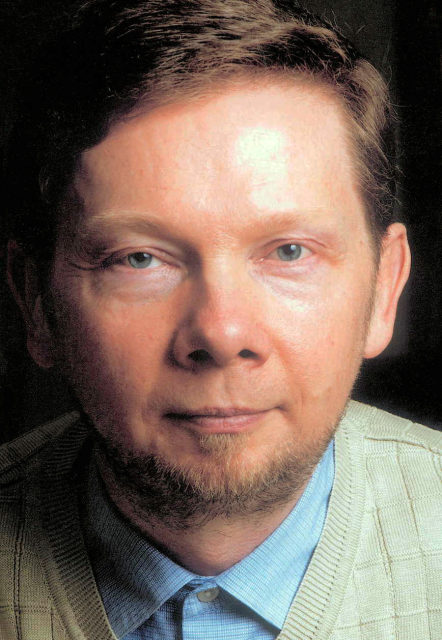
The Buddha's core teaching is often misread as pessimistic. "Dukkha is wherever you go, whatever you do," the Buddha said. The word dukkha—usually translated as suffering, but more precisely meaning misery, unsatisfactoriness, or simple unhappiness—awaits you sooner or later, and usually sooner. For those encountering this teaching without its full context, it can seem like a doctrine of cosmic futility. But the Buddha, Eckhart Tolle explains, did not stop at diagnosis. He showed the cure. His actual teaching, as Tolle understands it, was always dual: "I teach suffering and the end of suffering."
This distinction reshapes everything. The Buddha was not saying the world is fundamentally broken or that enlightenment requires you to escape into denial. Rather, he mapped out a path in which suffering arises through a specific mechanism—unconscious, egoic living on what Tolle calls the horizontal dimension—and can be transcended by accessing something deeper.
When Tolle speaks of the horizontal dimension, he is describing the realm of surface experience: your thoughts, your circumstances, your personal identity, the events that unfold in time. It is the domain of doing, acquiring, and becoming. On this level, challenges are inevitable. Even if you apply positive thinking—which Tolle affirms as genuinely useful for improving the texture of daily life—difficulties, obstacles, and setbacks will still arrive "periodically, big and small." This is not a failure of technique or willpower. It is the nature of the horizontal plane itself.
The error, Tolle emphasizes, is not that difficulties come. The error is the belief that they were not supposed to come. When we operate solely on the horizontal dimension, we build an unconscious expectation that life should be a steady stream of comfort and favorable outcomes. When reality contradicts this, we suffer not only from the actual challenge but from the shock of its contradiction to our imagined world. We suffer twice: once from what happens, and once from the story we tell ourselves about what should happen.
The antidote is not to change the horizontal dimension—though it will naturally shift as your consciousness shifts—but to gain access to what Tolle calls the vertical dimension, or the "deep I" within you. This is not a new identity to acquire or a belief system to adopt. It is a dimension of your being that exists underneath the persona, the ego, the narrative self. From this depth, something emerges that Tolle describes as power, though not power in the conventional sense of control or force. This power transcends who you are as a person.
At this point, Tolle introduces the word he uses sparingly: God. He is hesitant about it, noting that the moment the word enters language, it becomes a mental concept, a thing the mind can grasp and label—which immediately diminishes what it refers to. But the three-letter word points to something real: you are ultimately not an autonomous entity, isolated and self-sufficient. You are connected to the source of all life. That connection is not theoretical or aspirational. It is a lived reality accessible through the vertical dimension.
When you have access to this depth dimension, the suffering that felt inescapable on the horizontal level becomes greatly diminished and can even disappear entirely. This does not happen because external circumstances improve, though they sometimes do. It happens because your relationship to what happens has fundamentally changed. The challenge still arrives—the financial pressure, the illness, the loss, the disappointment—but it no longer hooks into your sense of self. It no longer carries the existential weight of personal catastrophe.
This is crucial: Tolle is not promising that the horizontal dimension will stop presenting obstacles. He is saying that obstacles stop defining you. Whatever happens on the surface "is no longer that problematic" when you have anchored yourself in the vertical. Yes, the horizontal dimension will always challenge you. But the challenge no longer feels like a threat to your existence, because your existence is no longer confined to the person-self operating on that surface.
The power that emanates from the deep I transcends your autonomy as a human being. It is not yours to wield; rather, you become a channel for it. This is why positive thinking, though valuable, has limits. Positive thinking works on the horizontal plane and genuinely improves life there. But it still operates within the realm of the person-self, trying to manipulate circumstances toward your preference. The vertical dimension operates from a completely different order.
Tolle names the fundamental misunderstanding that props up much of modern suffering: the belief that the world is here to make you happy. This belief is seductive because it feels true in moments of pleasure and achievement. But it inverts the relationship between self and world. The world is not a machine designed for your gratification. The world simply is—indifferent, arising according to laws and forces vastly larger than individual preference. When you unconsciously adopt the expectation that it should center on your happiness, you guarantee chronic disappointment.
This is not cynicism or defeatism. It is realism followed by transcendence. The Buddha's teaching acknowledges that suffering is woven into the fabric of the horizontal dimension. But it also shows that you are not confined to that dimension. You have access to a vertical depth in which the grip of surface-level pain loosens and eventually dissolves, not because the surface changes, but because you have relocated your sense of self to a place from which the surface no longer appears as the whole of reality.
The practical application of this teaching is not to become passive or to spiritually bypass real difficulties. Tolle explicitly endorses positive thinking and the effort to improve your life on the horizontal dimension. But it means letting go of the unconscious contract with reality that says discomfort should not exist. It means beginning to notice, through presence and awareness, the moments in which you are operating from the deep I rather than from the ego. It means recognizing that every setback, every frustration, every encounter with dukkha is an invitation to go deeper rather than a proof that something has gone wrong. The vertical dimension is not a distant goal. It is here, accessible now, beneath the constant noise of the person-self. That is the teaching the Buddha showed and that Tolle restates: suffering is real, but so is the transcendence of suffering. Both are always available.