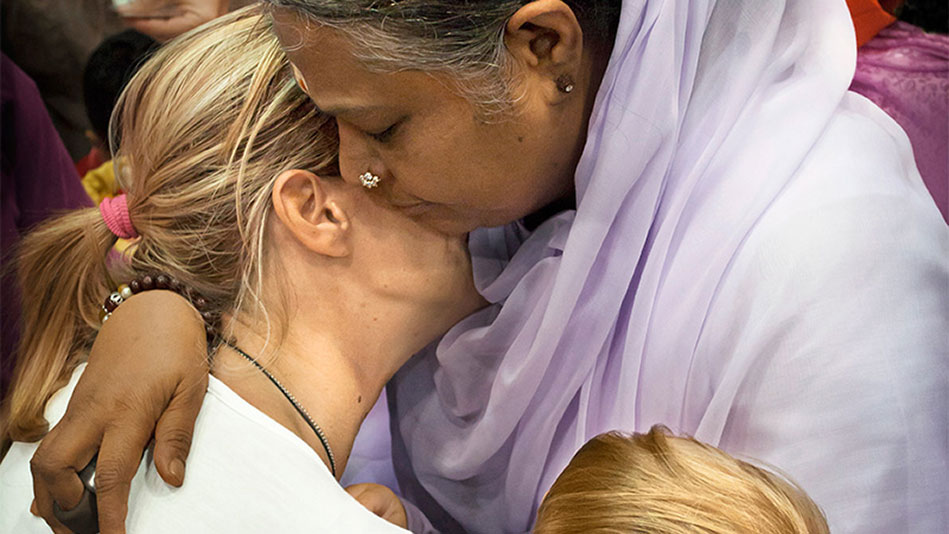
Amma's profound assertion, "To embrace another is to embrace God," invites us to reconsider the nature of our relationships and the divine. This statement suggests that the act of embracing another person transcends mere physical contact; it becomes a sacred act that connects us to the divine essence that resides within each individual. In a world often marked by division and isolation, this teaching serves as a reminder of the inherent unity that binds us all, urging us to recognize the divine in our interactions with others.
At its core, this quote challenges us to expand our understanding of love and connection. It posits that every embrace is not just a gesture of affection but a spiritual act that can lead us closer to God. By recognizing the divine presence in others, we cultivate compassion, empathy, and a sense of belonging that can transform our lives and the lives of those around us. This teaching resonates deeply in a time when the need for connection and understanding is more pressing than ever, inviting us to explore the sacredness of our relationships.
The image / the metaphor
The imagery of embracing another person evokes a sense of warmth, intimacy, and acceptance. The verb "embrace" suggests a full-bodied engagement, an opening of oneself to another, which implies vulnerability and trust. This act is not merely physical; it is an invitation to share in the emotional and spiritual realms, creating a bridge between two souls. The act of embracing becomes a metaphor for the interconnectedness of all beings, where each hug is a reminder of the divine presence that flows through us.
Diving deeper into the metaphor, we can see that embracing another is an act of recognition. It is a conscious acknowledgment of the divine spark that resides within each person, regardless of their circumstances or actions. This perspective encourages us to look beyond superficial differences and to see the shared humanity that connects us all. In this light, every embrace becomes a sacred ritual, a moment where the boundaries of self dissolve, and we experience the oneness of existence.
In the speaker's tradition
Amma's teachings are deeply rooted in the bhakti tradition, which emphasizes devotion and love for the divine as a path to spiritual realization. In bhakti, the act of loving and serving others is seen as a direct expression of love for God. This aligns with the concept of "seva," or selfless service, where serving others is not just an act of kindness but a way to connect with the divine essence that permeates all beings. The idea of "kenosis," or self-emptying, also resonates here, as embracing another requires us to let go of our ego and open ourselves to the experience of unity.
In the Bhagavad Gita, a foundational text of the bhakti tradition, Krishna teaches that seeing the divine in all beings is essential for spiritual growth. This perspective is echoed in Amma's quote, which invites us to recognize that every interaction holds the potential for divine connection. By embracing others, we engage in a practice that aligns with the teachings of love and devotion found throughout the Gita, where the ultimate goal is to realize the oneness of all existence.
Living the teaching
Consider a modern scenario where this teaching can be applied: a busy urban environment where people often rush past one another, absorbed in their own lives. In such a setting, a simple act of kindness—a smile, a helping hand, or a moment of genuine connection—can serve as an embrace of the divine. When we take the time to acknowledge another person, we create a ripple effect of compassion that can transform the atmosphere around us. This small act of embracing another, even in a fleeting moment, can remind us of our shared humanity and the divine presence that resides within us all.
In a more personal context, think about a challenging relationship in your life. Perhaps there is someone with whom you struggle to connect. By consciously choosing to embrace this person—whether through understanding, forgiveness, or simply being present—you open the door to a deeper connection. This act of embracing can lead to healing, not just for the relationship but also for your own spiritual journey. In these moments, we practice the teaching of Amma, recognizing that each encounter is an opportunity to embrace the divine and to grow in love.
A reflection
As we contemplate Amma's profound statement, we are invited to reflect on our own relationships and interactions. How can we cultivate a deeper awareness of the divine presence in those around us? In what ways can we practice embracing others, not just physically but emotionally and spiritually? These questions encourage us to explore the transformative power of love and connection, reminding us that in every embrace, we have the opportunity to touch the divine.