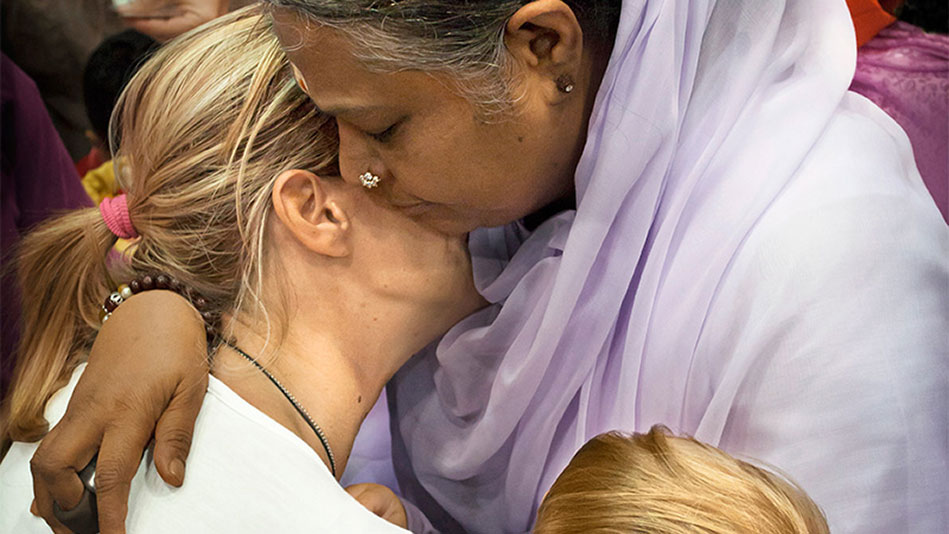
Amma's profound assertion, "In selfless service, the soul finds its wings," invites us to explore the liberating potential of altruism. This statement encapsulates a central tenet of the bhakti tradition, emphasizing that true fulfillment and spiritual elevation arise not from self-centered pursuits but from acts of love and service to others. In a world often dominated by individualism and material gain, this perspective serves as a poignant reminder of the interconnectedness of all beings and the transformative power of selflessness.
Delving deeper, we recognize that the notion of the soul finding its wings suggests a journey toward liberation and enlightenment. The imagery evokes a sense of ascension, where the burdens of ego and selfish desires are shed, allowing the soul to soar freely. This metaphor resonates with the human experience, as many of us have felt the weight of our own concerns and ambitions. In contrast, moments of genuine service often lift us beyond ourselves, revealing a profound sense of purpose and connection to the greater tapestry of life.
The image / the metaphor
At its core, the quote employs vivid imagery that speaks to the essence of spiritual awakening. The phrase "selfless service" conjures an act devoid of personal gain, where the giver's heart is open and generous. The choice of the word "wings" suggests not only freedom but also a transcendent state of being, where the soul is unencumbered by the limitations of the physical world. This imagery evokes a sense of lightness and elevation, inviting us to envision a state of existence where love and compassion reign supreme.
Moreover, the metaphor of wings implies movement and transformation. Just as a bird takes flight, so too does the soul, liberated through acts of kindness and service. This transformation is not merely a change in circumstance but a profound shift in consciousness. The act of serving others becomes a catalyst for personal growth, allowing us to transcend our individual struggles and connect with a larger purpose. In this way, the metaphor serves as a powerful reminder that our true nature is one of love and interconnectedness.
In the speaker's tradition
Amma's teachings are deeply rooted in the bhakti tradition, which emphasizes devotion and love for the divine as a path to spiritual realization. Central to this tradition is the concept of dharma, or righteous duty, which encourages individuals to act in ways that promote the welfare of others. The idea of kenosis, or self-emptying, resonates with Amma's message, suggesting that true fulfillment arises when we let go of our ego and embrace a life of service. This selflessness aligns with the notion of sunyata, or emptiness, where the realization of interconnectedness leads to a profound sense of liberation.
In the Bhagavad Gita, a foundational text of the bhakti tradition, Lord Krishna speaks of selfless action as a means to attain spiritual wisdom. He encourages Arjuna to perform his duty without attachment to the fruits of his labor, highlighting the importance of acting for the sake of others rather than personal gain. This teaching echoes Amma's assertion, reinforcing the idea that through selfless service, we not only uplift those around us but also elevate our own souls, allowing them to take flight.
Living the teaching
Consider a modern scenario where this teaching can be applied: a community volunteer program aimed at assisting the elderly. Participants often enter the program with their own motivations—perhaps seeking to fulfill community service hours or to gain experience. However, as they engage in selfless acts of service, such as providing companionship or helping with daily tasks, they often find themselves transformed. The initial motivations fade into the background as they experience the joy and fulfillment that comes from genuinely connecting with others, illustrating how selfless service can indeed allow the soul to find its wings.
In the context of personal relationships, this teaching can manifest during moments of conflict or misunderstanding. When we approach a disagreement with a mindset of service—seeking to understand the other person's perspective rather than defending our own—we create space for healing and connection. This selfless approach not only resolves the immediate tension but also deepens the bond between individuals, allowing both parties to rise above their differences and experience a shared sense of unity. In these moments, the soul's wings unfurl, revealing the beauty of compassion and understanding.
A reflection
As we contemplate Amma's words, we are invited to reflect on our own lives and the ways in which we engage with the world around us. Are there opportunities for selfless service that we might be overlooking? In what ways can we shift our focus from self-interest to the well-being of others? By considering these questions, we open ourselves to the possibility of transformation, allowing our souls to take flight through the simple yet profound act of serving others.