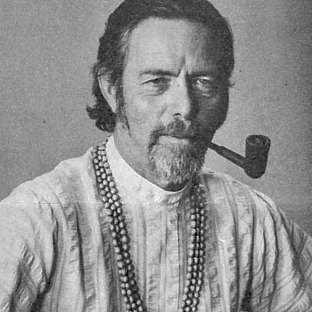
In a roughly ninety-second excerpt from his Cosmic Drama lectures, Alan Watts takes apart one of the most casually repeated pieces of advice in modern life: "be yourself." His argument is that the phrase assumes a self has already been identified, when in practice the self a child is asked to be has usually been chosen by the adults around them. Drawing on his own childhood, Watts describes moving between households and peer groups as a different person in each, being told to settle on one, and being corrected for imitating an admired friend. The result is a sharp reading of how identity gets assigned before it is ever examined, and why "authenticity" can become one more role to perform.
The excerpt opens not with a thesis but with an observation about how children perceive the world. Watts begins with a claim about education in general: "Our social way of bringing up children is to make them concentrate on the bits and to ignore the totality" (0:00). He pictures the ordinary parental habit of pointing at things, naming them, and saying "look at that" (0:11).
The example he chooses is a telling one. Children, he says, often ask about things adults have no name for: the backgrounds of a scene, the shapes of the spaces between objects. "What's that?" they ask, and the adult brushes it aside as unimportant, because it doesn't have a name (0:23 to 0:32). Watts's point is that the adult world trains attention toward labeled objects and away from the field in which those objects sit. A child's question about empty space is treated as noise, while the named thing is treated as signal.
This matters for the rest of the excerpt because identity works the same way. The named things are the parts, the roles, the labels. The background, the whole that holds them, is left unnamed and unattended. Watts is setting up a contrast between the totality and the bits before he ever says the word "mask."
The turn comes at about 0:37, when Watts says that "what everybody around a child does is to tell the child who he is" and "what sort of part he's expected to play, what sort of mask he must wear" (0:37 to 0:46). The word he chooses is mask, and it carries weight. A mask is not something a person invents from nothing; it is handed over, fitted to a face by someone else, and worn for the benefit of an audience.
Watts then makes this concrete with a memory from his own childhood (0:51). "I knew I had several different identities," he says, and that the adult world was "pushing" him to settle on one of them (0:51 to 0:59). He describes three rooms and three selves. At home with his parents he was one person. At his uncle's he was "another person altogether." With his own peer group he was "still quite another person" (1:02 to 1:10).
What is striking is that none of these identities is presented as fake. Each was real in its setting. The pressure came not from the variety itself but from the instruction that followed: decide who you really are. Watts names this directly, saying that society's demand was to "make up your mind who you are really" (1:12 to 1:16). The question assumes there is one answer hidden inside a person that the person can locate and then commit to. For a child moving between rooms, that is an impossible assignment.
Watts's most vivid detail is about imitation. He would admire another child and copy him. Then he would come home, and his mother would say, "Alan, that's not you. That's Peter" (1:16 to 1:22). The correction is immediate and social. The copied behavior is labeled as borrowed, and the child is told to return to himself.
"And you're you're you're putting on his game. You be yourself now. See that's otherwise you're somehow phony." — Alan Watts, Cosmic Drama excerpt (1:22 to 1:29)
The sequence is worth slowing down for, because it contains a small paradox. The child is criticized for performing someone else's personality, and then instructed to be himself. But the child has no independent access to "himself" that is not already a set of social reactions. Every way he has of knowing who he is has been shaped by what got praised, what got corrected, and what got laughed at. When his mother says "that's not you," she is pointing him toward a self she has an image of, even as she calls it his own.
This is why the phrase "be yourself" can function as a second mask. It sounds like permission, but it arrives with an expectation attached: the authentic version is the one already approved, and the one that differs is phony. Watts is pointing at the way authenticity itself can become a performance judged by the same audience that handed out the original roles.
The final line of the excerpt, "otherwise you're somehow phony" (1:25 to 1:29), gives the concept its emotional charge. Phoniness is the accusation that a person is not what they appear to be. Watts's argument turns the accusation around. If a child has been given several selves by several rooms, then the charge of phoniness is applied from the outside, by whichever room the child is standing in at the moment. The child who copies Peter is phony in his mother's eyes, but the child who is "himself" at home is only one of several legitimate performances.
Read this way, the excerpt is not an argument that there is a true self to be discovered and then protected. It is closer to the opposite claim: that the search for a single fixed identity is itself built into how children are raised. The adult world, in Watts's telling, wanted him to resolve his many selves into one, and to do it quickly, because a stable role is easier to manage than a shifting one.
The excerpt is short, and it would be a mistake to inflate it into a complete doctrine. What it offers is a set of questions a reader can actually use.
- Which rooms assigned you a role? Watts identifies family, extended family, and peers as three separate settings, each with its own version of him. Listing the rooms in your own life, and the person each one seems to expect, is a concrete way to see the masks.
- When did someone call you "not yourself"? The correction Watts remembers from his mother is revealing. Notice what behavior was labeled as borrowed, and who decided what counted as your own.
- Do you trust the question "who am I really?" Watts treats this demand as the source of the pressure. Sitting with the question without rushing to answer it may reveal how much of the answer was supplied by others.
- What is the background you were taught to ignore? Returning to his opening image, the child's question about empty space points to what gets lost when attention is trained only on labeled parts. Attending to the whole field of your life, rather than its named roles, is the alternative the excerpt implies.
None of this requires throwing out roles. Watts does not say that masks are illusions to be discarded, or that a parent or friend who says "be yourself" means harm. He is describing a mechanism. Children are handed identities, and then taught that the handed identity is the real one. Seeing the mechanism is the first step to holding roles more lightly.
The excerpt comes from the Cosmic Drama audio teaching, and the publisher's description frames it as a taste of his longer lectures. The short clip cannot show the full argument, and it would be unfair to pretend it does. What it does show clearly is a method Watts returns to across his work: start with an ordinary observation, a child asking about the space between things or a mother correcting a boy's imitation, and let it open onto a question about how the self is made.
The "be yourself" line is useful precisely because it is so familiar. Most listeners have heard it, and many have said it. Watts asks what it actually means when a child is told to do it, and who is standing behind the instruction.
If this excerpt landed, the best next step is to hear the full context. The Cosmic Drama material is part of Alan Watts's Essential Lectures collection, which is available at alanwatts.com. Listening to the surrounding passages will show how this childhood memory connects to his larger arguments about role, play, and the whole of experience.
For a reader working with the idea rather than just hearing it, try the four questions above over a week. Notice the rooms, notice the corrections, and notice when the question "who am I really?" starts to feel like a demand. Watts's excerpt does not solve that demand. It makes it visible, which is often the first thing a mask needs before it can be set down.