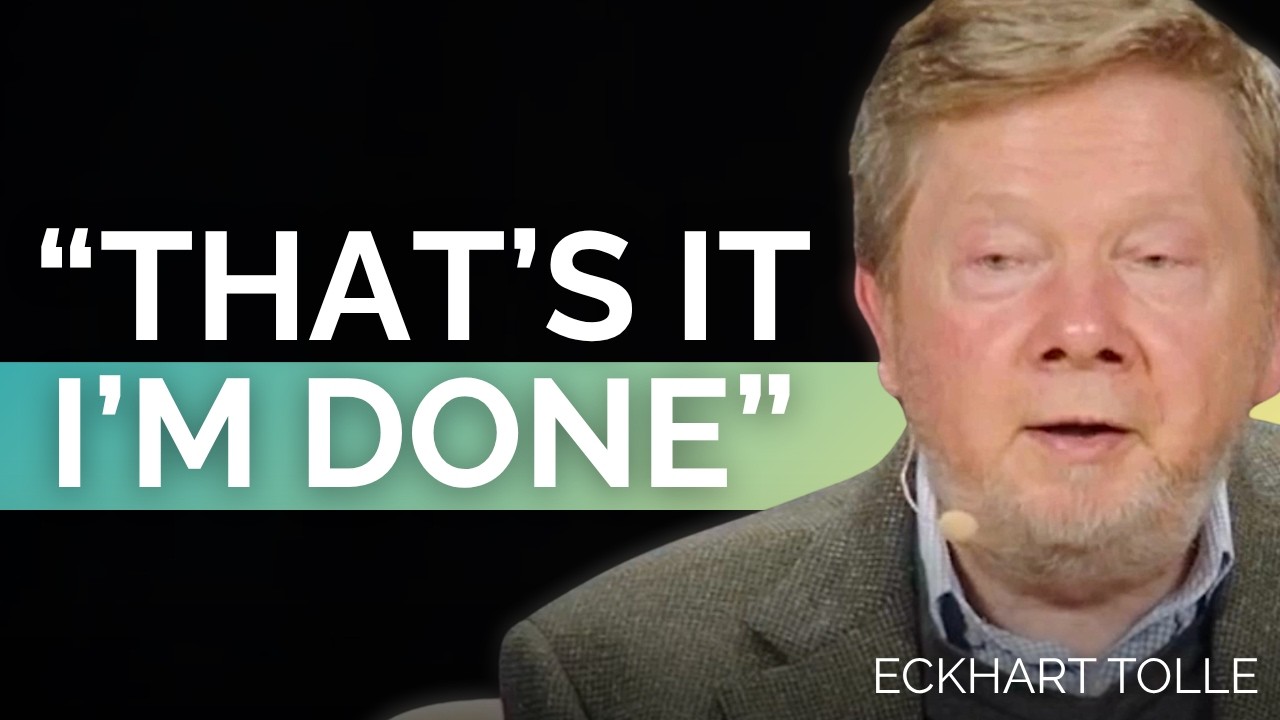
Countless people have built vision boards, sat in visualization, and watched nothing change. The problem isn't desire or intention—it's that the standard approach leaves out the most critical part: how to think. Without understanding the actual mechanism of thought itself, manifestation becomes wishful thinking. Eckhart Tolle rarely addresses this territory, but when he does, he adds the pieces that are almost always missing from popular "law of attraction" advice. The result is a map that distinguishes between real thinking and the noise that masquerades as it, and two entirely separate jobs the mind must do for anything new to actually arrive in your life.
The starting point is deceptively simple: if you have something you actually need to work through—a decision you're facing, a problem with no obvious solution, something you want to create—set aside fifteen or twenty minutes for it. Don't multitask. Don't half-attend to it while scrolling or listening to something else. Show up deliberately.
But the moment you sit down with that problem or vision is when most people go wrong. They start thinking and never stop. The mind goes in circles. It repeats the same ground. It spirals into worry or rehashing. This is not thinking; it's mental machinery spinning.
Real thinking, Tolle suggests, works in a rhythm: in, out, in, out. Think for a few thoughts. Then step back. Not step away from the subject—step back into what Tolle calls "stillness of presence." Stay there for just three or four seconds. Long doesn't matter. The length is irrelevant. What matters is the shift: you move from the thinking mind into pure awareness. The mind stops. Conscious awareness remains. Then you step forward into thought again. Back into the problem. Back into the possibilities. Then out again into the quiet.
The rhythm is what changes everything. "The real thinking happens when you bring these two dimensions together," Tolle says. Step into focused thought, then step into no-thought, then back into thought. Do this deliberately, and something shifts. Insights arrive that weren't there when you were just churning. The mind doesn't get exhausted. Instead, it becomes empowered. You'll be surprised, he notes, how many more insights suddenly emerge.
This isn't meditation in the traditional sense. It's a practice for your working mind. You're not trying to clear thought entirely; you're learning to use the space between thoughts as a generator of clarity. In that gap—that moment where you step back into pure presence—something deeper than your thinking mind has room to participate. And when you return to thought, you bring whatever that deeper intelligence has to offer.
Here's where most manifestation teaching falls apart: it treats all thinking as the same. It doesn't. There are two distinct mental operations, and confusing them is why vision boards so often lead nowhere.
The first job is deciding. This is the thinking you do to work out what course of action is required. You're facing a situation, and you need to figure out: what do I actually need to do? What steps do I need to take? This is problem-solving. This is strategy. This is the mind deployed toward clarity about action. When you're setting up an organization, or writing a book, or launching anything real, you need this kind of thinking. You need to know what's required. The rhythm of stepping in and out of thought helps here too—it keeps you from getting stuck in one angle, and it invites your deeper knowing to inform the practical decision.
The second job is entirely different. It's envisaging—using the mind not to solve the problem but to picture the finished thing as though it already exists. If it's a book, you visualize the completed manuscript there on the table. You see the title on the cover. You know it's in every bookstore in your town and in other towns. You hold the image of the finished reality. This isn't deciding what to do; this is creating a template in consciousness for what you're bringing into being.
These two operations are not the same because they're not both just problem-solving. The visualization, the envisioning, is working with a different kind of energy—what Tolle calls "a manifesting power in the universe." Once you've decided on a course of action and you're actually taking it, there's an additional energy field that comes in. It tends to bring to you helpful circumstances. It creates conditions. It aligns things. But—and this is crucial—it doesn't replace your action. It works alongside it. You still have to move. You still have to do the work. But something additional, something beyond your individual effort, can help bring what you've envisioned into existence.
This is the part that vision board culture so often omits, and it's where reality crashes into fantasy. The manifesting power of the universe is real, but it's not magic. It's not a substitute for your effort. You have to decide what to do, and then you have to do it. You have to move. "The moving is yours," as Tolle puts it. Only then—only once you're in motion, only once you've committed to action—does this additional field of possibility activate and start bringing helpful circumstances toward you.
This is why so many people visualize and nothing happens. They're envisaging without the deciding and the doing. They're holding the image without being willing to take the steps. The manifesting power doesn't work on its own. It works through the cooperation of your intention, your decision, your action, and your capacity to hold the vision of the finished thing simultaneously. All three together.
There's one final layer, and it's perhaps the most important. When you're doing this work—moving between thought and stillness, deciding and envisaging, acting and holding the vision—you're making choices about where the energy of creation comes from.
If you're in constant thought, constantly in your head, constantly problem-solving and planning without stepping back into stillness, you're almost certainly creating from ego. You're creating to prove something, to get something, to solve a problem defined by your personal history and your fears and your needs. The creation that emerges from that will carry that signature. It will be limited by your egoic consciousness.
But when you step back continuously from thought into no-thought and back into thought, something shifts in where the creation originates. What you're creating becomes less likely to be an egoic project and more likely to come from the deeper place of consciousness itself. It's not something designed to satisfy your ego or prove something about you. It comes from a deeper intelligence. And what comes from that place has a different quality. It has less friction. It meets less resistance. It aligns more easily with how things actually work.
This is why the rhythm matters so much. It's not just a technique for clearer thinking—though it is that. It's a safeguard. It's a way of staying connected to something larger than your personal will while you're pursuing what you want to create. You're not forcing. You're cooperating. You're inviting something deeper into the process. And that changes everything about what emerges.
Start small. Take something real that you're facing—a decision, a problem, a creative project. Set aside fifteen or twenty minutes. Sit with it and practice the rhythm: think, step back into stillness for three or four seconds, think again. Notice what arrives in those gaps. Notice how your mind feels different after cycling through it that way.
Then get clear about what action you actually need to take. Make the decision. Commit to the steps. Start moving.
And while you're moving, hold the vision. See the finished thing. Feel it as real. Keep coming back to that image.
But stay grounded in the space between your thoughts. Stay connected to the stillness. Let that shape where your creation comes from. The moving is still yours—but so is the cooperation with something larger. Both matter. Both are required. And when you have both, the results tend to surprise you.