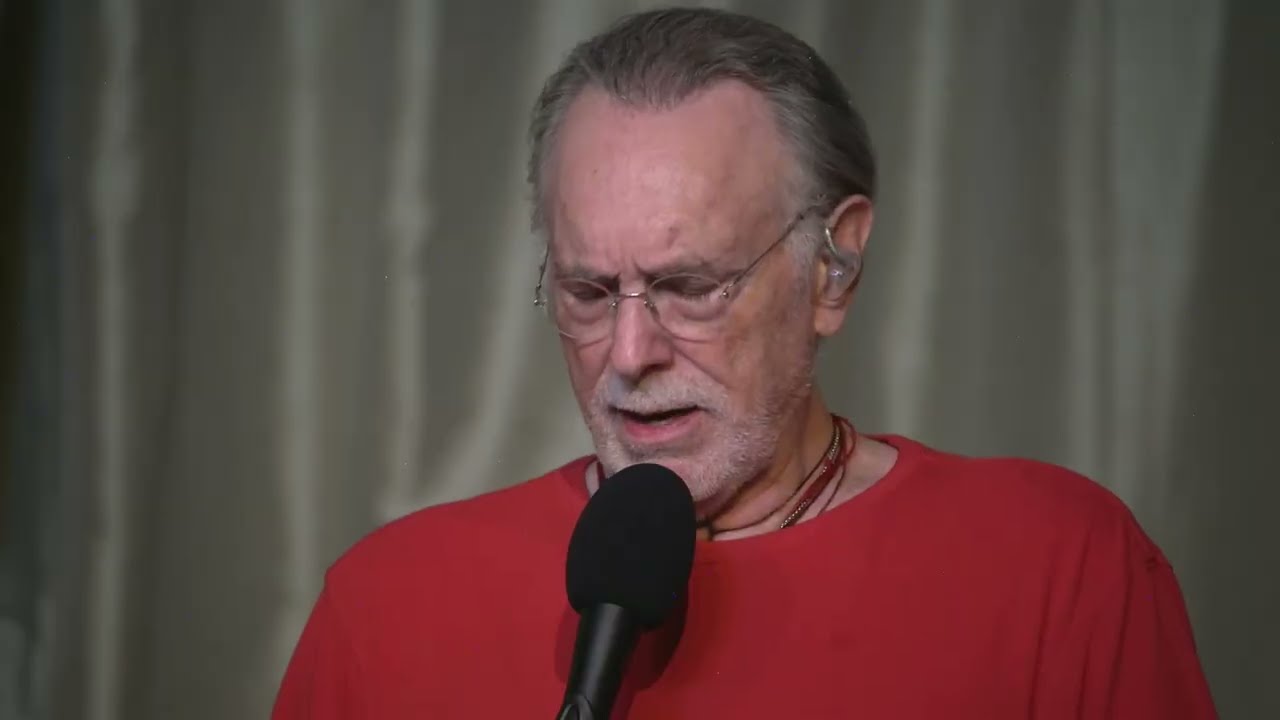
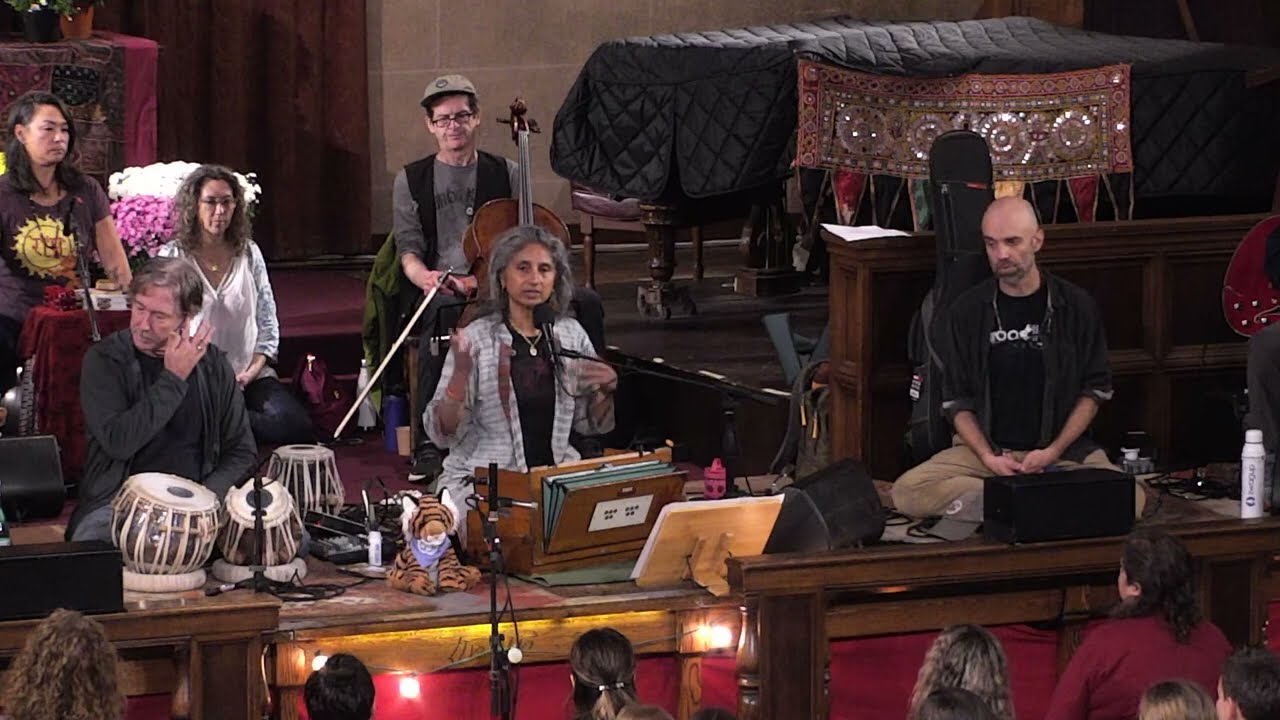
In a modest Amsterdam venue, Siobhan Moore stands with acoustic guitar and voice — the foundation of a song that asks almost nothing of listeners except to follow the breath. "Breathe (I Am Free)" from the 2021 album Voices Like Rain is not a performance designed to impress. It is an invitation to notice what is already happening: the simple fact of breathing, the space between effort and surrender, and the freedom that lives there.
The Anatomy of a Kirtan Song
Kirtan — the call-and-response chant form rooted in Indian devotional practice — has evolved in Western contexts to include songwriting that borrows the mantra's directness but adds harmonic and melodic sophistication. "Breathe (I Am Free)" exemplifies this hybrid. Moore's composition strips the form to its essential elements: a lyric that states its truth plainly, instruments that serve rather than dominate, and space enough for the listener's own breath to become audible.
The recording credits reveal a careful assembly. Aisling Urwin's harp provides luminous texture — an instrument that can sustain without pushing. Raffa Martinez's percussion sits lightly in the mix, marking time rather than driving it. Ezra Landis on acoustic guitar and background vocals thickens the harmonic field without crowding it. The engineering — Marcel Drache's recording work, Piper Payne's mastering — suggests that every element was heard, considered, and placed with intention.
This is the infrastructure of kirtan as a healing practice: not exotic instrumentation or complex arrangements, but clarity. What you hear is what is meant.
What Does "I Am Free" Actually Mean?
The song's title carries a paradox. In most spiritual traditions, freedom is not something you claim but something you realize — a truth that was always so. The phrase "I am free" could be read as an affirmation, a statement of fact meant to reprogram doubt. Or it could be heard as a question: a reminder to check whether you are, in fact, free right now, in this moment, as you breathe.
The live setting matters here. When Moore sings this in a room full of people, each listening, the song becomes a shared moment of permission. If she can claim it, so can you. The simplicity of the lyric — coupled with the title's directness — suggests that freedom is not complicated. It does not require belief in a distant goal. It lives in breath itself: in the willingness to take the next one, and the next.
Breath as a Doorway
Pranayama, the yogic science of breath, holds that the breath is not merely a physiological function but a bridge between conscious and unconscious mind. To attend to the breath is to touch the place where intention and autonomy meet. You do not consciously instruct your lungs to expand — the body knows how. Yet you can also choose to breathe differently: deeper, slower, with awareness.
A song titled "Breathe" in a kirtan context activates this recognition. It is a subtle teaching dressed as a simple instruction. By singing the word — by making breath itself the subject of a chant — Moore and her collaborators create a moment where listeners may feel their own physiology sharpen into focus. The breath is no longer invisible background. It is the foreground.
And with that shift of attention comes the freedom claimed in the title. Not freedom from something — fear, doubt, distraction — but freedom into something: presence, awareness, the felt sense of being alive right now.
The Album Context: Voices Like Rain
Voices Like Rain, released in 2021 under the Spirit Voyage Records label, positioned itself during a moment of deep collective introspection. The album's title — with its plural "voices" and the organic metaphor of rain — suggests interdependence, nourishment, and the idea that liberation is not a solitary achievement but something that happens in relationship, or in the presence of others.
"Breathe (I Am Free)" sits within that philosophy. It is a solo voice, yes, but never isolated. Urwin's harp, Martinez's rhythm, Landis's guitar — they do not accompany so much as they create the acoustic equivalent of witness. The song is sung, but it is heard. And in the space between singer and listener, something shifts.
Why This Song Matters Now
In an era of breath-stealing news cycles, shallow scrolling, and the chronic fragmentation of attention, a three-minute song that asks you to notice your breathing is a kind of resistance. Not angry resistance — gentle, persistent resistance. The song does not argue that you should feel free. It simply models the act: a voice taking breath, releasing it as sound, trusting that others will join, that breath will return, that the cycle continues.
The Amsterdam live recording captures something that studio tracks often cannot: the exact moment when a shared inhale and exhale becomes a room full of people recognizing themselves in the same gesture. That is the gift of kirtan in its best forms — not mysticism, but a form of collective remembering.
Where to go from here
If "Breathe (I Am Free)" resonated, explore Voices Like Rain in full to encounter how Ajeet weaves kirtan and songwriting across an album. Pay attention to the other musicians on the record — particularly Aisling Urwin's harp work — and notice how the album's production choices prioritize intimacy over spectacle. Consider also the broader landscape of contemporary kirtan: artists like Krishna Das, Jai Uttal, and C.C. White have similarly developed hybrid forms that honor mantra tradition while creating original compositions. And return, often, to your own breath. The song's instruction is simple; its depth is infinite.