Transcript
[0:01] [music]
[0:07] [music]
[0:28] [singing]
[0:37] [singing]
[0:52] [clears throat]
[0:57] >> Good evening, everyone.
[0:59] Welcome. Welcome to the Beginner's Mind
[1:01] Temple. Good to be with all of you this
[1:03] evening.
[1:04] Thank you for opening the window so we
[1:06] can get a little bit more air in here.
[1:09] And uh
[1:12] I have
[1:13] my Gesha
[1:15] Ellen and the Ino
[1:17] Michael had uh offered to do an
[1:20] interpretive dance uh on the theme of my
[1:22] talk tonight.
[1:24] And I almost took them up on it.
[1:26] Um
[1:28] but they couldn't quite figure out how
[1:29] to do renunciation as a
[1:32] in dance form, so we'll see.
[1:35] >> [laughter]
[1:36] >> Anyhow, we are we are in the midst of a
[1:38] 10-week fall practice period or ango.
[1:41] And the study of our ango is um
[1:45] the six paramitas, and I'm framing them
[1:49] as bodhisattvas' bodhisattva practices
[1:52] for an uncertain world.
[1:54] And uh for those of you who are not
[1:57] familiar with the paramitas, I'm
[2:00] wondering how many people are new this
[2:01] evening, who have not been here before.
[2:04] Well, welcome. By the way, my name is
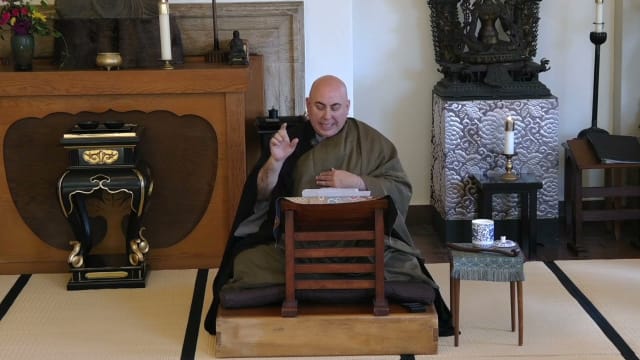
[2:06] Tenzin David Zimmerman.
[2:07] And I'm a resident here, resident
[2:09] priest, and I also serve as one of the
[2:11] abbots.
[2:13] And so, our study of the paramitas, the
[2:16] six paramitas, uh they are they are
[2:19] essentially considered them virtues or
[2:23] uh liberated attitudes, as I like to
[2:25] think about them,
[2:27] uh for Buddhist practice.
[2:29] And they include dana, dana paramita,
[2:32] which is generosity.
[2:34] Uh sila,
[2:36] sila paramita, which is, you know, it's
[2:38] often framed as ethical conduct or
[2:40] ethical discipline or morality.
[2:43] There's also kshanti, which is um
[2:45] patience or tolerance.
[2:47] Um
[2:49] there is virya,
[2:51] can be translated as energy, effort,
[2:54] diligence.
[2:55] There's dhyana, which is um
[2:58] concentration or meditation. And then
[3:00] the sixth is prajna, which is wisdom.
[3:04] And these paramitas are often sometimes
[3:07] referred to as perfections.
[3:10] Uh cuz they're considered the heart
[3:12] practices of a bodhisattva, uh a being
[3:15] who is dedicated to the path of
[3:17] awakening for the benefit of all beings.
[3:20] So, when they are perfected,
[3:21] particularly through the paramita of
[3:23] wisdom, they take us beyond our usual
[3:27] self-clinging and dualistic point of
[3:29] view.
[3:30] And um
[3:34] these far-reaching attitudes, they take
[3:37] us to the other shore,
[3:39] uh from this shore of samsara, of
[3:42] suffering, we would say, to the shore of
[3:44] nirvana,
[3:46] uh uh often you can consider liberation,
[3:49] uh
[3:50] a realm of peace and ease and uh joy.
[3:55] And um
[3:56] >> [snorts]
[3:57] >> you know, there's actually several
[3:59] different versions of the paramitas.
[4:01] Some of the my in our class on Monday
[4:03] nights I've I've brought this up before.
[4:06] There is the six Mahayana
[4:09] um paramitas that I just offered to you.
[4:12] And these are drawn from uh texts such
[4:15] as the Lotus Sutra and the large Sutra
[4:18] on the perfection of wisdom.
[4:20] And there's actually a Mahayana list of
[4:23] 10 paramitas. So, somewhere along the
[4:26] way the Mahayana said, "Oh, we we want
[4:29] 10, not just six." And so, they added
[4:32] four more perfections. And the
[4:34] additional four they added were upaya,
[4:37] which means skillful or compassionate
[4:39] means,
[4:41] uh
[4:42] pranidhana, which means aspiration,
[4:45] bala, which translates as spiritual
[4:48] strength, and jnana, which is uh
[4:51] knowledge in this case.
[4:54] And these come also draw from the
[4:58] original 10
[5:00] uh Theravadin paramis or paramitas.
[5:04] And uh those are also drawn from various
[5:06] different sources. So, the Buddha didn't
[5:08] take teach these directly, but were
[5:10] pulled from his teachings and from other
[5:13] uh collections of Buddhist texts,
[5:15] including the Jataka tales, the stories
[5:17] of the Buddha's past lives, which depict
[5:20] uh these particular paramitas.
[5:23] And the Theravadin 10 share five of the
[5:26] Mahayana six. So, they're not exactly
[5:28] equivalent lists.
[5:30] Um and so, uh they share the Theravadin
[5:34] 10 share generosity, morality, patience,
[5:38] energy, and wisdom. But then they
[5:40] include five additional virtues:
[5:43] renunciation,
[5:44] truthfulness, determination, loving
[5:47] kindness, and equanimity.
[5:50] And um the Mahayana fifth perfection,
[5:54] meditation, isn't named here in uh the
[5:58] Theravadan 10, but it's you can consider
[6:01] it as represented in uh equanimity in
[6:04] some way.
[6:06] >> [snorts]
[6:08] >> And so
[6:09] uh each week we've been taking up a
[6:11] different uh of the six paramitas, the
[6:13] six Mahayana paramitas. And this week we
[6:16] were uh focusing our focusing on sila,
[6:19] ethical discipline. And because we had
[6:23] um
[6:24] already discussed sila in our Monday
[6:26] night class, and then about oh I think
[6:29] it was about a week and a half ago Pam
[6:31] Weiss was here and she gave a a lovely
[6:33] talk on a Saturday on
[6:36] uh sila as well.
[6:38] I thought I would take the opportunity
[6:40] to introduce you to a different
[6:42] paramita, one that isn't in our list of
[6:46] Mahayana six, as a way to kind of
[6:48] broaden our exposure to the paramitas,
[6:52] and see maybe what some of the other uh
[6:55] lists are trying to point to or offer as
[6:58] um perfection practices. So with that in
[7:01] mind, as I already uh foretold, I'm
[7:05] going to take up the paramita of
[7:06] renunciation.
[7:08] And uh
[7:10] I
[7:11] the in the Theravadan list of 10
[7:13] paramis, renunciation is the third. So
[7:16] rather than patience, uh which is the
[7:19] third in the Mahayana, renunciation
[7:21] comes, and it comes right after
[7:23] generosity and morality.
[7:26] So for this reason I thought this is
[7:28] kind of a good time to introduce it
[7:29] because since renunciation, I think of
[7:32] it as naturally aligning with the first
[7:34] two uh paramita practices of giving and
[7:38] ethical discipline.
[7:41] Uh
[7:42] I
[7:43] can imagine that encountered Buddhism
[7:44] before and renunciation often comes up
[7:47] frequently in discussions of Buddhism
[7:50] and Zen. But it's true meaning and
[7:53] significance are not always properly
[7:56] understood.
[7:57] So, what exactly does renunciation mean?
[8:01] When you hear that word, what do you
[8:02] think? Why is it particularly important
[8:04] to Buddhism since we hear it a lot,
[8:06] including Zen? And how might we approach
[8:09] it or understand it as both a liberative
[8:12] attitude and also a beneficial practice?
[8:16] Um
[8:17] when you hear the word renunciation,
[8:19] what comes to mind?
[8:21] Mhm.
[8:22] What do you think?
[8:25] Regret?
[8:27] What images, what thoughts, what what
[8:29] ideas of renunciation?
[8:32] Shaving your head, renouncing the hair.
[8:35] Anything else?
[8:37] What's that?
[8:38] Letting go, yes.
[8:40] Restrain, great.
[8:44] Yeah, so there might be different
[8:45] things. I'll be speaking about letting
[8:46] go and restraint as part of the talk
[8:49] this evening. Um but there's also a lot
[8:51] of misperceptions about renunciation,
[8:54] which I kind of when I first came to
[8:55] Buddhism, I also
[8:57] in some ways had and kind of it leads
[8:59] people to kind of struggle with the idea
[9:01] and the practice of renunciation.
[9:04] Um
[9:05] and for some people this is a
[9:08] assumption that renunciation means
[9:10] becoming homeless, abandoning one's
[9:13] family, living in extreme poverty,
[9:17] or becoming a celibate monk and nun. So,
[9:20] any of you have that idea about
[9:22] renunciation? Yeah? Yeah. So, it's it's
[9:25] not uncommon. Um some people think that
[9:27] renunciation means you hate the world.
[9:30] I'm going to renounce the world. I'm
[9:32] going to leave the world. Uh or that um
[9:35] Um, practicing renunciation makes you
[9:38] depressed and joyless in some way,
[9:40] right?
[9:41] Uh, many people, particularly Americans,
[9:44] equate renunciation with the notion of
[9:46] someone taking away their freedom.
[9:50] Right? How dare you take away the
[9:51] freedom? You want me to renounce
[9:53] something? You want me to renounce my my
[9:55] attachment to gasoline?
[9:58] You're going to take away my freedom.
[9:59] How dare you, right?
[10:02] Uh, but from a Dharma perspective, all
[10:04] these mistaken notions miss the genuine
[10:08] purpose, significance, and power of true
[10:11] renunciation.
[10:14] So, in English, to renounce means to
[10:17] give away or relinquish,
[10:20] uh, to reject and to disown.
[10:23] And for those who have a Christian
[10:25] background, such as myself, this can
[10:27] sound a lot like penance, right? Like
[10:29] some kind of kind of self-punishment or
[10:33] deprivation to atone from for your sins
[10:36] in some way, right?
[10:39] Uh,
[10:39] and of course that kind of understanding
[10:42] makes the idea of renunciation less
[10:44] appealing, right?
[10:46] However, Buddhist renunciation is
[10:48] entirely different. It's pointing to a
[10:51] practice that can actually bring us joy,
[10:54] ease, and liberation.
[10:57] So, there's a different orientation.
[10:59] The term in Pali Sutras that is usually
[11:02] translated as renunciation is Nekkhamma.
[11:07] Nekkhamma.
[11:08] And, uh, Nekkhamma,
[11:10] um,
[11:11] relates to the Pali verb nikkhamati,
[11:15] which means to go forth or to leave
[11:18] behind.
[11:20] Uh, so you can think of as home leaving
[11:22] in some way. So, over to time this word
[11:25] came to signify the act of renouncing
[11:28] and freeing oneself from attachment to
[11:31] sensuality.
[11:34] Well, some
[11:36] um there's some traditional explanations
[11:38] that connect the word to another framing
[11:41] which is nekkhamma,
[11:44] which means away from sensual desire.
[11:47] That's kind of more of a gloss on the
[11:49] term and it's not
[11:51] uh strictly linguistic um derivation.
[11:55] What matters though is the meaning that
[11:58] um that of joyful turning away from the
[12:02] endless pursuit of sensory
[12:05] gratification.
[12:06] Right?
[12:07] So, nekkhamma renunciation most often
[12:11] describes the act of a monk or a nun
[12:14] going forth into a homeless life to be
[12:16] liberated from sensual pleasures.
[12:20] Uh however, as we're going to see,
[12:22] renunciation is also a practice that lay
[12:25] people
[12:26] uh can take up.
[12:30] You would imagine most spiritual
[12:31] traditions have some classic form some
[12:34] of the classic forms of renunciation,
[12:36] some way of limiting or restricting the
[12:39] things that we kind of tend to hold on
[12:41] or engage in on a on a habitual level
[12:45] such as
[12:46] um engaging in food, uh sleep, comfort,
[12:51] sex, entertainment, possessions, choice,
[12:54] and control. So, you can think of many
[12:56] different traditions where that is a
[12:58] practice giving up one of these.
[13:00] And the basic idea is to free ourselves
[13:03] from those desires and worldly pleasures
[13:06] that undermine our contentment.
[13:11] Now, we might ask ourselves, what
[13:13] exactly is the problem with worldly
[13:15] pleasures? Do you have any problems with
[13:17] worldly pleasures?
[13:19] What is the problem? You know, if
[13:21] especially if enjoying them doesn't do
[13:24] anyone else harm.
[13:25] Of course, if we enjoy them and it does
[13:27] harm to someone else, then we can
[13:29] question, "Why am I engaging in this?"
[13:31] But, if it doesn't harm anyone else,
[13:32] what's the what's the the drawback?
[13:35] Um we can think of one drawback to
[13:37] engaging worldly pleasures that we we
[13:41] engage in, but then we naturally want
[13:43] them to last. We want them to go on
[13:45] forever,
[13:46] right? Even though, uh
[13:49] you know, they're not going to. We know
[13:50] that all transient things come to an
[13:52] end. That Netflix series that you really
[13:55] love, it's going to come to an end,
[13:58] right? At some point,
[13:59] right? And uh another drawback is that
[14:02] because they're firmable, we constantly
[14:05] seek more of the pleasures we have,
[14:08] right? Or we seek new ones.
[14:10] So, the Netflix series you liked ended,
[14:13] you quick go back to and you start
[14:14] clicking and looking for the next
[14:15] series, right? You need that endorphin
[14:18] hit. What's the next thing I can look
[14:20] at? I want more pleasure. What's the
[14:22] next thing? This is the whole uh
[14:25] Facebook and all those algorithms.
[14:26] They're constantly They know your
[14:28] addiction level. They know how to track
[14:30] you and have you keep seeking for
[14:33] something that's pleasurable or the
[14:35] possibility of pleasure,
[14:37] right? And uh there's also a lot of
[14:40] significant um I could say stress and
[14:42] burden involved in trying to obtain your
[14:44] pleasures.
[14:45] Uh and then, even more so in some cases,
[14:48] trying to maintain them. So, once you
[14:50] get it, you wanted that really fancy
[14:53] car, you got it finally, and it takes a
[14:55] lot of effort to maintain it and keep it
[14:58] up and so on, right?
[15:00] Uh
[15:01] furthermore, chasing pleasures can act
[15:04] actually distract us from our Dharma
[15:06] practice,
[15:08] uh making it less of a priority in our
[15:10] lives. So, for those who are committed
[15:12] to a path of practice, we might ask
[15:13] ourselves,
[15:14] "Have you ever given in to the pleasant
[15:17] distraction?" I'll just use Netflix
[15:19] again, since it's the easy thing. A
[15:21] Netflix movie instead of sitting zazen
[15:24] before bed.
[15:26] All right. Oh, I'm going to really sit.
[15:28] I'm going to really sit. But, oh,
[15:30] there's that movie on. Okay. So, just
[15:32] going to notice that it takes us away
[15:34] from
[15:36] um attending to our our practice in some
[15:38] way.
[15:39] And finally, um
[15:41] attachment to personal pleasure can make
[15:43] us self-centered. It's all about me.
[15:46] It's about what I enjoy. It's about my
[15:48] pleasure. And uh when we constantly are
[15:51] seeking our own comfort and pleasure, we
[15:54] give little time and attention
[15:56] uh to others. What do they need? What do
[15:59] they need to be happy? How can I help
[16:01] them?
[16:03] It's understood in Buddhism that giving
[16:06] oneself over to central pleasure is a
[16:09] great hindrance to enlightenment.
[16:12] Uh central desire, in fact, is one of
[16:15] the is the first of the five hindrances.
[16:18] Um and they're they're considered
[16:21] hindrances to our progress in meditation
[16:24] and in our daily life and then to our
[16:26] liberation.
[16:28] And uh but we can
[16:30] we're told overcome
[16:32] uh these hindrances through mindfulness
[16:35] because when we practice mindfulness, we
[16:38] are able to see how things really are
[16:41] and we fully appreciate that trying to
[16:43] grasp on to central pleasure,
[16:47] it's only a temporary distraction.
[16:50] All right.
[16:51] And uh it's temporary distraction from
[16:54] whatever this kind of deeper quality of
[16:57] suffering or disease or dukkha you might
[17:01] be experiencing. You know, we never we
[17:04] often kind of only address the surface
[17:06] layer of our dissatisfaction and disease
[17:08] and we actually don't get to the root of
[17:10] it, right? And uh
[17:14] and when we, you know, we distract
[17:16] ourselves and then when that distraction
[17:18] wears off, uh we want something else. We
[17:21] grasp onto something else. And this
[17:23] cycle of grabbing onto the next thing
[17:26] binds us to Dukkha, to suffering, to
[17:29] this constant process of disease. And
[17:32] the Buddha taught in the Four Noble
[17:33] Truths that thirst or desire, the the
[17:37] the original word is Tanha, puts us in
[17:40] this endless cycle of grasping
[17:43] and keeps us dissatisfied. I'm always
[17:46] reaching, never satisfied. It's kind of
[17:48] like having this kind of stick and you
[17:51] know, the carrot in front of you
[17:53] metaphor. You're constantly going after
[17:55] it
[17:56] and you're never able to reach it.
[18:02] Now, it's important to understand that
[18:04] it's the attachment to central pleasure
[18:07] and desire that's the hindrance, not the
[18:09] pleasure itself.
[18:11] Right? So, sure, you can go out and
[18:14] occasionally to enjoy your
[18:17] Ben & Jerry's Cherry Garcia frozen
[18:19] yogurt.
[18:21] Mhm.
[18:22] Um but don't get attached to it. Don't
[18:24] end up having it every day or for every
[18:26] meal, right?
[18:28] And furthermore, uh
[18:30] merely giving something up that you
[18:32] enjoy isn't necessarily renunciation.
[18:36] Right? You can give something up such as
[18:38] ice cream and still crave it.
[18:41] Right? Which suggests you're still
[18:43] attached to the the pleasure that uh it
[18:47] was giving to you. So, you haven't given
[18:48] up the pleasure pleasure part of it.
[18:51] You haven't renounced that.
[18:52] And
[18:54] but at the same time it's important to
[18:55] understand that enjoying something isn't
[18:58] bad.
[18:59] You know, some some religions may say,
[19:02] "Oh, you shouldn't enjoy anything
[19:04] because that's going to lead you to
[19:05] doing bad things or to evil and
[19:07] somehow." And Buddhism says, "No, enjoy
[19:10] it." All right? You can enjoy the frozen
[19:14] yogurt.
[19:16] Uh but can you eat it and enjoy it
[19:18] without attachment in some way?
[19:21] What And what is it to only eat as only
[19:24] as much as you need without being
[19:26] greedy?
[19:27] You know, how many times have you said,
[19:29] "I'm just going to have one cup.
[19:32] Just one cup."
[19:33] And then suddenly the whole pint is
[19:35] gone. Right?
[19:37] And so um this I often think of uh this
[19:41] meaning of the word Oryoki.
[19:44] Uh Oryoki is a uh form of serving uh
[19:47] eating ritually in our meditation hall.
[19:50] And uh with three interlocking bowls
[19:53] where you're served. And Oryoki means
[19:55] just enough. So you take just enough to
[19:58] sustain yourself and your health so you
[20:01] can continue to practice.
[20:03] So what is Oryoki for you in terms of
[20:06] everything that you enjoy?
[20:08] You know, rather than overindulging,
[20:11] what is it just to have just enough to
[20:13] appreciate it
[20:15] but not lean in to the point where uh
[20:17] greed mind takes over.
[20:22] Another kind of less intimidating name
[20:25] for renunciation is simply letting go.
[20:29] Right? Letting go might take the
[20:31] traditional forms that I mentioned
[20:32] earlier. It might also take some of the
[20:35] opposite forms in some way.
[20:37] Um but essentially renunciation can be
[20:39] understood as a letting go whatever
[20:42] binds us to ignorance and to suffering.
[20:46] So this might sound simple.
[20:49] Um but it's easier said than done.
[20:52] And um because the things that bind us
[20:55] are usually the very things that we
[20:57] mistakenly think we must have in order
[21:00] to be happy.
[21:01] How many times have you gone you logged
[21:04] on I'm just going to assume you've done
[21:05] this too onto Amazon and you see
[21:07] something you're like, I really need to
[21:09] have that. That's going to bring me
[21:11] happiness. And you get it a few days
[21:13] later and you're like, ah
[21:15] huh, okay.
[21:17] And suddenly that hit is gone, right?
[21:21] And it really doesn't bring you
[21:22] happiness.
[21:23] The Buddha taught that genuine
[21:25] renunciation requires clearly seeing how
[21:29] we make ourselves unhappy through
[21:32] grasping and through
[21:34] greed.
[21:36] So when we do then
[21:38] uh when we recognize this, when we
[21:40] recognize these grasping tendencies,
[21:43] this the mind of greed, then we
[21:45] naturally what
[21:47] what happens is renunciation naturally
[21:48] follows.
[21:50] You know, and in this case it's a
[21:51] positive liberating act.
[21:54] Right? It's not a punishment.
[21:57] The Buddha spoke to this when he said,
[22:00] "If by forsaking by forsaking a limited
[22:03] ease,
[22:04] one would see an abundance of ease, the
[22:07] enlightened person would forsake the
[22:09] limited ease for the sake of the
[22:11] abundance."
[22:13] So in other words, a wise person
[22:15] understands the value of forsaking what
[22:17] brings only limited temporary joy for
[22:21] that which will eventually bring a
[22:23] greater lasting joy and ease.
[22:26] Right?
[22:27] So this idea, you know, they've done
[22:29] these experiments with kids and and
[22:32] sometimes
[22:33] animals and so on, you know, we'll give
[22:36] you this piece of candy,
[22:38] but if you don't eat it now, if you wait
[22:41] 5 minutes, we'll give you something
[22:43] more, right? And and something
[22:45] different. And oftentimes it they may or
[22:48] may not be able to wait that long,
[22:50] right?
[22:53] Renunciation is also an important aspect
[22:56] of the Buddha's Noble Eightfold Path. So
[23:00] in um second factor on the eightfold
[23:03] path is right intention.
[23:06] And uh the Buddha
[23:09] defined explicitly defined right
[23:11] intention as having three parts to it.
[23:15] The intention of renunciation,
[23:18] the intention of non-ill will,
[23:21] and the intention of non-cruelty.
[23:25] So, this means that renunciation it's
[23:27] it's a structural component of the path
[23:31] itself, right?
[23:34] And each time you cultivate the
[23:35] intention to let go, you're walking the
[23:38] noble eightfold path.
[23:44] So, the intention of renunciation, you
[23:47] can think of it as directly opposing the
[23:49] intention of pursuing sensual pleasure
[23:52] in some way.
[23:54] And in daily life, this
[23:56] manifests as a conscious choice.
[24:00] A choice to turn the mind away from
[24:04] thoughts of seeking pleasure,
[24:06] from uh seeking status, comfort, to any
[24:09] of those things that you are naturally
[24:12] wanting to grasp, toward thoughts of
[24:14] simplicity, of contentment, of release,
[24:19] right?
[24:20] So, we got to be careful. We don't want
[24:22] to be suppressing desire. Renunciation
[24:25] isn't about suppressing desire,
[24:28] because that sometimes just makes it
[24:29] stronger. Rather, it means recognizing
[24:32] that thoughts of sensuality lead to
[24:35] agitation and suffering,
[24:38] right? While thoughts of renunciation
[24:40] lead to peace.
[24:42] So, this grasping the grasping mind,
[24:45] right?
[24:47] It's it creates agitation in the body.
[24:49] You can feel it in the body.
[24:51] Where the letting go mind, you can feel
[24:54] how there's a release in the body,
[24:56] All So, there's a tangible physical
[24:58] experience throughout the whole body
[25:01] when you constantly choose to turn the
[25:03] mind away from grasping and focus on
[25:06] what is present and releasing into the
[25:09] fullness of the present moment.
[25:21] So, different Buddhist traditions
[25:23] approach um
[25:25] and apply renunciation in slightly
[25:27] different ways. In the Theravada
[25:29] tradition, for example, the primary
[25:30] practice is discern through
[25:32] contemplation how one's enjoyment of
[25:35] sensual pleasure might impede one's
[25:37] spiritual path.
[25:39] And so, renunciation therefore in in
[25:42] that tradition is seen as not only a
[25:44] direct antidote to sensual desire, but
[25:47] also it's considered a prerequisite for
[25:50] a deep state of meditation.
[25:52] So, um when the mind is entangled in uh
[25:58] thoughts of and desires of pleasure,
[26:00] it's not able to settle into deeper
[26:02] states of absorption and concentration
[26:05] known as the jhanas. Um because the
[26:08] mind's constantly being pulled, you
[26:10] could almost think of it towards
[26:12] objects.
[26:14] However, renunciation kind of acts as a
[26:16] gatekeeper,
[26:18] uh helping to turn the mind inward
[26:20] rather than they have become entangled
[26:23] by desire and distraction.
[26:26] And then there's Mahayana Buddhism,
[26:29] which holds that well, renunciation is
[26:32] an antidote to grasping a sensual desire
[26:35] and it's a prerequisite for deep states
[26:37] of meditation, it also sees renunciation
[26:40] renunciation practice as part of the
[26:43] Bodhisattva path.
[26:45] So, which uh the Bodhisattva path
[26:47] entails committing to awakening to um
[26:51] enlightenment for the benefit of all
[26:53] beings. So, it's not holding on to it
[26:56] for yourself, it's for practicing for
[26:58] the well-being and liberation of
[27:00] everyone.
[27:02] And so, here renunciation becomes a
[27:04] bodhisattva practice for developing
[27:07] bodhicitta, or the the thought of
[27:09] awakening,
[27:11] and removing the obstacles that prevent
[27:13] you from helping others to be free or
[27:16] liberated.
[27:19] You can say that,
[27:21] um,
[27:21] renunciation is more of an inner
[27:24] attitude of non-attachment,
[27:27] uh, than it is a literal, uh,
[27:29] abandonment of worldly life.
[27:33] You know, Zen often holds the
[27:35] that genuine renunciation is
[27:37] fundamentally a matter of the mind,
[27:40] rather than external appearances.
[27:42] For example, um,
[27:45] most of us, you know, you might define
[27:46] yourself as a layperson or a
[27:48] householder. Uh, none of us here are
[27:51] traditionally, uh, monastics,
[27:53] um, that I know of. Um, but, uh, for
[27:56] example, a layperson who works, raises a
[27:59] family, participates in society, can
[28:02] still practice deep renunciation
[28:04] internally.
[28:06] I do with the same spirit as a monk or a
[28:09] nun might, right?
[28:11] There's a traditional saying from
[28:13] Tibetan Buddhism,
[28:15] uh, that goes, "Renunciation is not
[28:18] giving up your possessions, it is giving
[28:21] up your attachment to them."
[28:24] So, you, uh,
[28:26] a lay bodhisattva, they can have lots of
[28:28] wealth, but they use it for the benefit
[28:32] of others. They generously give, and
[28:34] they remain unattached to that wealth.
[28:38] This is sometimes called renunciation
[28:41] within samsara. So, we're acting within
[28:44] this world, a great hidden solution,
[28:46] but, uh, we're renouncing the attachment
[28:50] uh to the fleeting world.
[28:53] And uh
[28:56] you know, if a lay person or householder
[28:58] were not expected to give up our home,
[29:00] uh go sleep under the tree like the
[29:02] original the first monks in Buddhist
[29:05] time did, but we could practice to
[29:08] realize the ephemeral nature of
[29:10] possessions and not be attached in them
[29:12] in some way.
[29:14] Suzuki Roshi said that uh "Renunciation
[29:16] is not giving up the things of the
[29:18] world, but accepting they go away."
[29:22] Not giving up the things of the world,
[29:24] but accepting they go away.
[29:27] So, it's all going to go away, folks.
[29:30] Your looks, your youth, your strength,
[29:33] your health, parents, friends, all of it
[29:35] goes away. Your bodies, our lives of
[29:38] themselves are going to slip away.
[29:40] But
[29:41] and most of us find this a hard reality
[29:43] to accept, right? So, given this, it
[29:47] might be wise to begin
[29:48] practicing renunciation sooner than
[29:51] later
[29:52] through practice of non-attachment
[29:56] to letting go, letting go of what you
[29:58] already have, not grabbing onto it yet
[30:01] and trying to maintain it in some way.
[30:05] I recently came across the mission
[30:06] statement for Norman Fischer's Everyday
[30:09] Zen Foundation, and includes the
[30:11] following line.
[30:13] We believe in the possibility of engaged
[30:15] renunciation.
[30:17] Being in the world, but not of it.
[30:20] Living a fully committed religious life
[30:22] that does not exclude family, work, and
[30:25] a powerful interest in the world.
[30:28] Engaged renunciation, what a great term.
[30:30] We hear we hear um socially engaged
[30:33] Buddhism, but I've never heard engaged
[30:35] renunciation.
[30:37] So, to take up a conscious, thoughtful,
[30:40] deliberate way of practicing
[30:42] renunciation
[30:44] uh in our everyday life, whether we're
[30:47] living at a at a Zen center or
[30:51] in the world.
[30:52] And renunciation doesn't have to be a
[30:54] dramatic giving up of your possessions.
[30:57] Again, it can be kind of a quiet
[30:59] moment-to-moment release of our moment
[31:03] our mental commentary,
[31:05] the thoughts that are going on in our
[31:07] head, our worries. You can renounce your
[31:09] worries, your planning, all the craving
[31:12] your head you're having. It
[31:15] uh can mean choosing to stop living in
[31:18] the past or the future and just be fully
[31:21] here in the present moments.
[31:24] So, this is a internal renunciation
[31:28] uh and it's accessible to everyone,
[31:30] everywhere, all the time.
[31:32] Right?
[31:38] So, ultimately renunciation comes down
[31:40] to being present and aware of what we're
[31:43] holding on to and releasing our grip in
[31:46] the moments.
[31:47] And what is the the best practice
[31:51] um training in renunciation?
[31:55] Zazen. Yes. Yes.
[31:59] You could call zazen as an
[32:00] all-encompassing renunciation practice,
[32:03] right? So, we sit down with the
[32:05] intention, I'm just going to sit here,
[32:07] I'm going to be quiet, I'm going to be
[32:08] still, I'm going to let go of all my
[32:10] thoughts, right? And then what happens?
[32:14] A moment or so after you sit down,
[32:16] suddenly there's this urge to start
[32:18] thinking, daydreaming, you want to move,
[32:20] you want to do something else, anything
[32:22] but be with what's here in the present
[32:24] moments.
[32:25] And the practice of zazen is don't move.
[32:28] Stay here. Stay with this. Renounce the
[32:31] urge to move away from the present
[32:33] moments. Renounce the urge to grab onto
[32:35] your thoughts, your daydreams, your
[32:38] fantasies, whatever it is.
[32:40] Renounce the the desire to make reality
[32:44] different than what it is.
[32:46] Right? And that is the hardest thing for
[32:48] us to do in many cases. Right? And we we
[32:52] really um struggle
[32:55] with just letting go
[32:58] of this tendency to sh- shape reality in
[33:02] the way that we want it to be.
[33:05] You know? And so to we um
[33:08] renounce that that tendency and be able
[33:11] to settle fully here uh and in being
[33:15] fully here in this present moment with
[33:17] things as it is, that form of
[33:19] renunciation, I let go of my desire to
[33:22] for things to be a different, we have
[33:25] true freedom.
[33:26] True freedom is just accepting things as
[33:28] it is. Right? And we notice uh over time
[33:32] um
[33:33] part of what also begins to happen is we
[33:35] let go of uh a deeper and deeper layers
[33:38] of habitual grasping and attachment in
[33:40] the way that we want things
[33:42] uh to be different, but also the stories
[33:44] that we have of ourselves. We begin to
[33:47] renounce the stories of self.
[33:49] You know? I no longer want to hold onto
[33:52] the story itself. It takes so much to
[33:54] maintain, to carry, to keep going over
[33:58] and over and keep trying to keep it from
[34:00] dissolving. So, can we renounce the
[34:03] story of self? That's the truest form of
[34:05] freedom.
[34:06] Let go of your who you think you are and
[34:10] discover who you truly are before
[34:12] thought even arises.
[34:17] You could call that uh we call that in
[34:18] Zen the great renunciation.
[34:21] Right? It goes beyond central pleasures.
[34:23] It it goes to renouncing the deepest
[34:26] attachment of all, the belief in a
[34:28] separate solid self.
[34:31] Ultimate renunciation is letting go of
[34:33] ego clinging.
[34:37] Hm.
[34:38] >> [snorts]
[34:41] >> I think it's safe to say that the
[34:43] teachings of renunciation are under
[34:46] siege in our modern society. Um
[34:49] culturally there's an ever-increasing
[34:50] push to get more, to
[34:53] get better, be better, um get the latest
[34:56] upgrade, you know, all of which is seen
[34:58] bigger and better, right? Keep going.
[35:00] And so this practice of renunciation
[35:02] kind of doesn't get into the door,
[35:05] right? At all. And there's not much um
[35:08] encouragement for simplicity.
[35:11] Uh
[35:12] in fact there's a particular sentiment
[35:13] in American culture and capitalism that
[35:15] you can have it all.
[35:17] You can have it all. Right? Do you want
[35:20] it all?
[35:22] I don't.
[35:23] >> [laughter]
[35:24] >> Uh and you can have it your way, too.
[35:26] Not only can you have it all, you can
[35:28] have it your way, right?
[35:30] And of course this uh
[35:33] is predicated on the idea that you
[35:34] already don't have enough, right?
[35:37] There's something that you're lacking,
[35:38] that you're somehow
[35:39] uh you're lacking or your life is
[35:42] lacking or somehow there's a
[35:43] powerlessness there. And so we get swept
[35:46] up into this kind of idea.
[35:48] And uh but the Buddha Buddhism suggests
[35:51] that when you let go of everything,
[35:53] everything belongs to you.
[35:56] Right? There's a a passage in the Sutta
[35:58] Nipata where the Buddha says that the
[36:01] wise see that nothing belongs to them.
[36:04] Nothing doesn't belong to them, either.
[36:07] When there is real letting go, the heart
[36:10] of non-attachment is fully attuned to
[36:13] the world, yet not entangled in it.
[36:17] When renunciation is truly enacted,
[36:19] there's a beautiful sense in which
[36:21] everything is yours.
[36:23] Right?
[36:25] So renunciation is actually true
[36:27] renunciation is the experience of
[36:29] fullness.
[36:30] All right? Uh which you know uh
[36:34] the Buddha would say gives rise to
[36:37] um a certain feeling of bliss, profound
[36:40] joy. The heart leaps from the freedom of
[36:43] non-attachment.
[36:45] All right? Great bliss arises when
[36:47] you're not attached. And it's So,
[36:49] renunciation isn't a rejection of life,
[36:52] but it's a deepening engagement with
[36:54] life. You can go more deeply into life
[36:57] when you're not trying to hold on and
[36:59] grasping, you know, on the whole way.
[37:01] All right?
[37:03] Um there are various actual ways to
[37:07] bring renunciation into your daily
[37:09] routine. You can do it gradually. You
[37:11] can do it gradually. Sorry, folks. You
[37:12] don't have to go home tonight and throw
[37:14] everything out, you know, into the
[37:16] streets. You know, you can take up some
[37:18] practices. You can start with just uh
[37:21] embracing simplicity. All right?
[37:24] Particularly maybe material simplicity.
[37:27] Uh which means living a life free from
[37:31] unnecessary acquisition and complexity.
[37:34] So, before you acquire something new,
[37:37] ask yourself, do I really need this?
[37:40] Do I really need yet another pair of
[37:42] sneakers?
[37:44] Do I really need another house?
[37:48] Another computer? Another Do I really
[37:50] need this? What? What What is that
[37:52] trying to fulfill here? If I don't
[37:55] really need it, you know,
[37:57] uh what's the urge? What's under the
[37:58] urge? You can also explore reducing your
[38:01] use or exposure to digital technology. I
[38:04] keep hearing that going off in the room.
[38:07] All right? So, that includes your
[38:08] smartphones, your social media,
[38:10] streaming services, news feeds. You can
[38:14] renounce the news, folks. You don't have
[38:16] to read it every day. You don't have to
[38:18] read all of it. You don't have to expose
[38:20] yourself to it. Does it bring you joy
[38:22] and peace? No.
[38:24] Right? So, take a you know, take a break
[38:27] from it. Right?
[38:29] Um I think you know, there's a certain
[38:32] spiritual hunger for simplicity in our
[38:34] culture, which is why these days people
[38:36] pay hundreds, thousands of dollars to go
[38:39] off to some place where there's no
[38:41] internet, you know, no Wi-Fi, and no
[38:45] cell phone reception, and just have
[38:47] silence and simplicity.
[38:51] We can also practice self-restraint,
[38:53] which means exercising control over our
[38:56] desires and cravings. So, it might be
[38:59] easier, you know, you can start with um
[39:02] you can think of it as periodic
[39:03] restraints.
[39:04] Uh meaning you're deliberately giving
[39:06] something up for a short period of time
[39:08] rather than forever.
[39:10] Right?
[39:11] And so, for example, many people take up
[39:13] the practice of dry January, when you
[39:15] give up alcohol for the entire month of
[39:18] January. You can also do a digital
[39:21] Sabbath one day a week. I have people
[39:24] who uh friends who are like, "I won't
[39:26] touch anything digital on a Sunday. I
[39:29] put it all away. I put it in the closet,
[39:31] my phone, my computer, anything
[39:33] electronic uh other than a light, I put
[39:35] away. Right?"
[39:37] And uh and they uh
[39:40] And there's also you can practice types
[39:42] of you can think of it as fasting. You
[39:44] can do a digital fasting, not just from
[39:46] food, but you can fast from shopping.
[39:49] You know, I will for one whole week, I
[39:51] won't buy anything.
[39:53] Um or you can also practice fasting from
[39:56] speaking, which is one of my favorite
[39:58] practices. You know, when we do a
[39:59] silence session here, I will give up
[40:02] speaking for a period of time.
[40:05] I've already touched on the practices of
[40:08] letting go, releasing, releasing our
[40:10] compulsive attachments to objects, to
[40:12] pleasant experiences. You can also,
[40:15] again, let go of your story lines, the
[40:18] kind of stories of self that you keep
[40:20] reiterating over and over again in your
[40:23] head.
[40:24] And finally, there's the practice of
[40:27] contentment, which can serve as a It's
[40:30] You can think of it as a a counterpart,
[40:32] a positive counterpart to renunciation.
[40:35] Whereas renunciation is often described
[40:37] as giving up something,
[40:39] contentment is about appreciating what
[40:41] is already present.
[40:43] Right? And so, these two work together.
[40:47] We can also kind of study when we're not
[40:49] content, what is the nature of our
[40:51] dissatisfaction.
[40:53] Right?
[40:54] And when we have this kind of tendency
[40:56] to feel we don't have enough, or often
[41:00] times underneath that we don't have
[41:02] enough is I'm not enough.
[41:05] So, just go to the root of it. It's not
[41:07] that I don't have enough. I feel somehow
[41:09] I'm not enough, and I'm trying to fill
[41:12] that hole with some kind of object or
[41:15] or experience, right?
[41:17] And so, there's always often a story
[41:20] there.
[41:21] Right? And part of that story is I
[41:23] resist allowing reality as it is to be
[41:26] enough.
[41:28] I resist that. And And zazen is sitting
[41:30] there allowing reality to be enough.
[41:33] Allowing your life just as it is to be
[41:36] enough. Right?
[41:38] And it doesn't mean that the world, you
[41:41] know, the world and circumstances may
[41:43] not be to your liking. It's true.
[41:46] There's a lot of terrible things out
[41:47] there that I don't like.
[41:49] Right? And it also may cause great
[41:51] discomfort and pain. That's true, too.
[41:54] But, there is a way in which things as
[41:57] it is is already complete and perfect.
[42:00] It is reality. It exactly what it is. It
[42:03] is like this.
[42:06] Start with that. It is like this.
[42:09] As this, this is enough.
[42:11] Now, how do I meet it is like this in a
[42:14] way that's conscious and choiceful?
[42:17] Right?
[42:22] So, we start with reality. We start with
[42:24] what is. And then we renounce the desire
[42:26] to grasp onto what isn't.
[42:30] You know, we renounce the idea to
[42:32] fabricate a different reality or a
[42:34] different idea, something, you know,
[42:37] that some idea that things should be
[42:39] different.
[42:40] And when you when you are generally
[42:42] content with what is,
[42:45] the compulsive need to acquire more
[42:48] just kind of naturally falls away. I
[42:51] have enough. I don't need more for more.
[42:53] I'm I'm satisfied.
[42:55] There's a deep sense of satisfaction.
[42:57] Right?
[42:59] And so, the the baseline happiness is
[43:04] it is complete just as it is. Nothing is
[43:08] lacking.
[43:09] Mhm.
[43:10] So, to summarize,
[43:13] while um you know, external forms of
[43:15] renunciation, they have their place,
[43:18] they have their purpose, they have their
[43:19] time. You can take up material
[43:22] renunciation and other forms of
[43:24] uh that kind of renunciation, but it's
[43:26] really um a matter of internal an
[43:29] internal mental and attitudinal shift.
[43:33] Right?
[43:34] It's primarily a mental letting go of
[43:36] our craving and attachment and not so
[43:39] much about the abandoning of
[43:41] possessions.
[43:43] Renunciation, it's not a form of
[43:45] self-punishment, but rather it's a
[43:47] liberated process that replaces
[43:51] kind of our fleeting
[43:53] grasping to onto fleeting experiences
[43:56] and pleasures and
[43:59] uh
[44:00] opening to a more stable, lasting sense
[44:04] of peace and joy.
[44:06] And ultimately, what we discover is
[44:08] renunciation can be a an act of love.
[44:13] You know, it's an intent intentional,
[44:15] willing,
[44:16] and dignified choice
[44:19] of choosing to love what is
[44:22] and choosing about choosing what matters
[44:25] most to you.
[44:30] So, that's it.
[44:32] >> [snorts]
[44:33] >> I'm willing.
[44:34] I appreciate your patience and
[44:36] attention, and I hope you explore and
[44:39] take up
[44:41] practices of renunciation or letting go
[44:44] just to see what it might free you of.
[44:48] You know, if it might bring you a little
[44:50] bit more contentment to do a little
[44:53] less, have a little less, grasp a little
[44:55] less.
[44:58] Thank you, everyone.
[45:02] >> Sentient beings are
[45:03] countless.
[45:05] I vow
[45:06] to liberate
[45:08] them to every being
[45:10] and place
[45:12] with the true merit of goodness
[45:18] way.
[45:21] Beings
[45:23] are numberless.
[45:25] I vow
[45:27] to save them.
[45:29] Delusions
[45:31] are
[45:32] >> [singing]
[45:32] >> inexhaustible.
[45:34] I vow
[45:37] to surrender
[45:38] them.
[45:39] Karma
[45:41] >> [singing]
[45:41] >> gains are countless.
[45:44] I
[45:46] vow to enter
[45:47] them.
[45:48] The Buddha's
[45:50] way
[45:51] is unsurpassable.
[45:54] I vow
[45:56] to attain it.